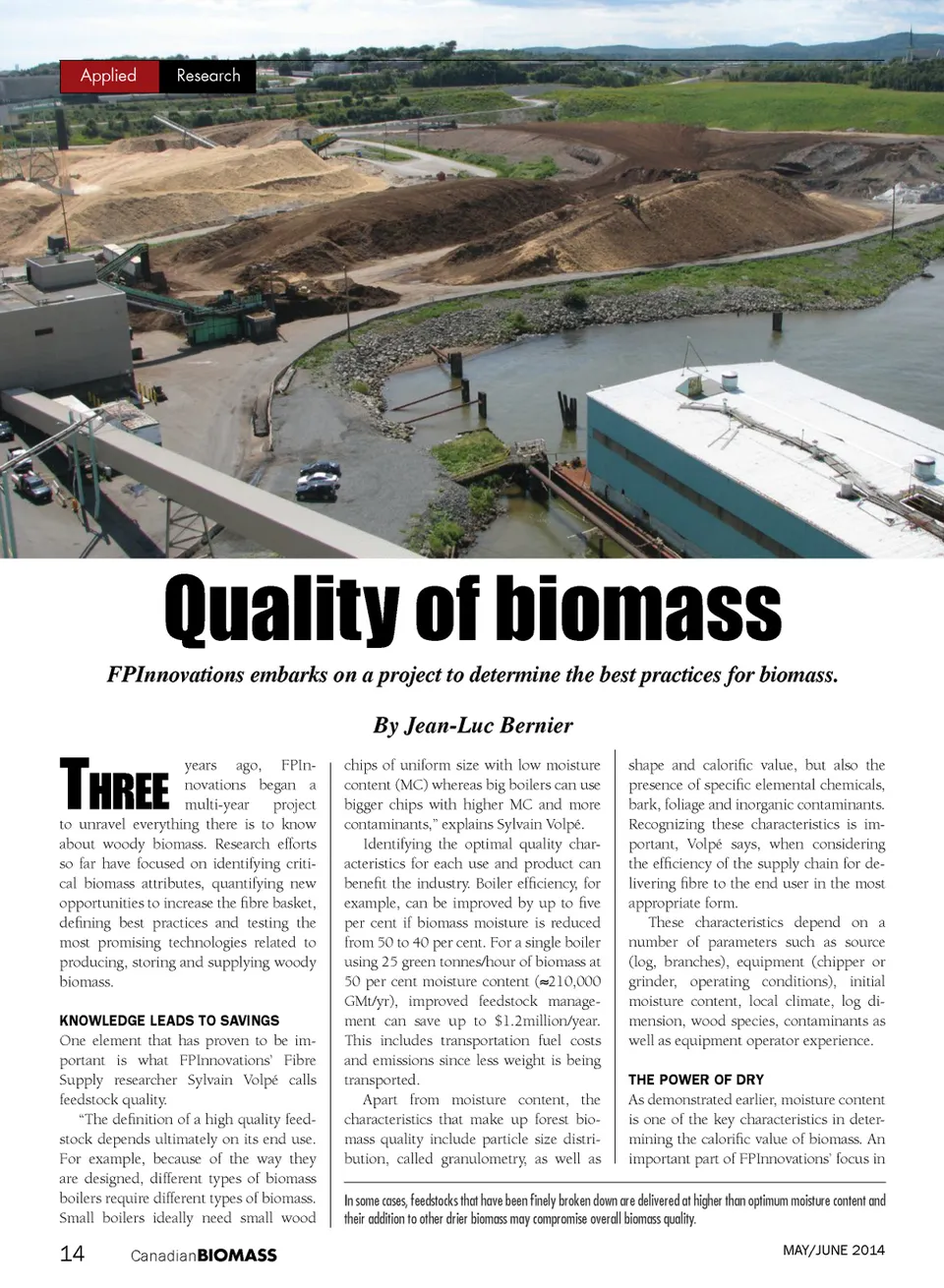
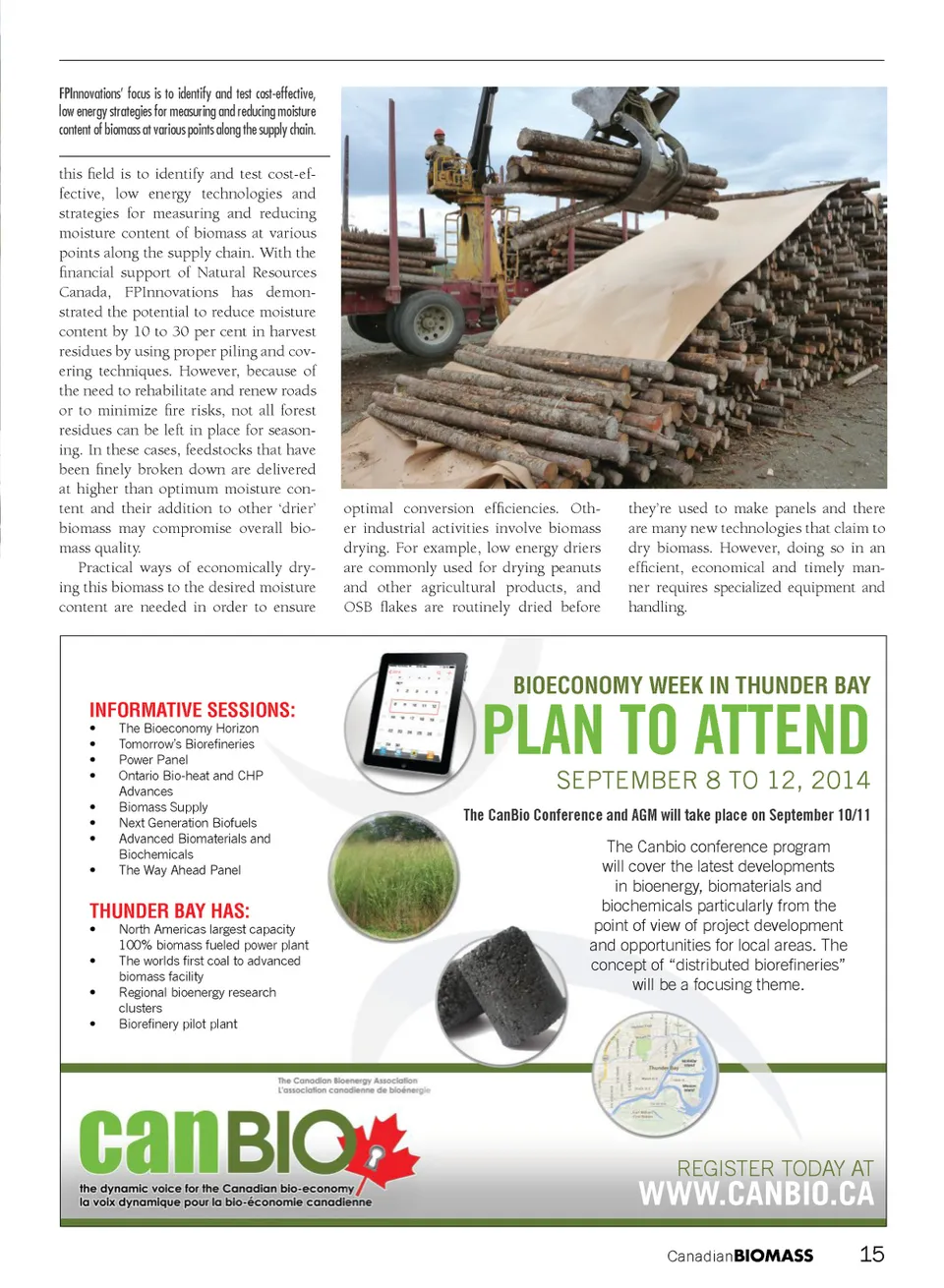
Applied Research FPInnovations embarks on a project to determine the best practices for biomass. Quality of biomass By Jean-Luc Bernier chips of uniform size with low moisture content (MC) whereas big boilers can use bigger chips with higher MC and more contaminants,” explains Sylvain Volpé. Identifying the optimal quality char-acteristics for each use and product can benefit the industry. Boiler efficiency, for example, can be improved by up to five per cent if biomass moisture is reduced from 50 to 40 per cent. For a single boiler using 25 green tonnes/hour of biomass at 50 per cent moisture content ( ≈ 210,000 GMt/yr), improved feedstock manage-ment can save up to $1.2million/year. This includes transportation fuel costs and emissions since less weight is being transported. Apart from moisture content, the characteristics that make up forest bio-mass quality include particle size distri-bution, called granulometry, as well as T hree years ago, FPIn-novations began a multi-year project to unravel everything there is to know about woody biomass. Research efforts so far have focused on identifying criti-cal biomass attributes, quantifying new opportunities to increase the fibre basket, defining best practices and testing the most promising technologies related to producing, storing and supplying woody biomass. Knowledge leads to savings One element that has proven to be im-portant is what FPInnovations’ Fibre Supply researcher Sylvain Volpé calls feedstock quality. “The definition of a high quality feed-stock depends ultimately on its end use. For example, because of the way they are designed, different types of biomass boilers require different types of biomass. Small boilers ideally need small wood shape and calorific value, but also the presence of specific elemental chemicals, bark, foliage and inorganic contaminants. Recognizing these characteristics is im-portant, Volpé says, when considering the efficiency of the supply chain for de-livering fibre to the end user in the most appropriate form. These characteristics depend on a number of parameters such as source (log, branches), equipment (chipper or grinder, operating conditions), initial moisture content, local climate, log di-mension, wood species, contaminants as well as equipment operator experience. the PoweR oF dRy As demonstrated earlier, moisture content is one of the key characteristics in deter-mining the calorific value of biomass. An important part of FPInnovations’ focus in In some cases, feedstocks that have been finely broken down are delivered at higher than optimum moisture content and their addition to other drier biomass may compromise overall biomass quality. MAY/JUNE 2014 14 Canadian BIOMASS
Canadian Biomass May June 2014: Page 14