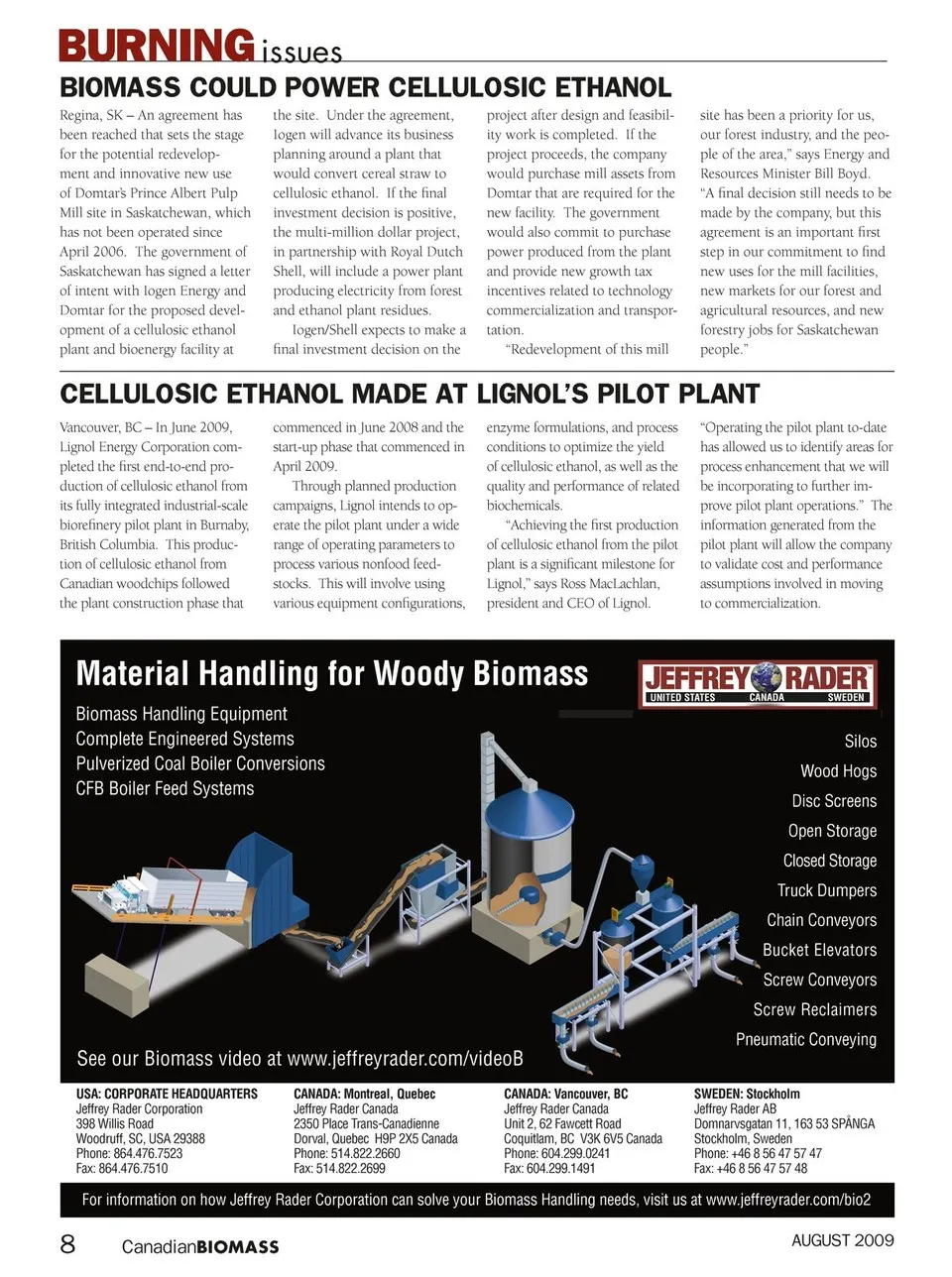
BURNINGissues Biomass coulD poweR cellulosic ethanol Regina, SK – An agreement has been reached that sets the stage for the potential redevelop- ment and innovative new use of Domtar’s Prince Albert Pulp Mill site in Saskatchewan, which has not been operated since April 2006. The government of Saskatchewan has signed a letter of intent with Iogen Energy and Domtar for the proposed devel- opment of a cellulosic ethanol plant and bioenergy facility at the site. Under the agreement, Iogen will advance its business planning around a plant that would convert cereal straw to cellulosic ethanol. If the final investment decision is positive, the multi-million dollar project, in partnership with Royal Dutch Shell, will include a power plant producing electricity from forest and ethanol plant residues. Iogen/Shell expects to make a final investment decision on the “Redevelopment of this mill project after design and feasibil- ity work is completed. If the project proceeds, the company would purchase mill assets from Domtar that are required for the new facility. The government would also commit to purchase power produced from the plant and provide new growth tax incentives related to technology commercialization and transpor- tation. site has been a priority for us, our forest industry, and the peo- ple of the area,” says Energy and Resources Minister Bill Boyd. “A final decision still needs to be made by the company, but this agreement is an important first step in our commitment to find new uses for the mill facilities, new markets for our forest and agricultural resources, and new forestry jobs for Saskatchewan people.” cellulosic ethanol maDe at lignol’s pilot plant Vancouver, BC – In June 2009, Lignol Energy Corporation com- pleted the first end-to-end pro- duction of cellulosic ethanol from its fully integrated industrial-scale biorefinery pilot plant in Burnaby, British Columbia. This produc- tion of cellulosic ethanol from Canadian woodchips followed the plant construction phase that commenced in June 2008 and the start-up phase that commenced in April 2009. Through planned production campaigns, Lignol intends to op- erate the pilot plant under a wide range of operating parameters to process various nonfood feed- stocks. This will involve using various equipment configurations, enzyme formulations, and process conditions to optimize the yield of cellulosic ethanol, as well as the quality and performance of related biochemicals. “Achieving the first production of cellulosic ethanol from the pilot plant is a significant milestone for Lignol,” says Ross MacLachlan, president and CEO of Lignol. Material Handling for Woody Biomass UNITED STATES CANADA UNITED STATES Biomass Handling Equipment Complete Engineered Systems Pulverized Coal Boiler Conversions CFB Boiler Feed Systems CANADA SWEDEN SWEDEN Silos Wood Hogs Disc Screens Open Storage Closed Storage Truck Dumpers Chain Conveyors Bucket Elevators Screw Conveyors Screw Reclaimers Pneumatic Conveying See our Biomass video at www.jeffreyrader.com/videoB USA: CORPORATE HEADQUARTERS Jeffrey Rader Corporation 398 Willis Road Woodruff, SC, USA 29388 Phone: 864.476.7523 Fax: 864.476.7510 CANADA: Montreal, Quebec Jeffrey Rader Canada 2350 Place Trans-Canadienne Dorval, Quebec H9P 2X5 Canada Phone: 514.822.2660 Fax: 514.822.2699 CANADA: Vancouver, BC Jeffrey Rader Canada Unit 2, 62 Fawcett Road Coquitlam, BC V3K 6V5 Canada Phone: 604.299.0241 Fax: 604.299.1491 SWEDEN: Stockholm Jeffrey Rader AB Domnarvsgatan 11, 163 53 SPÅNGA Stockholm, Sweden Phone: +46 8 56 47 57 47 Fax: +46 8 56 47 57 48 For information on how Jeffrey Rader Corporation can solve your Biomass Handling needs, visit us at www.jeffreyrader.com/bio2 8 CanadianBIOMASS AUGUST 2009 “Operating the pilot plant to-date has allowed us to identify areas for process enhancement that we will be incorporating to further im- prove pilot plant operations.” The information generated from the pilot plant will allow the company to validate cost and performance assumptions involved in moving to commercialization.
Canadian Biomass August 2009: Page 8