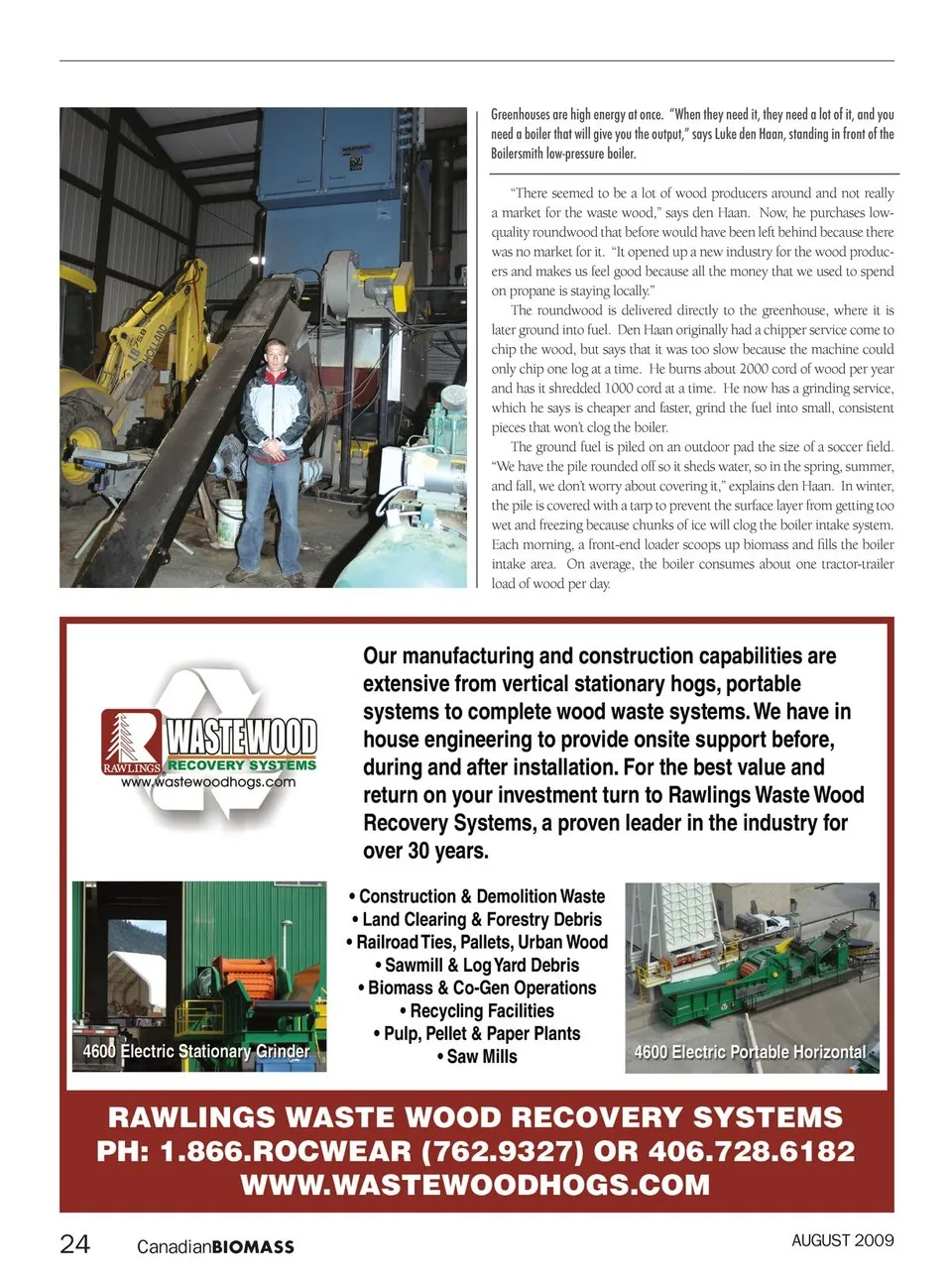
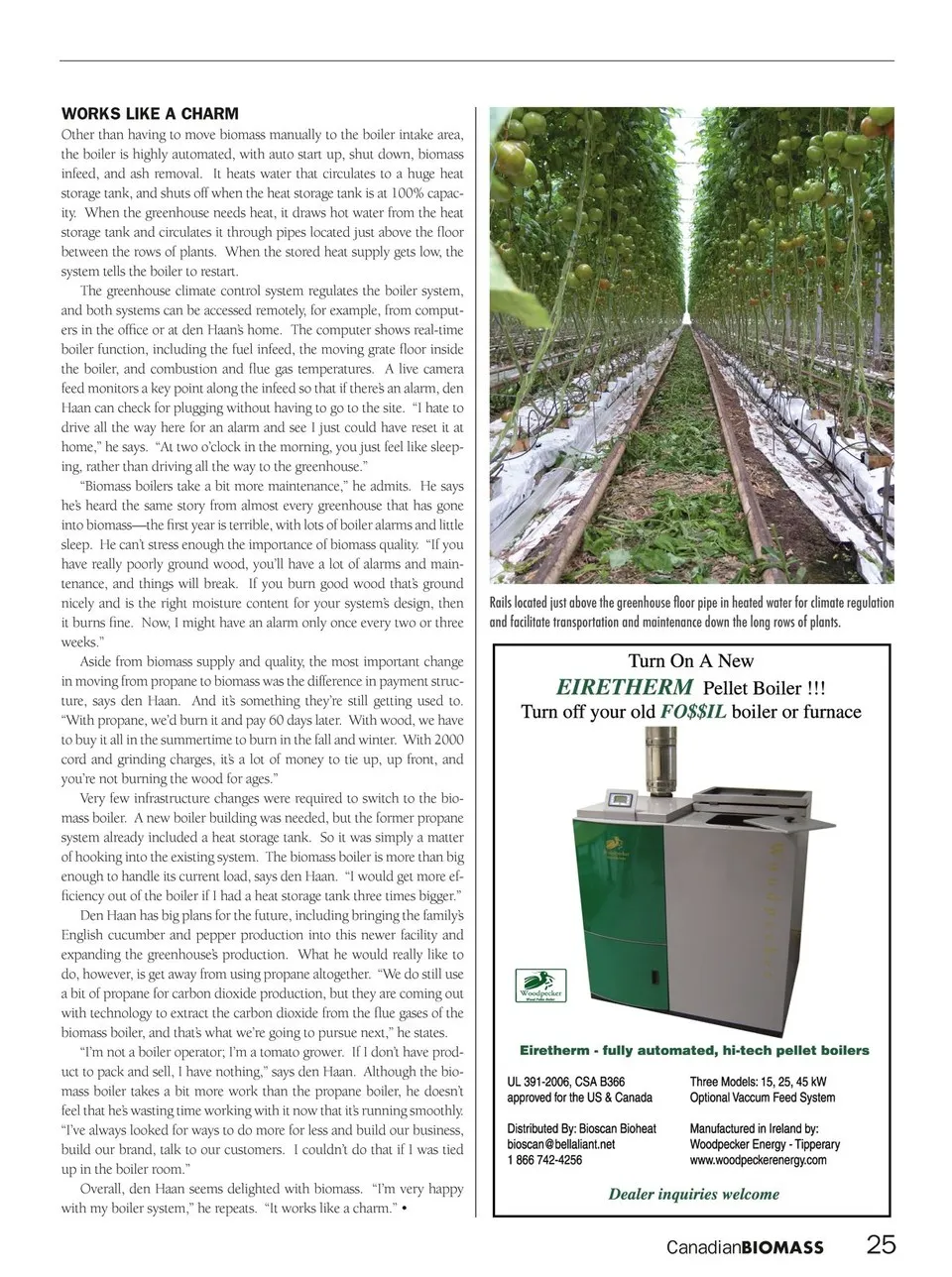
woRks like a chaRm Other than having to move biomass manually to the boiler intake area, the boiler is highly automated, with auto start up, shut down, biomass infeed, and ash removal. It heats water that circulates to a huge heat storage tank, and shuts off when the heat storage tank is at 100% capac- ity. When the greenhouse needs heat, it draws hot water from the heat storage tank and circulates it through pipes located just above the floor between the rows of plants. When the stored heat supply gets low, the system tells the boiler to restart. The greenhouse climate control system regulates the boiler system, and both systems can be accessed remotely, for example, from comput- ers in the office or at den Haan’s home. The computer shows real-time boiler function, including the fuel infeed, the moving grate floor inside the boiler, and combustion and flue gas temperatures. A live camera feed monitors a key point along the infeed so that if there’s an alarm, den Haan can check for plugging without having to go to the site. “I hate to drive all the way here for an alarm and see I just could have reset it at home,” he says. “At two o’clock in the morning, you just feel like sleep- ing, rather than driving all the way to the greenhouse.” “Biomass boilers take a bit more maintenance,” he admits. He says he’s heard the same story from almost every greenhouse that has gone into biomass—the first year is terrible, with lots of boiler alarms and little sleep. He can’t stress enough the importance of biomass quality. “If you have really poorly ground wood, you’ll have a lot of alarms and main- tenance, and things will break. If you burn good wood that’s ground nicely and is the right moisture content for your system’s design, then it burns fine. Now, I might have an alarm only once every two or three weeks.” Aside from biomass supply and quality, the most important change in moving from propane to biomass was the difference in payment struc- ture, says den Haan. And it’s something they’re still getting used to. “With propane, we’d burn it and pay 60 days later. With wood, we have to buy it all in the summertime to burn in the fall and winter. With 2000 cord and grinding charges, it’s a lot of money to tie up, up front, and you’re not burning the wood for ages.” Very few infrastructure changes were required to switch to the bio- mass boiler. A new boiler building was needed, but the former propane system already included a heat storage tank. So it was simply a matter of hooking into the existing system. The biomass boiler is more than big enough to handle its current load, says den Haan. “I would get more ef- ficiency out of the boiler if I had a heat storage tank three times bigger.” Den Haan has big plans for the future, including bringing the family’s English cucumber and pepper production into this newer facility and expanding the greenhouse’s production. What he would really like to do, however, is get away from using propane altogether. “We do still use a bit of propane for carbon dioxide production, but they are coming out with technology to extract the carbon dioxide from the flue gases of the biomass boiler, and that’s what we’re going to pursue next,” he states. “I’m not a boiler operator; I’m a tomato grower. If I don’t have prod- uct to pack and sell, I have nothing,” says den Haan. Although the bio- mass boiler takes a bit more work than the propane boiler, he doesn’t feel that he’s wasting time working with it now that it’s running smoothly. “I’ve always looked for ways to do more for less and build our business, build our brand, talk to our customers. I couldn’t do that if I was tied up in the boiler room.” Overall, den Haan seems delighted with biomass. “I’m very happy with my boiler system,” he repeats. “It works like a charm.” • CanadianBIOMASS 25 Rails located just above the greenhouse floor pipe in heated water for climate regulation and facilitate transportation and maintenance down the long rows of plants.
Canadian Biomass August 2009: Page 25