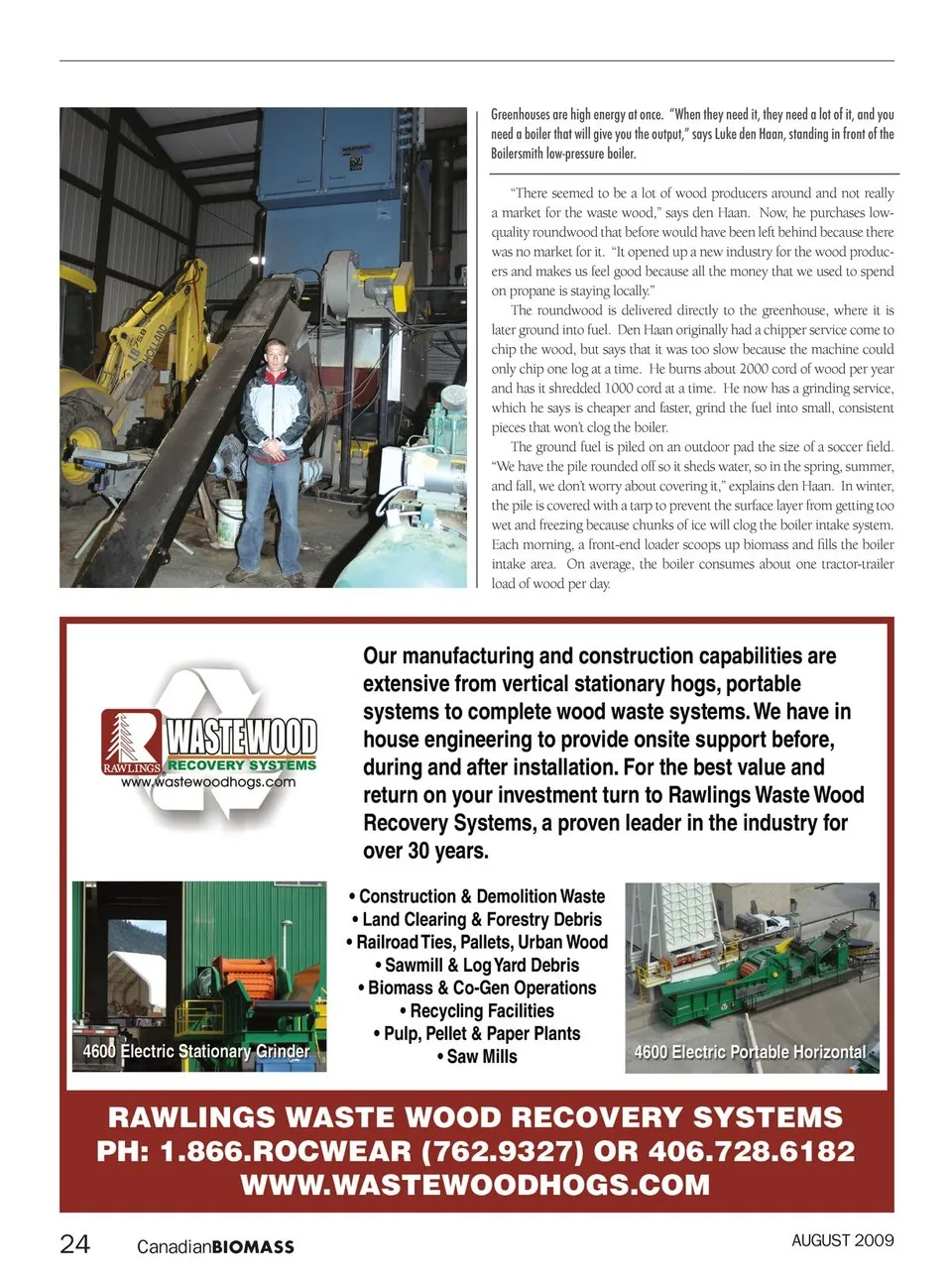
Greenhouses are high energy at once. “When they need it, they need a lot of it, and you need a boiler that will give you the output,” says Luke den Haan, standing in front of the Boilersmith low-pressure boiler. “There seemed to be a lot of wood producers around and not really a market for the waste wood,” says den Haan. Now, he purchases low- quality roundwood that before would have been left behind because there was no market for it. “It opened up a new industry for the wood produc- ers and makes us feel good because all the money that we used to spend on propane is staying locally.” The roundwood is delivered directly to the greenhouse, where it is later ground into fuel. Den Haan originally had a chipper service come to chip the wood, but says that it was too slow because the machine could only chip one log at a time. He burns about 2000 cord of wood per year and has it shredded 1000 cord at a time. He now has a grinding service, which he says is cheaper and faster, grind the fuel into small, consistent pieces that won’t clog the boiler. The ground fuel is piled on an outdoor pad the size of a soccer field. “We have the pile rounded off so it sheds water, so in the spring, summer, and fall, we don’t worry about covering it,” explains den Haan. In winter, the pile is covered with a tarp to prevent the surface layer from getting too wet and freezing because chunks of ice will clog the boiler intake system. Each morning, a front-end loader scoops up biomass and fills the boiler intake area. On average, the boiler consumes about one tractor-trailer load of wood per day. 24 CanadianBIOMASS AUGUST 2009
Canadian Biomass August 2009: Page 24