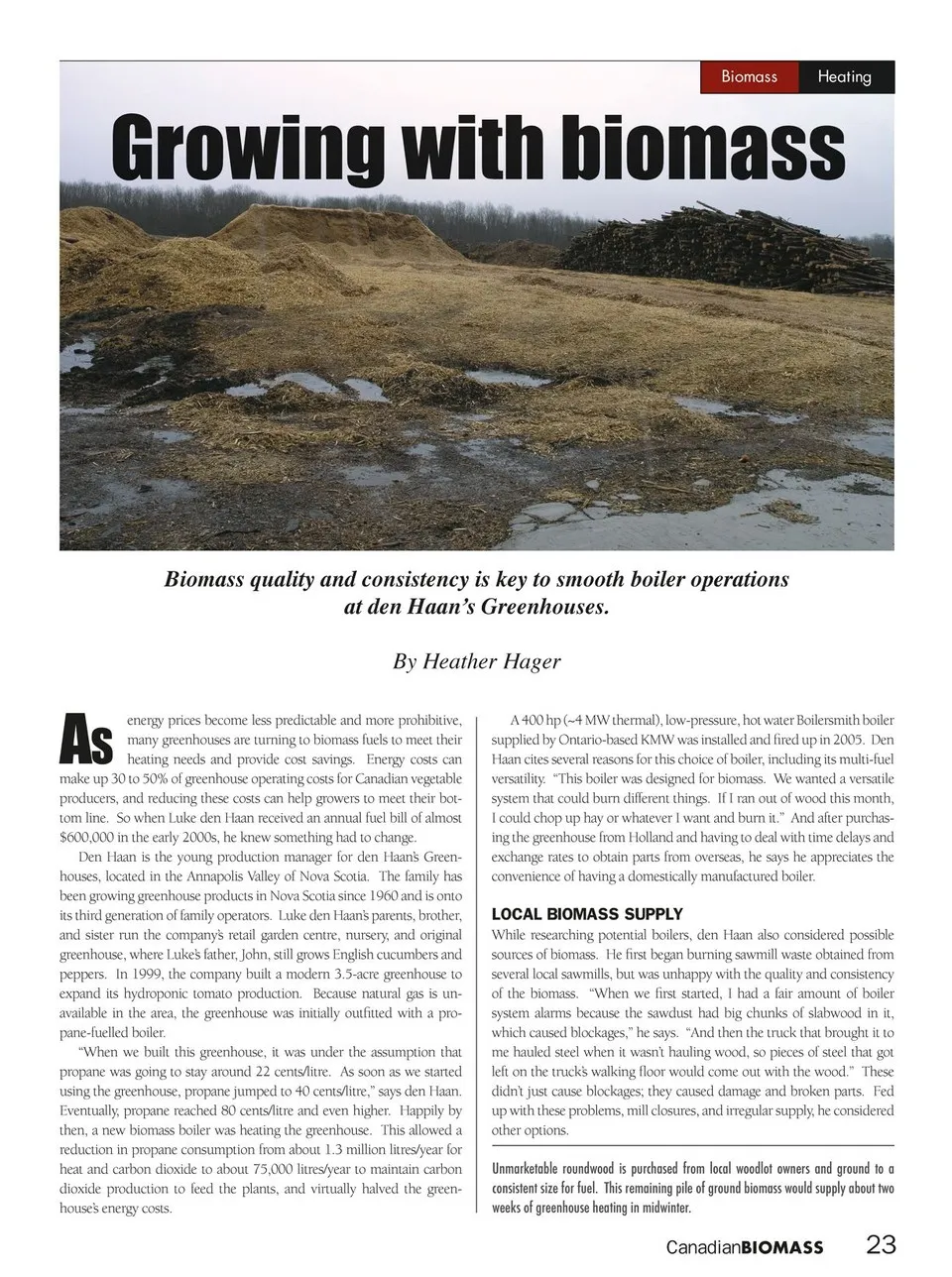
Biomass Heating Growing with biomass Biomass quality and consistency is key to smooth boiler operations at den Haan’s Greenhouses. By Heather Hager as energy prices become less predictable and more prohibitive, many greenhouses are turning to biomass fuels to meet their heating needs and provide cost savings. Energy costs can make up 30 to 50% of greenhouse operating costs for Canadian vegetable producers, and reducing these costs can help growers to meet their bot- tom line. So when Luke den Haan received an annual fuel bill of almost $600,000 in the early 2000s, he knew something had to change. Den Haan is the young production manager for den Haan’s Green- houses, located in the Annapolis Valley of Nova Scotia. The family has been growing greenhouse products in Nova Scotia since 1960 and is onto its third generation of family operators. Luke den Haan’s parents, brother, and sister run the company’s retail garden centre, nursery, and original greenhouse, where Luke’s father, John, still grows English cucumbers and peppers. In 1999, the company built a modern 3.5-acre greenhouse to expand its hydroponic tomato production. Because natural gas is un- available in the area, the greenhouse was initially outfitted with a pro- pane-fuelled boiler. “When we built this greenhouse, it was under the assumption that propane was going to stay around 22 cents/litre. As soon as we started using the greenhouse, propane jumped to 40 cents/litre,” says den Haan. Eventually, propane reached 80 cents/litre and even higher. Happily by then, a new biomass boiler was heating the greenhouse. This allowed a reduction in propane consumption from about 1.3 million litres/year for heat and carbon dioxide to about 75,000 litres/year to maintain carbon dioxide production to feed the plants, and virtually halved the green- house’s energy costs. A 400 hp (~4 MW thermal), low-pressure, hot water Boilersmith boiler supplied by Ontario-based KMW was installed and fired up in 2005. Den Haan cites several reasons for this choice of boiler, including its multi-fuel versatility. “This boiler was designed for biomass. We wanted a versatile system that could burn different things. If I ran out of wood this month, I could chop up hay or whatever I want and burn it.” And after purchas- ing the greenhouse from Holland and having to deal with time delays and exchange rates to obtain parts from overseas, he says he appreciates the convenience of having a domestically manufactured boiler. local Biomass supply While researching potential boilers, den Haan also considered possible sources of biomass. He first began burning sawmill waste obtained from several local sawmills, but was unhappy with the quality and consistency of the biomass. “When we first started, I had a fair amount of boiler system alarms because the sawdust had big chunks of slabwood in it, which caused blockages,” he says. “And then the truck that brought it to me hauled steel when it wasn’t hauling wood, so pieces of steel that got left on the truck’s walking floor would come out with the wood.” These didn’t just cause blockages; they caused damage and broken parts. Fed up with these problems, mill closures, and irregular supply, he considered other options. Unmarketable roundwood is purchased from local woodlot owners and ground to a consistent size for fuel. This remaining pile of ground biomass would supply about two weeks of greenhouse heating in midwinter. CanadianBIOMASS 23
Canadian Biomass August 2009: Page 23