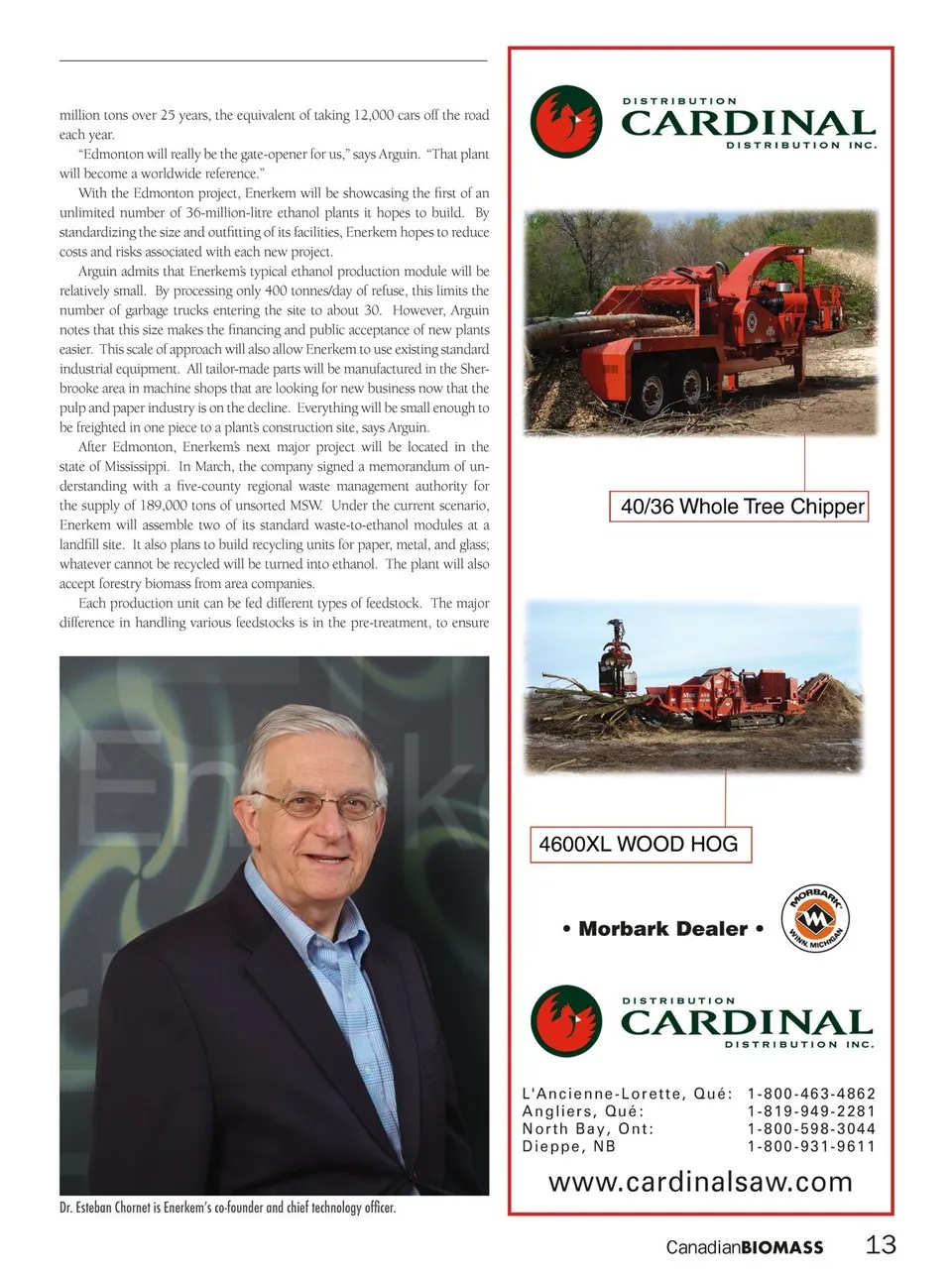
million tons over 25 years, the equivalent of taking 12,000 cars off the road each year. “Edmonton will really be the gate-opener for us,” says Arguin. “That plant will become a worldwide reference.” With the Edmonton project, Enerkem will be showcasing the first of an unlimited number of 36-million-litre ethanol plants it hopes to build. By standardizing the size and outfitting of its facilities, Enerkem hopes to reduce costs and risks associated with each new project. Arguin admits that Enerkem’s typical ethanol production module will be relatively small. By processing only 400 tonnes/day of refuse, this limits the number of garbage trucks entering the site to about 30. However, Arguin notes that this size makes the financing and public acceptance of new plants easier. This scale of approach will also allow Enerkem to use existing standard industrial equipment. All tailor-made parts will be manufactured in the Sher- brooke area in machine shops that are looking for new business now that the pulp and paper industry is on the decline. Everything will be small enough to be freighted in one piece to a plant’s construction site, says Arguin. After Edmonton, Enerkem’s next major project will be located in the state of Mississippi. In March, the company signed a memorandum of un- derstanding with a five-county regional waste management authority for the supply of 189,000 tons of unsorted MSW. Under the current scenario, Enerkem will assemble two of its standard waste-to-ethanol modules at a landfill site. It also plans to build recycling units for paper, metal, and glass; whatever cannot be recycled will be turned into ethanol. The plant will also accept forestry biomass from area companies. Each production unit can be fed different types of feedstock. The major difference in handling various feedstocks is in the pre-treatment, to ensure Dr. Esteban Chornet is Enerkem’s co-founder and chief technology officer. CanadianBIOMASS 13
Canadian Biomass August 2009: Page 13