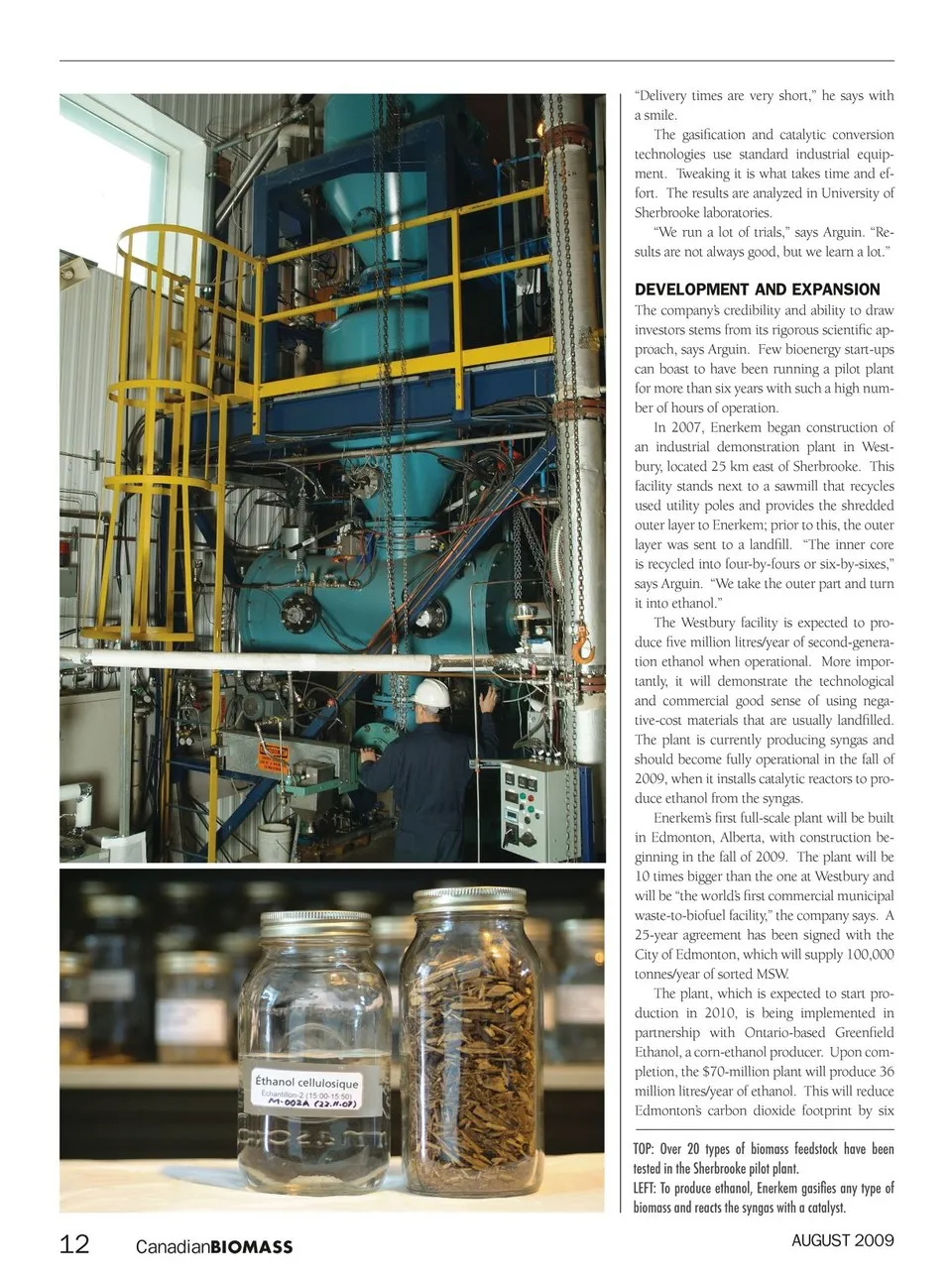
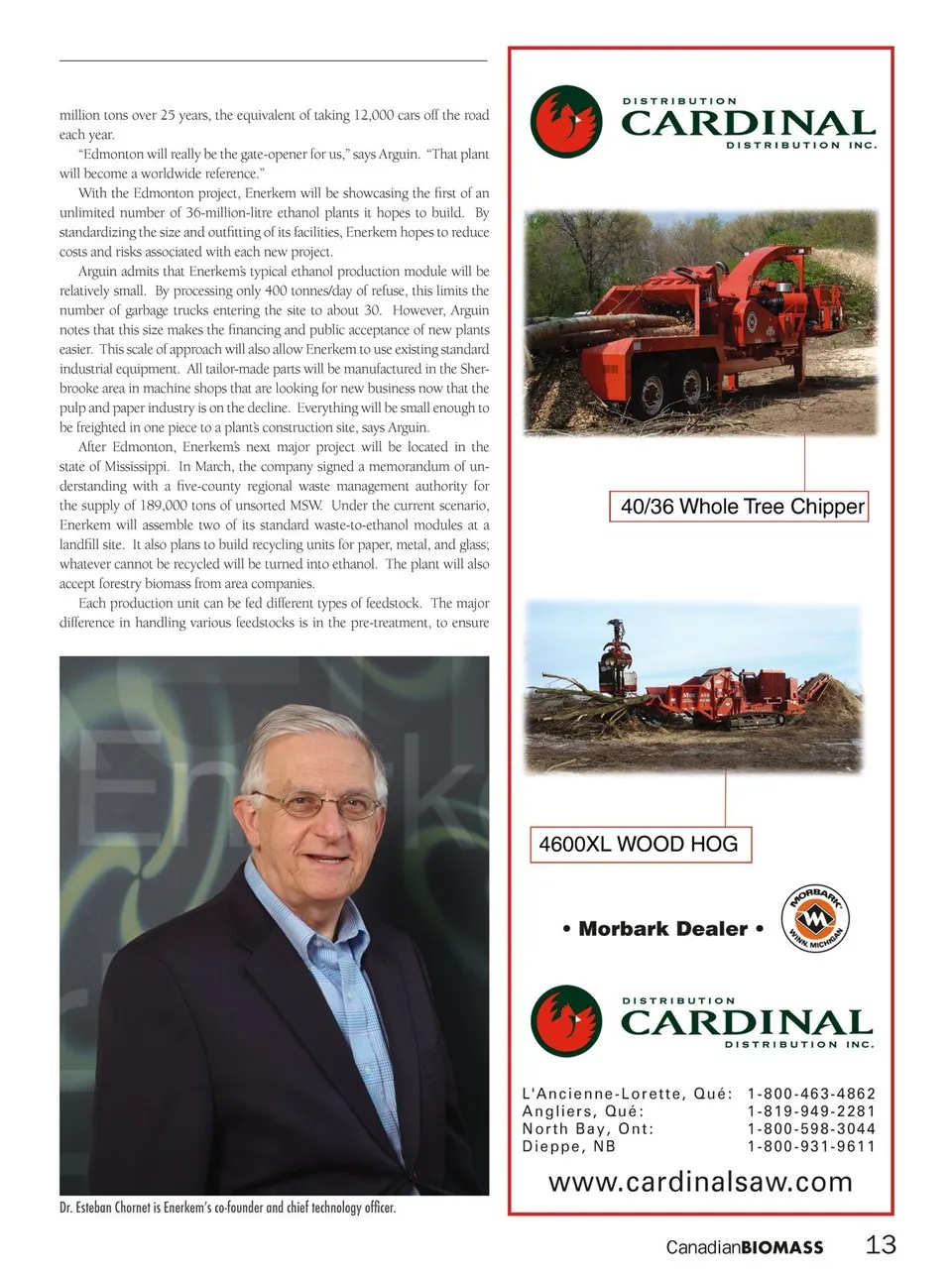
“Delivery times are very short,” he says with a smile. The gasification and catalytic conversion technologies use standard industrial equip- ment. Tweaking it is what takes time and ef- fort. The results are analyzed in University of Sherbrooke laboratories. “We run a lot of trials,” says Arguin. “Re- sults are not always good, but we learn a lot.” Development anD expansion The company’s credibility and ability to draw investors stems from its rigorous scientific ap- proach, says Arguin. Few bioenergy start-ups can boast to have been running a pilot plant for more than six years with such a high num- ber of hours of operation. In 2007, Enerkem began construction of an industrial demonstration plant in West- bury, located 25 km east of Sherbrooke. This facility stands next to a sawmill that recycles used utility poles and provides the shredded outer layer to Enerkem; prior to this, the outer layer was sent to a landfill. “The inner core is recycled into four-by-fours or six-by-sixes,” says Arguin. “We take the outer part and turn it into ethanol.” The Westbury facility is expected to pro- duce five million litres/year of second-genera- tion ethanol when operational. More impor- tantly, it will demonstrate the technological and commercial good sense of using nega- tive-cost materials that are usually landfilled. The plant is currently producing syngas and should become fully operational in the fall of 2009, when it installs catalytic reactors to pro- duce ethanol from the syngas. Enerkem’s first full-scale plant will be built in Edmonton, Alberta, with construction be- ginning in the fall of 2009. The plant will be 10 times bigger than the one at Westbury and will be “the world’s first commercial municipal waste-to-biofuel facility,” the company says. A 25-year agreement has been signed with the City of Edmonton, which will supply 100,000 tonnes/year of sorted MSW. The plant, which is expected to start pro- duction in 2010, is being implemented in partnership with Ontario-based Greenfield Ethanol, a corn-ethanol producer. Upon com- pletion, the $70-million plant will produce 36 million litres/year of ethanol. This will reduce Edmonton’s carbon dioxide footprint by six TOP: Over 20 types of biomass feedstock have been tested in the Sherbrooke pilot plant. LEFT: To produce ethanol, Enerkem gasifies any type of biomass and reacts the syngas with a catalyst. 12 CanadianBIOMASS AUGUST 2009
Canadian Biomass August 2009: Page 12