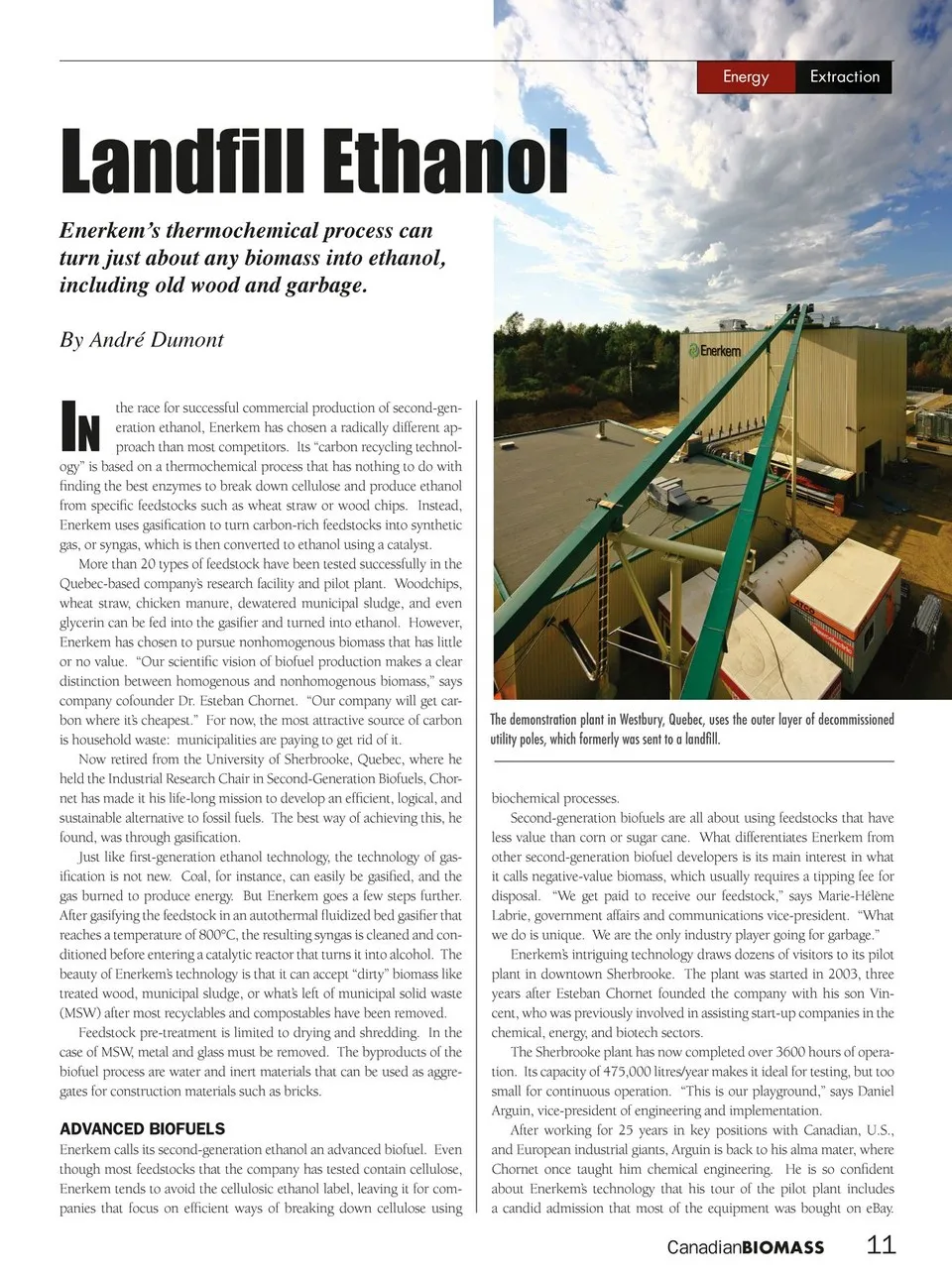
Energy Landfill Ethanol Enerkem’s thermochemical process can turn just about any biomass into ethanol, including old wood and garbage. By André Dumont In the race for successful commercial production of second-gen- eration ethanol, Enerkem has chosen a radically different ap- proach than most competitors. Its “carbon recycling technol- ogy” is based on a thermochemical process that has nothing to do with finding the best enzymes to break down cellulose and produce ethanol from specific feedstocks such as wheat straw or wood chips. Instead, Enerkem uses gasification to turn carbon-rich feedstocks into synthetic gas, or syngas, which is then converted to ethanol using a catalyst. More than 20 types of feedstock have been tested successfully in the Quebec-based company’s research facility and pilot plant. Woodchips, wheat straw, chicken manure, dewatered municipal sludge, and even glycerin can be fed into the gasifier and turned into ethanol. However, Enerkem has chosen to pursue nonhomogenous biomass that has little or no value. “Our scientific vision of biofuel production makes a clear distinction between homogenous and nonhomogenous biomass,” says company cofounder Dr. Esteban Chornet. “Our company will get car- bon where it’s cheapest.” For now, the most attractive source of carbon is household waste: municipalities are paying to get rid of it. Now retired from the University of Sherbrooke, Quebec, where he held the Industrial Research Chair in Second-Generation Biofuels, Chor- net has made it his life-long mission to develop an efficient, logical, and sustainable alternative to fossil fuels. The best way of achieving this, he found, was through gasification. Just like first-generation ethanol technology, the technology of gas- ification is not new. Coal, for instance, can easily be gasified, and the gas burned to produce energy. But Enerkem goes a few steps further. After gasifying the feedstock in an autothermal fluidized bed gasifier that reaches a temperature of 800°C, the resulting syngas is cleaned and con- ditioned before entering a catalytic reactor that turns it into alcohol. The beauty of Enerkem’s technology is that it can accept “dirty” biomass like treated wood, municipal sludge, or what’s left of municipal solid waste (MSW) after most recyclables and compostables have been removed. Feedstock pre-treatment is limited to drying and shredding. In the case of MSW, metal and glass must be removed. The byproducts of the biofuel process are water and inert materials that can be used as aggre- gates for construction materials such as bricks. aDvanceD Biofuels Enerkem calls its second-generation ethanol an advanced biofuel. Even though most feedstocks that the company has tested contain cellulose, Enerkem tends to avoid the cellulosic ethanol label, leaving it for com- panies that focus on efficient ways of breaking down cellulose using Extraction The demonstration plant in Westbury, Quebec, uses the outer layer of decommissioned utility poles, which formerly was sent to a landfill. biochemical processes. Second-generation biofuels are all about using feedstocks that have less value than corn or sugar cane. What differentiates Enerkem from other second-generation biofuel developers is its main interest in what it calls negative-value biomass, which usually requires a tipping fee for disposal. “We get paid to receive our feedstock,” says Marie-Hélène Labrie, government affairs and communications vice-president. “What we do is unique. We are the only industry player going for garbage.” Enerkem’s intriguing technology draws dozens of visitors to its pilot plant in downtown Sherbrooke. The plant was started in 2003, three years after Esteban Chornet founded the company with his son Vin- cent, who was previously involved in assisting start-up companies in the chemical, energy, and biotech sectors. The Sherbrooke plant has now completed over 3600 hours of opera- tion. Its capacity of 475,000 litres/year makes it ideal for testing, but too small for continuous operation. “This is our playground,” says Daniel Arguin, vice-president of engineering and implementation. After working for 25 years in key positions with Canadian, U.S., and European industrial giants, Arguin is back to his alma mater, where Chornet once taught him chemical engineering. He is so confident about Enerkem’s technology that his tour of the pilot plant includes a candid admission that most of the equipment was bought on eBay. CanadianBIOMASS 11
Canadian Biomass August 2009: Page 11