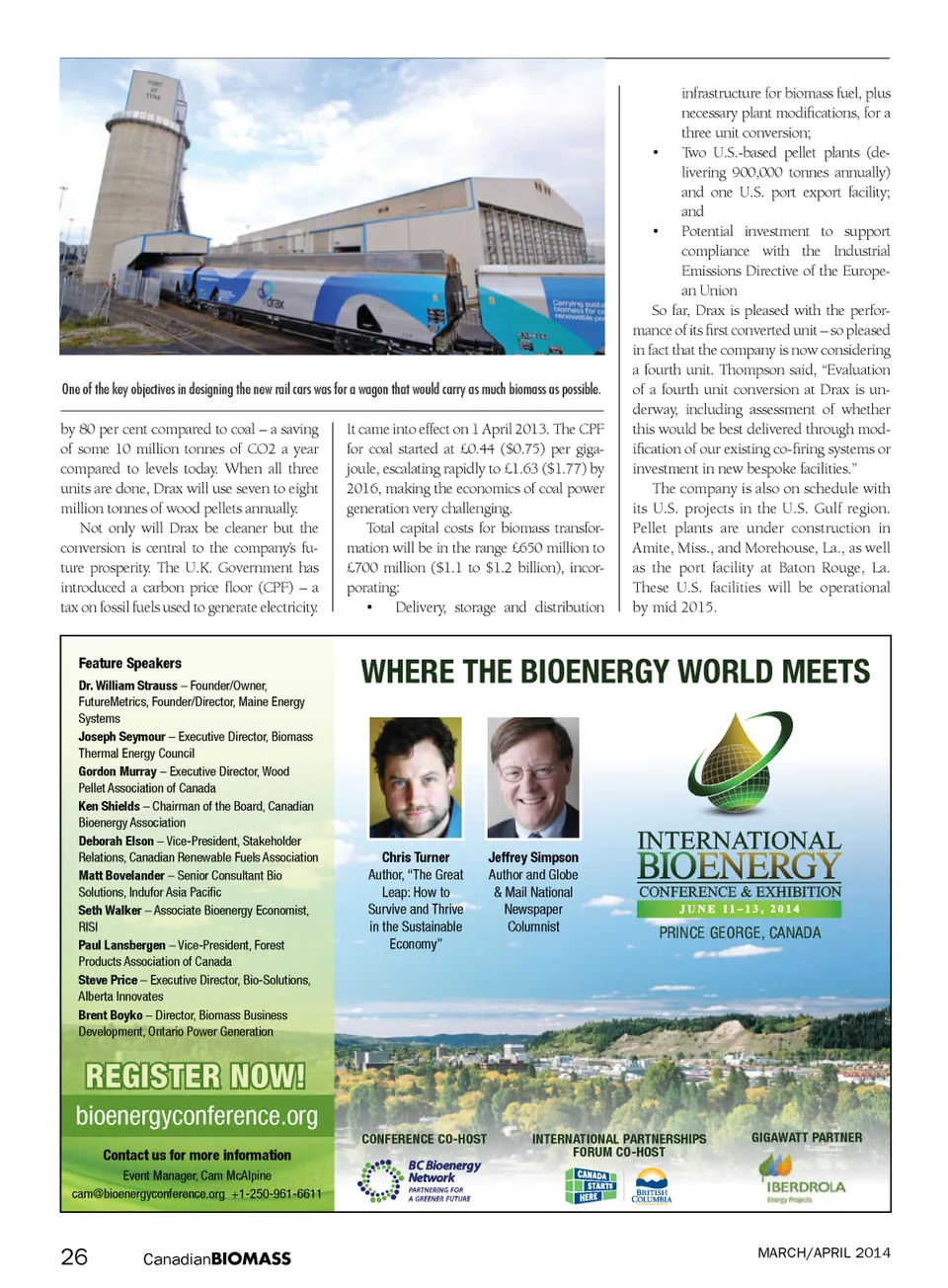
BIOMASS TRANSPORTATION AND LOGISTICS Obviously handling seven to eight million tonnes per year of wood pel-lets is enormously challenging. Brian Greensmith, divisional head of optimi-zation and logistics, said, “It’s a complex project in terms of engineering and con-struction, mostly in terms of scale.” Most wood pellets will be imported from North America. Multiple U.K. port termi-nals are required to be able to receive the large quantities of wood pellets and for re-dundancy in case of mishaps at any single port. Currently, pellets are being received at the Port of Tyne, which can handle two million tonnes of wood pellets annually. Unloading, storage and handling capabili-ties are also being developed at the Ports of Hull (1 million tonnes annually) and Im-mingham (three million tonnes annually). Immingham will be capable of receiving Panamax-size vessels. Several other port options are actively being investigated to ensure enough capacity to receive eight mil-lion tonnes of wood pellets annually. Biomass is a third lighter than coal but susceptible to rain, a problem solved initial-ly by retrofitting roof components to old, open coal rail wagons (called rail cars in North America). The difference in density meant that a complete redesign to produce a totally new type of wagon was necessary. Thus, Drax decided to find help to design its own specialized wagons. Graham Backhouse, head of supply chain and logistics, said, “We decided to commission Lloyd’s to look at designing a new rail wagon. One of the key objectives we gave them was to design a wagon that would carry as much biomass as possible. This was to be the industry leading wagon and even NASA would not be able to come up with a better one.” To produce a vehicle capable of carrying the maximum amount of fuel, Lloyd’s had to squeeze control equipment, pipework, etc. into otherwise redundant areas of a traditional hopper wagon while designing a viable steel/aluminium roof that could be operated pneumatically and automatically. The discharge of the fuel is also controlled by a patented product flow control system. Work on two prototypes began in Janu-ary 2013 and presented the design engineers with a number of challenges in achieving the increased wagon capacity within the limits of the Network Rail loading gauge. At 18.9 metres long with top doors stretching 18.2 metres and bottom doors of 3.7 metres, the supersize wagon has a capacity of 116 cubic metres. This allows a biomass load weigh-ing 71.6 tonnes. Its volume is almost 30 per cent bigger than any freight wagon currently used in the U.K. WH Davis, the last inde-pendent British freight wagon manufactur-er, met this design specification by working to a measurement tolerance of 5 mm, the highest possible and half that normally asso-ciated with wagon manufacturing. Drax has ordered 200 wagons, for which it owns the designs. Peter Emery, Drax’s pro-duction director, said, “Our transformation to become one of Europe’s largest renewable generators through the use of sustainable biomass means we need new, bigger and better rail wagons. We need to keep the bio-mass dry, move more of it and speed up the process of delivery.” Drax has engineered an innovative and complex system of fuel delivery, handling, Our experience makes all the difference We have an experienced team at every stage of a project. We provide design, manufacturing, installation for all your dust collection and air conveying needs. air Filtration pellets plants ProduCts › air pulse › silo › industrial duct › abort gate › screw and belt conveyor ✓ Our prOducts are designed and manufactured tO the highest standards in regards tO market specificatiOns. dust collector › Cyclone › Multicyclone › Fan › rotary air lock › air density separator 1890, 1 st Street, Industrial Center St-Romuald, Quebec G6W 5M6 Tel.: 418 839-0400 Fax: 418 839-0201 www.rodriguemetal.com Canadian BIOMASS 27
Canadian Biomass March/April 2014: Page 27