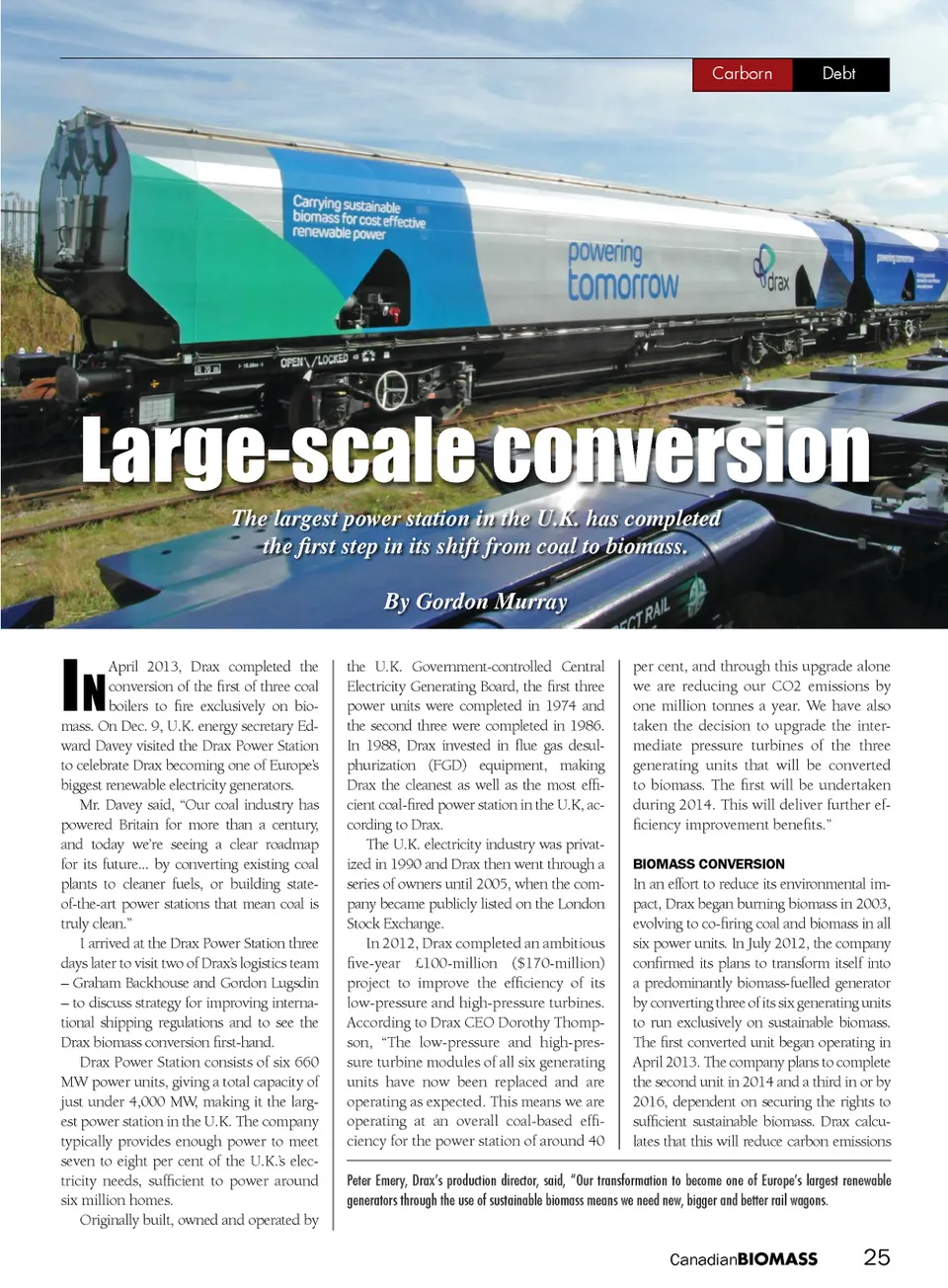
Carborn Debt Large-scale conversion The largest power station in the U.K. has completed the first step in its shift from coal to biomass. By Gordon Murray April 2013, Drax completed the conversion of the first of three coal boilers to fire exclusively on bio-mass. On Dec. 9, U.K. energy secretary Ed-ward Davey visited the Drax Power Station to celebrate Drax becoming one of Europe’s biggest renewable electricity generators. Mr. Davey said, “Our coal industry has powered Britain for more than a century, and today we’re seeing a clear roadmap for its future... by converting existing coal plants to cleaner fuels, or building state-of-the-art power stations that mean coal is truly clean.” I arrived at the Drax Power Station three days later to visit two of Drax’s logistics team – Graham Backhouse and Gordon Lugsdin – to discuss strategy for improving interna-tional shipping regulations and to see the Drax biomass conversion first-hand. Drax Power Station consists of six 660 MW power units, giving a total capacity of just under 4,000 MW, making it the larg-est power station in the U.K. The company typically provides enough power to meet seven to eight per cent of the U.K.’s elec-tricity needs, sufficient to power around six million homes. Originally built, owned and operated by I n the U.K. Government-controlled Central Electricity Generating Board, the first three power units were completed in 1974 and the second three were completed in 1986. In 1988, Drax invested in flue gas desul-phurization (FGD) equipment, making Drax the cleanest as well as the most effi-cient coal-fired power station in the U.K, ac-cording to Drax. The U.K. electricity industry was privat-ized in 1990 and Drax then went through a series of owners until 2005, when the com-pany became publicly listed on the London Stock Exchange. In 2012, Drax completed an ambitious five-year £100-million ($170-million) project to improve the efficiency of its low-pressure and high-pressure turbines. According to Drax CEO Dorothy Thomp-son, “The low-pressure and high-pres-sure turbine modules of all six generating units have now been replaced and are operating as expected. This means we are operating at an overall coal-based effi-ciency for the power station of around 40 per cent, and through this upgrade alone we are reducing our CO2 emissions by one million tonnes a year. We have also taken the decision to upgrade the inter-mediate pressure turbines of the three generating units that will be converted to biomass. The first will be undertaken during 2014. This will deliver further ef-ficiency improvement benefits.” BIOMASS CONVERSION In an effort to reduce its environmental im-pact, Drax began burning biomass in 2003, evolving to co-firing coal and biomass in all six power units. In July 2012, the company confirmed its plans to transform itself into a predominantly biomass-fuelled generator by converting three of its six generating units to run exclusively on sustainable biomass. The first converted unit began operating in April 2013. The company plans to complete the second unit in 2014 and a third in or by 2016, dependent on securing the rights to sufficient sustainable biomass. Drax calcu-lates that this will reduce carbon emissions Peter Emery, Drax’s production director, said, “Our transformation to become one of Europe’s largest renewable generators through the use of sustainable biomass means we need new, bigger and better rail wagons. Canadian BIOMASS 25
Canadian Biomass March/April 2014: Page 25