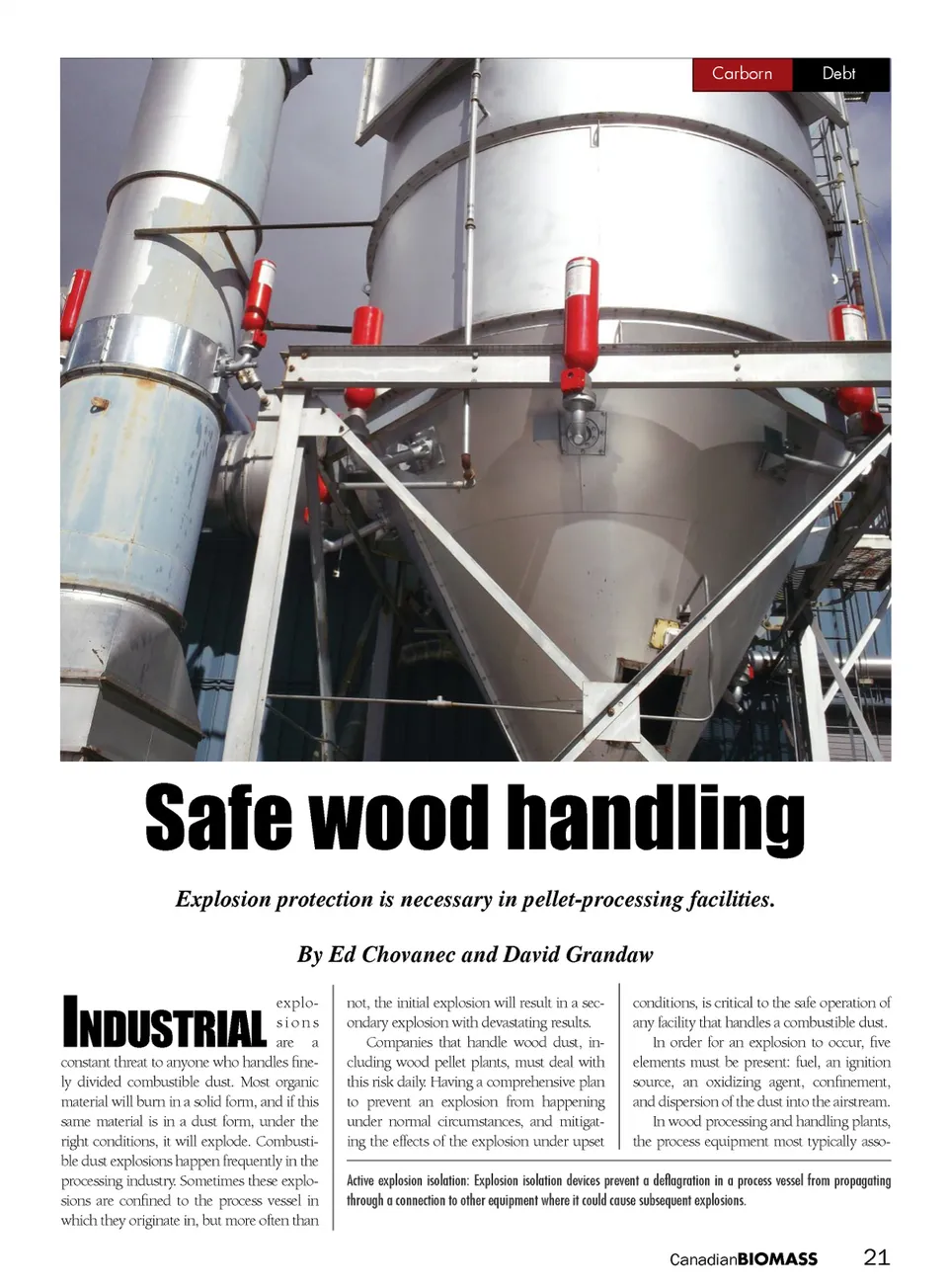
Carborn Debt Safe wood handling Explosion protection is necessary in pellet-processing facilities. By Ed Chovanec and David Grandaw I ndustrIal explo-sions are a constant threat to anyone who handles fine-ly divided combustible dust. Most organic material will burn in a solid form, and if this same material is in a dust form, under the right conditions, it will explode. Combusti-ble dust explosions happen frequently in the processing industry. Sometimes these explo-sions are confined to the process vessel in which they originate in, but more often than not, the initial explosion will result in a sec-ondary explosion with devastating results. Companies that handle wood dust, in-cluding wood pellet plants, must deal with this risk daily. Having a comprehensive plan to prevent an explosion from happening under normal circumstances, and mitigat-ing the effects of the explosion under upset conditions, is critical to the safe operation of any facility that handles a combustible dust. In order for an explosion to occur, five elements must be present: fuel, an ignition source, an oxidizing agent, confinement, and dispersion of the dust into the airstream. In wood processing and handling plants, the process equipment most typically asso-Active explosion isolation: Explosion isolation devices prevent a deflagration in a process vessel from propagating through a connection to other equipment where it could cause subsequent explosions. Canadian BIOMASS 21
Canadian Biomass March/April 2014: Page 21