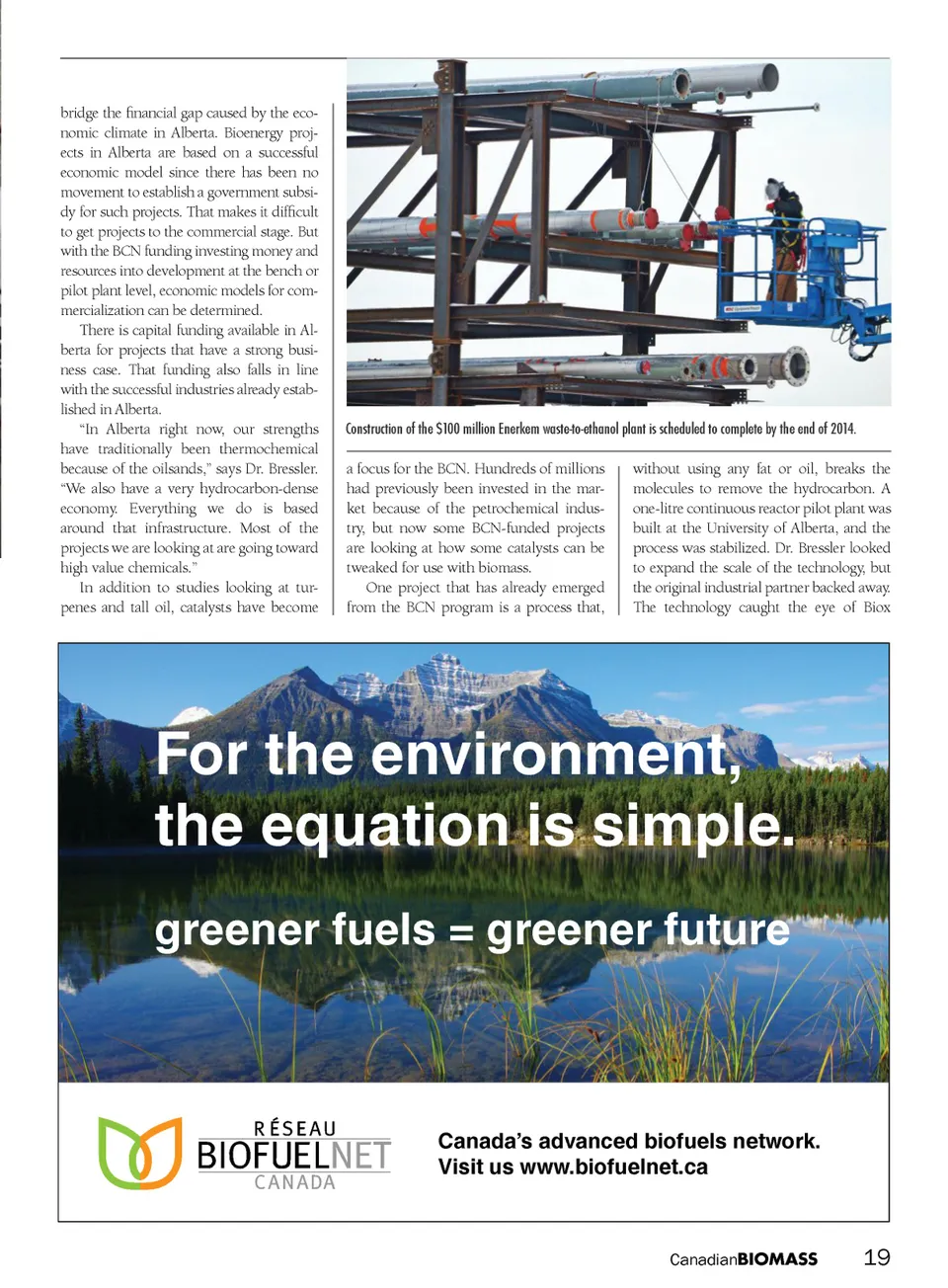
bridge the financial gap caused by the eco-nomic climate in Alberta. Bioenergy proj-ects in Alberta are based on a successful economic model since there has been no movement to establish a government subsi-dy for such projects. That makes it difficult to get projects to the commercial stage. But with the BCN funding investing money and resources into development at the bench or pilot plant level, economic models for com-mercialization can be determined. There is capital funding available in Al-berta for projects that have a strong busi-ness case. That funding also falls in line with the successful industries already estab-lished in Alberta. “In Alberta right now, our strengths have traditionally been thermochemical because of the oilsands,” says Dr. Bressler. “We also have a very hydrocarbon-dense economy. Everything we do is based around that infrastructure. Most of the projects we are looking at are going toward high value chemicals.” In addition to studies looking at tur-BFN_Canadian Biomass ad FINAL.pdf 1 14/03/2014 penes and tall oil, catalysts have become Construction of the $100 million Enerkem waste-to-ethanol plant is scheduled to complete by the end of 2014. a focus for the BCN. Hundreds of millions had previously been invested in the mar-ket because of the petrochemical indus-try, but now some BCN-funded projects are looking at how some catalysts can be tweaked for use with biomass. One project that has already emerged 1:45:00 from PM the BCN program is a process that, without using any fat or oil, breaks the molecules to remove the hydrocarbon. A one-litre continuous reactor pilot plant was built at the University of Alberta, and the process was stabilized. Dr. Bressler looked to expand the scale of the technology, but the original industrial partner backed away. The technology caught the eye of Biox C M For the environment, the equation is simple. greener fuels = greener future Y CM MY CY CMY K Canada’s advanced biofuels network. Visit us www.biofuelnet.ca Canadian BIOMASS 19
Canadian Biomass March/April 2014: Page 19