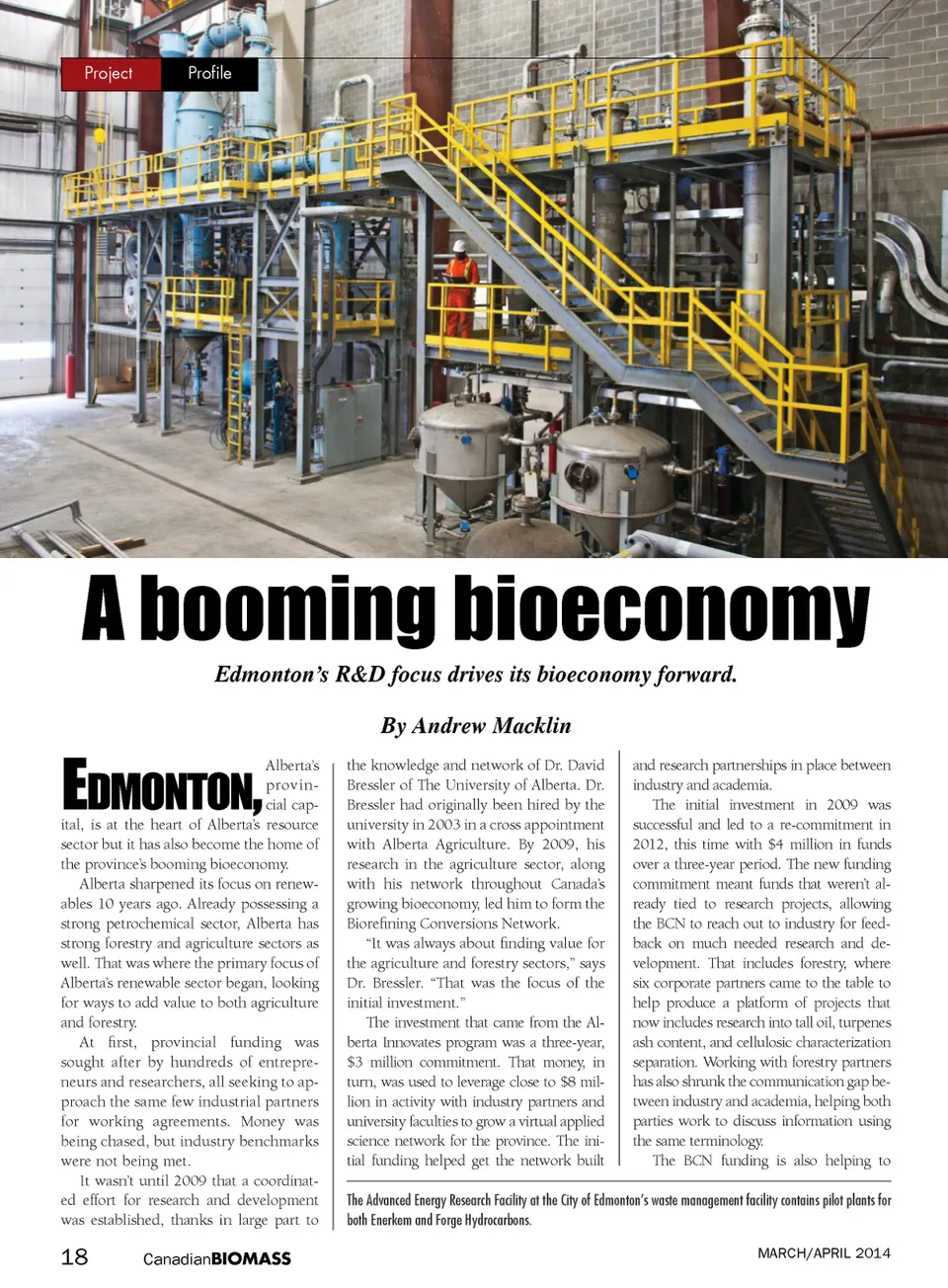
Project Profile A booming bioeconomy Edmonton’s R&D focus drives its bioeconomy forward. By Andrew Macklin the knowledge and network of Dr. David Bressler of The University of Alberta. Dr. Bressler had originally been hired by the university in 2003 in a cross appointment with Alberta Agriculture. By 2009, his research in the agriculture sector, along with his network throughout Canada’s growing bioeconomy, led him to form the Biorefining Conversions Network. “It was always about finding value for the agriculture and forestry sectors,” says Dr. Bressler. “That was the focus of the initial investment.” The investment that came from the Al-berta Innovates program was a three-year, $3 million commitment. That money, in turn, was used to leverage close to $8 mil-lion in activity with industry partners and university faculties to grow a virtual applied science network for the province. The ini-tial funding helped get the network built and research partnerships in place between industry and academia. The initial investment in 2009 was successful and led to a re-commitment in 2012, this time with $4 million in funds over a three-year period. The new funding commitment meant funds that weren’t al-ready tied to research projects, allowing the BCN to reach out to industry for feed-back on much needed research and de-velopment. That includes forestry, where six corporate partners came to the table to help produce a platform of projects that now includes research into tall oil, turpenes ash content, and cellulosic characterization separation. Working with forestry partners has also shrunk the communication gap be-tween industry and academia, helping both parties work to discuss information using the same terminology. The BCN funding is also helping to Alberta’s provin-cial cap-ital, is at the heart of Alberta’s resource sector but it has also become the home of the province’s booming bioeconomy. Alberta sharpened its focus on renew-ables 10 years ago. Already possessing a strong petrochemical sector, Alberta has strong forestry and agriculture sectors as well. That was where the primary focus of Alberta’s renewable sector began, looking for ways to add value to both agriculture and forestry. At first, provincial funding was sought after by hundreds of entrepre-neurs and researchers, all seeking to ap-proach the same few industrial partners for working agreements. Money was being chased, but industry benchmarks were not being met. It wasn’t until 2009 that a coordinat-ed effort for research and development was established, thanks in large part to E dmonton , The Advanced Energy Research Facility at the City of Edmonton’s waste management facility contains pilot plants for both Enerkem and Forge Hydrocarbons. MARCH/APRIL 2014 18 Canadian BIOMASS
Canadian Biomass March/April 2014: Page 18