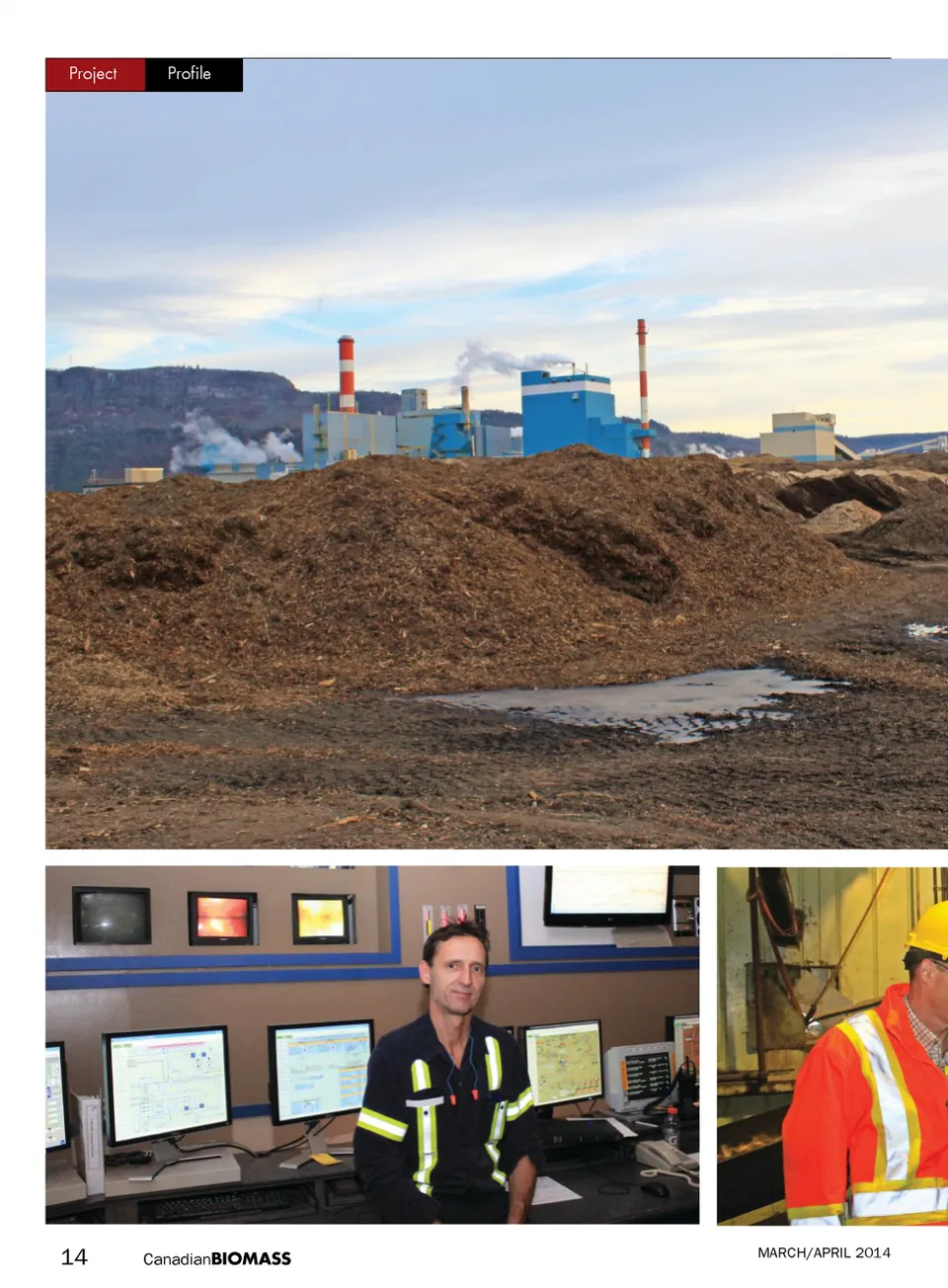
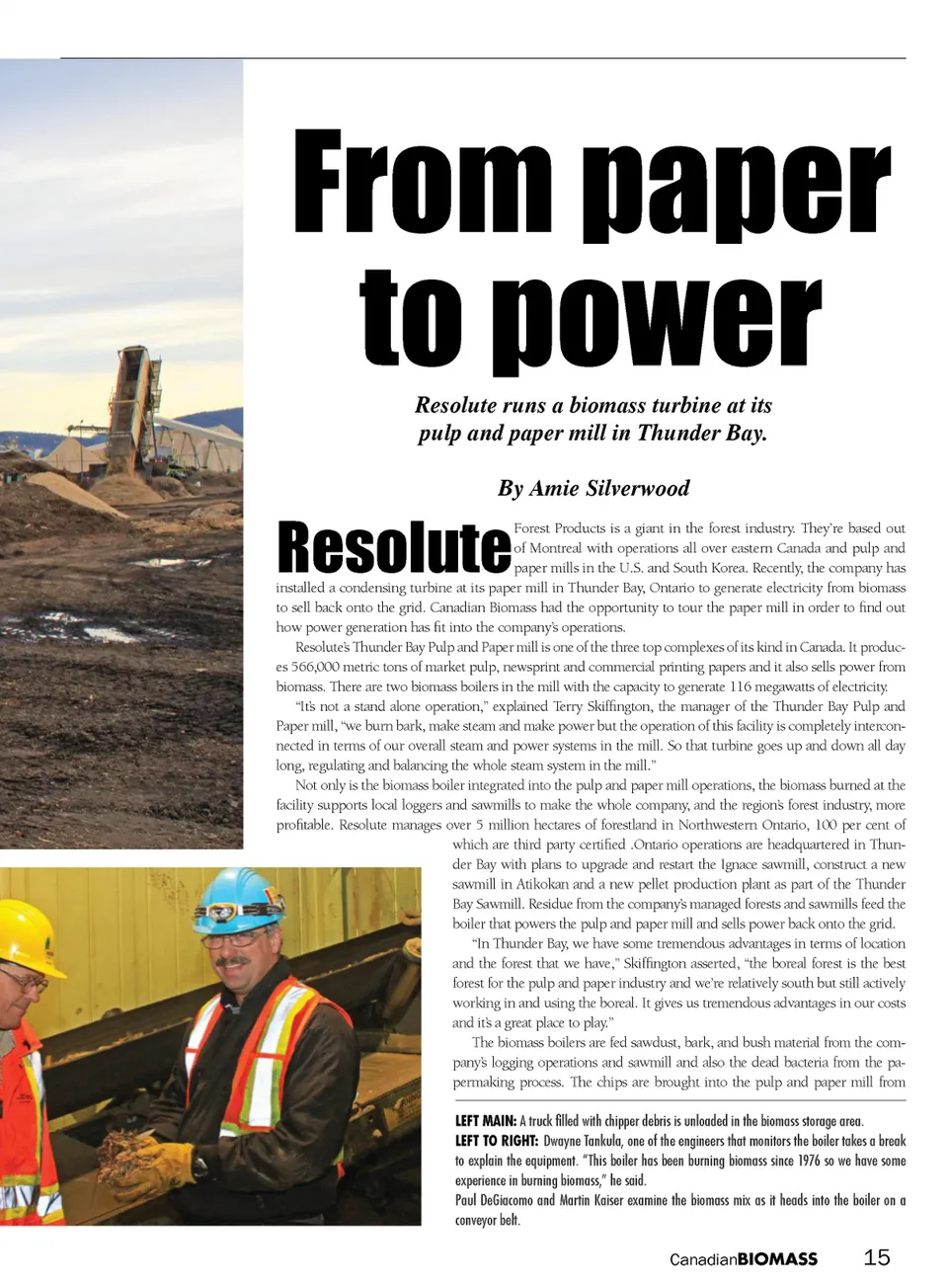
From paper to power Resolute runs a biomass turbine at its pulp and paper mill in Thunder Bay. By Amie Silverwood Forest Products is a giant in the forest industry. They’re based out of Montreal with operations all over eastern Canada and pulp and paper mills in the U.S. and South Korea. Recently, the company has installed a condensing turbine at its paper mill in Thunder Bay, Ontario to generate electricity from biomass to sell back onto the grid. Canadian Biomass had the opportunity to tour the paper mill in order to find out how power generation has fit into the company’s operations. Resolute’s Thunder Bay Pulp and Paper mill is one of the three top complexes of its kind in Canada. It produc-es 566,000 metric tons of market pulp, newsprint and commercial printing papers and it also sells power from biomass. There are two biomass boilers in the mill with the capacity to generate 116 megawatts of electricity. “It’s not a stand alone operation,” explained Terry Skiffington, the manager of the Thunder Bay Pulp and Paper mill, “we burn bark, make steam and make power but the operation of this facility is completely intercon-nected in terms of our overall steam and power systems in the mill. So that turbine goes up and down all day long, regulating and balancing the whole steam system in the mill.” Not only is the biomass boiler integrated into the pulp and paper mill operations, the biomass burned at the facility supports local loggers and sawmills to make the whole company, and the region’s forest industry, more profitable. Resolute manages over 5 million hectares of forestland in Northwestern Ontario, 100 per cent of which are third party certified .Ontario operations are headquartered in Thun-der Bay with plans to upgrade and restart the Ignace sawmill, construct a new sawmill in Atikokan and a new pellet production plant as part of the Thunder Bay Sawmill. Residue from the company’s managed forests and sawmills feed the boiler that powers the pulp and paper mill and sells power back onto the grid. “In Thunder Bay, we have some tremendous advantages in terms of location and the forest that we have,” Skiffington asserted, “the boreal forest is the best forest for the pulp and paper industry and we’re relatively south but still actively working in and using the boreal. It gives us tremendous advantages in our costs and it’s a great place to play.” The biomass boilers are fed sawdust, bark, and bush material from the com-pany’s logging operations and sawmill and also the dead bacteria from the pa-permaking process. The chips are brought into the pulp and paper mill from LEFT MAIN: A truck filled with chipper debris is unloaded in the biomass storage area. LEFT TO RIGHT: Dwayne Tankula, one of the engineers that monitors the boiler takes a break to explain the equipment. “This boiler has been burning biomass since 1976 so we have some experience in burning biomass,” he said. Paul DeGiacomo and Martin Kaiser examine the biomass mix as it heads into the boiler on a conveyor belt. Resolute Canadian BIOMASS 15
Canadian Biomass March/April 2014: Page 15