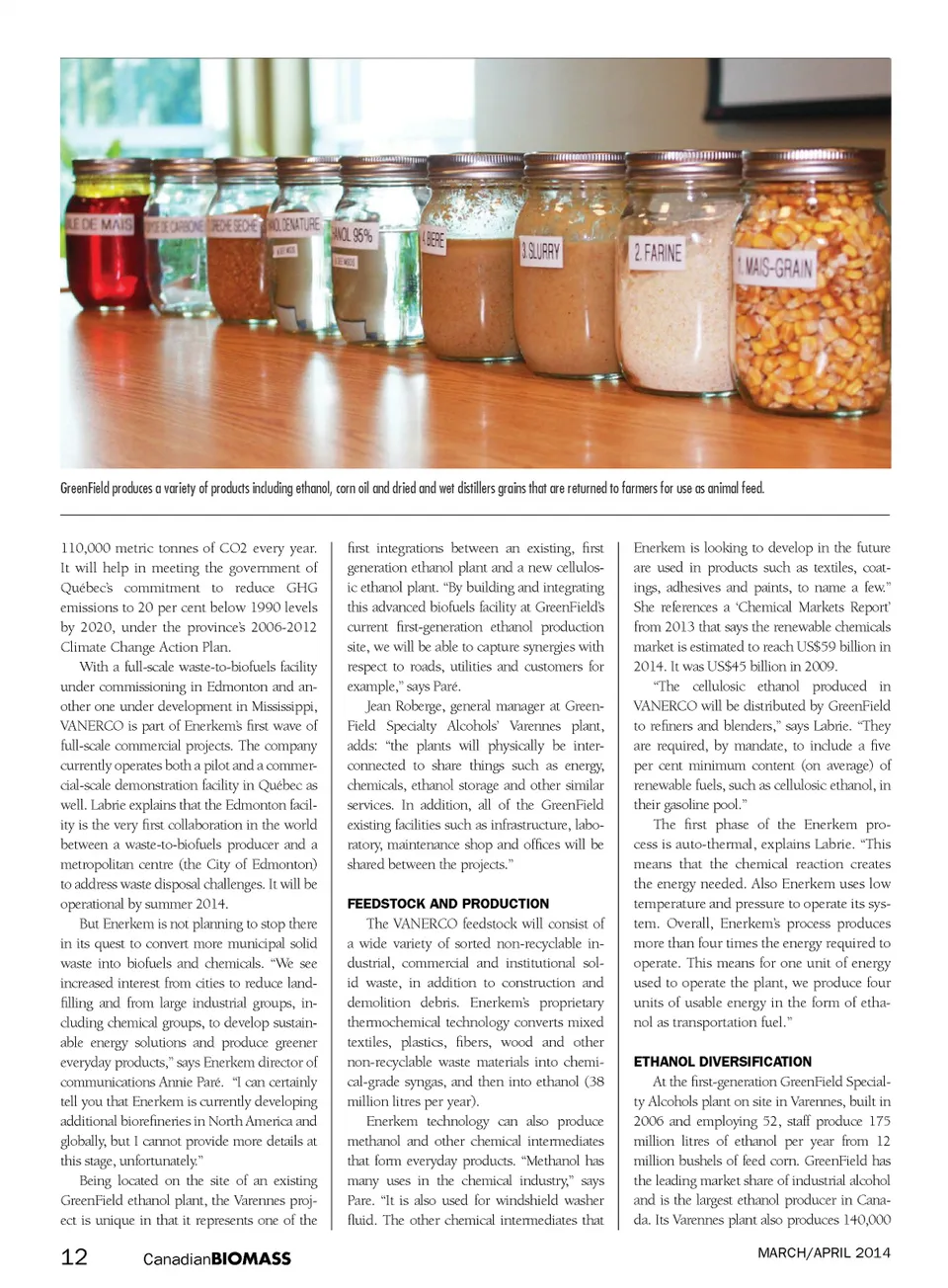
GreenField produces a variety of products including ethanol, corn oil and dried and wet distillers grains that are returned to farmers for use as animal feed. 110,000 metric tonnes of CO2 every year. It will help in meeting the government of Québec’s commitment to reduce GHG emissions to 20 per cent below 1990 levels by 2020, under the province’s 2006-2012 Climate Change Action Plan. With a full-scale waste-to-biofuels facility under commissioning in Edmonton and an-other one under development in Mississippi, VANERCO is part of Enerkem’s first wave of full-scale commercial projects. The company currently operates both a pilot and a commer-cial-scale demonstration facility in Québec as well. Labrie explains that the Edmonton facil-ity is the very first collaboration in the world between a waste-to-biofuels producer and a metropolitan centre (the City of Edmonton) to address waste disposal challenges. It will be operational by summer 2014. But Enerkem is not planning to stop there in its quest to convert more municipal solid waste into biofuels and chemicals. “We see increased interest from cities to reduce land-filling and from large industrial groups, in-cluding chemical groups, to develop sustain-able energy solutions and produce greener everyday products,” says Enerkem director of communications Annie Paré. “I can certainly tell you that Enerkem is currently developing additional biorefineries in North America and globally, but I cannot provide more details at this stage, unfortunately.” Being located on the site of an existing GreenField ethanol plant, the Varennes proj-ect is unique in that it represents one of the first integrations between an existing, first generation ethanol plant and a new cellulos-ic ethanol plant. “By building and integrating this advanced biofuels facility at GreenField’s current first-generation ethanol production site, we will be able to capture synergies with respect to roads, utilities and customers for example,” says Paré. Jean Roberge, general manager at Green-Field Specialty Alcohols’ Varennes plant, adds: “the plants will physically be inter-connected to share things such as energy, chemicals, ethanol storage and other similar services. In addition, all of the GreenField existing facilities such as infrastructure, labo-ratory, maintenance shop and offices will be shared between the projects.” FEEDSTOCK AND PRODUCTION The VANERCO feedstock will consist of a wide variety of sorted non-recyclable in-dustrial, commercial and institutional sol-id waste, in addition to construction and demolition debris. Enerkem’s proprietary thermochemical technology converts mixed textiles, plastics, fibers, wood and other non-recyclable waste materials into chemi-cal-grade syngas, and then into ethanol (38 million litres per year). Enerkem technology can also produce methanol and other chemical intermediates that form everyday products. “Methanol has many uses in the chemical industry,” says Pare. “It is also used for windshield washer fluid. The other chemical intermediates that Enerkem is looking to develop in the future are used in products such as textiles, coat-ings, adhesives and paints, to name a few.” She references a ‘Chemical Markets Report’ from 2013 that says the renewable chemicals market is estimated to reach US$59 billion in 2014. It was US$45 billion in 2009. “The cellulosic ethanol produced in VANERCO will be distributed by GreenField to refiners and blenders,” says Labrie. “They are required, by mandate, to include a five per cent minimum content (on average) of renewable fuels, such as cellulosic ethanol, in their gasoline pool.” The first phase of the Enerkem pro-cess is auto-thermal, explains Labrie. “This means that the chemical reaction creates the energy needed. Also Enerkem uses low temperature and pressure to operate its sys-tem. Overall, Enerkem’s process produces more than four times the energy required to operate. This means for one unit of energy used to operate the plant, we produce four units of usable energy in the form of etha-nol as transportation fuel.” ETHANOL DIVERSIFICATION At the first-generation GreenField Special-ty Alcohols plant on site in Varennes, built in 2006 and employing 52, staff produce 175 million litres of ethanol per year from 12 million bushels of feed corn. GreenField has the leading market share of industrial alcohol and is the largest ethanol producer in Cana-da. Its Varennes plant also produces 140,000 MARCH/APRIL 2014 12 Canadian BIOMASS
Canadian Biomass March/April 2014: Page 12