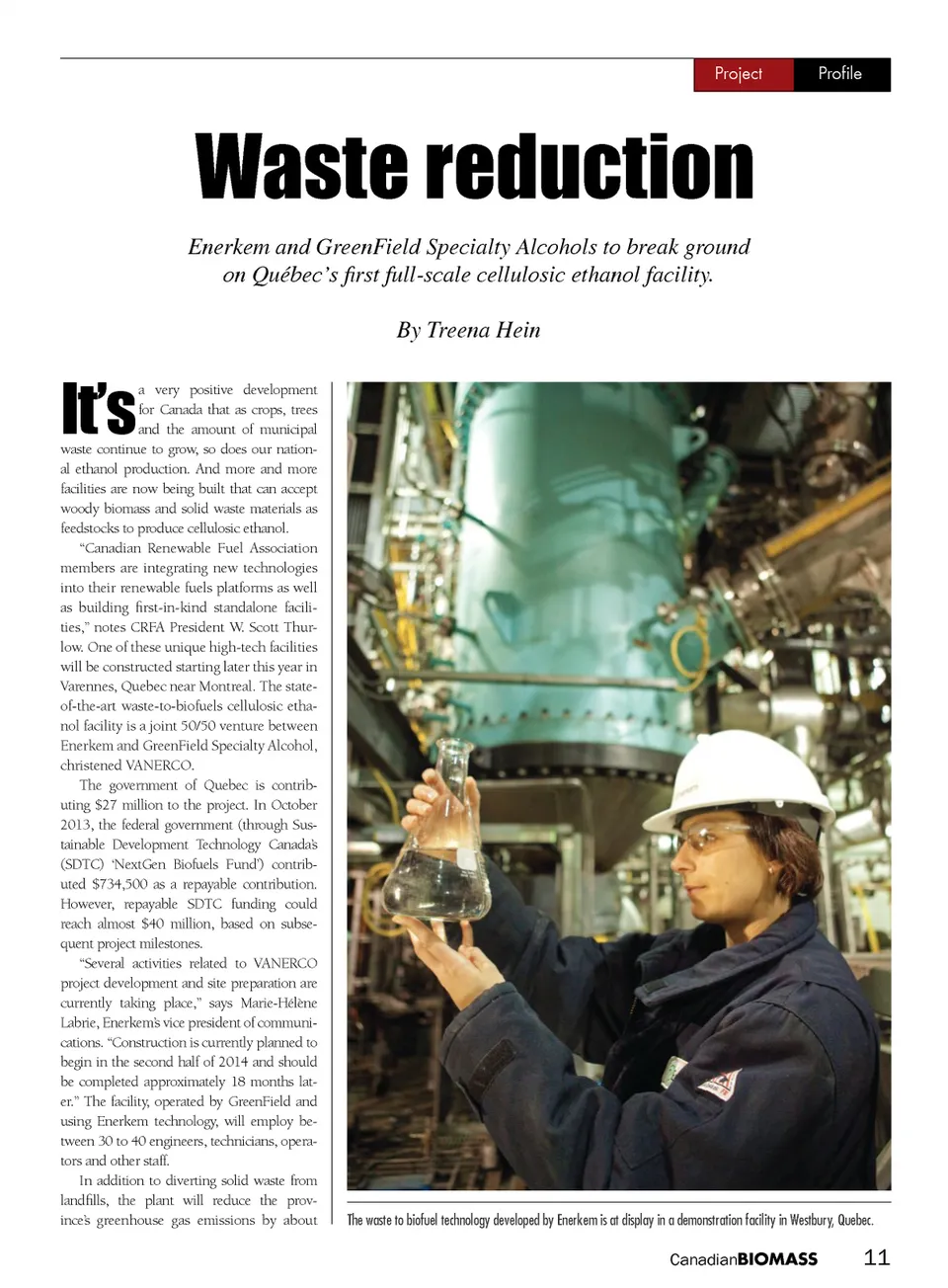
Project Profile Waste reduction Enerkem and GreenField Specialty Alcohols to break ground on Québec’s first full-scale cellulosic ethanol facility. By Treena Hein It’s a very positive development for Canada that as crops, trees and the amount of municipal waste continue to grow, so does our nation-al ethanol production. And more and more facilities are now being built that can accept woody biomass and solid waste materials as feedstocks to produce cellulosic ethanol. “Canadian Renewable Fuel Association members are integrating new technologies into their renewable fuels platforms as well as building first-in-kind standalone facili-ties,” notes CRFA President W. Scott Thur-low. One of these unique high-tech facilities will be constructed starting later this year in Varennes, Quebec near Montreal. The state-of-the-art waste-to-biofuels cellulosic etha-nol facility is a joint 50/50 venture between Enerkem and GreenField Specialty Alcohol, christened VANERCO. The government of Quebec is contrib-uting $27 million to the project. In October 2013, the federal government (through Sus-tainable Development Technology Canada’s (SDTC) ‘NextGen Biofuels Fund’) contrib-uted $734,500 as a repayable contribution. However, repayable SDTC funding could reach almost $40 million, based on subse-quent project milestones. “Several activities related to VANERCO project development and site preparation are currently taking place,” says Marie-Hélène Labrie, Enerkem’s vice president of communi-cations. “Construction is currently planned to begin in the second half of 2014 and should be completed approximately 18 months lat-er.” The facility, operated by GreenField and using Enerkem technology, will employ be-tween 30 to 40 engineers, technicians, opera-tors and other staff. In addition to diverting solid waste from landfills, the plant will reduce the prov-ince’s greenhouse gas emissions by about The waste to biofuel technology developed by Enerkem is at display in a demonstration facility in Westbury, Quebec. Canadian BIOMASS 11
Canadian Biomass March/April 2014: Page 11