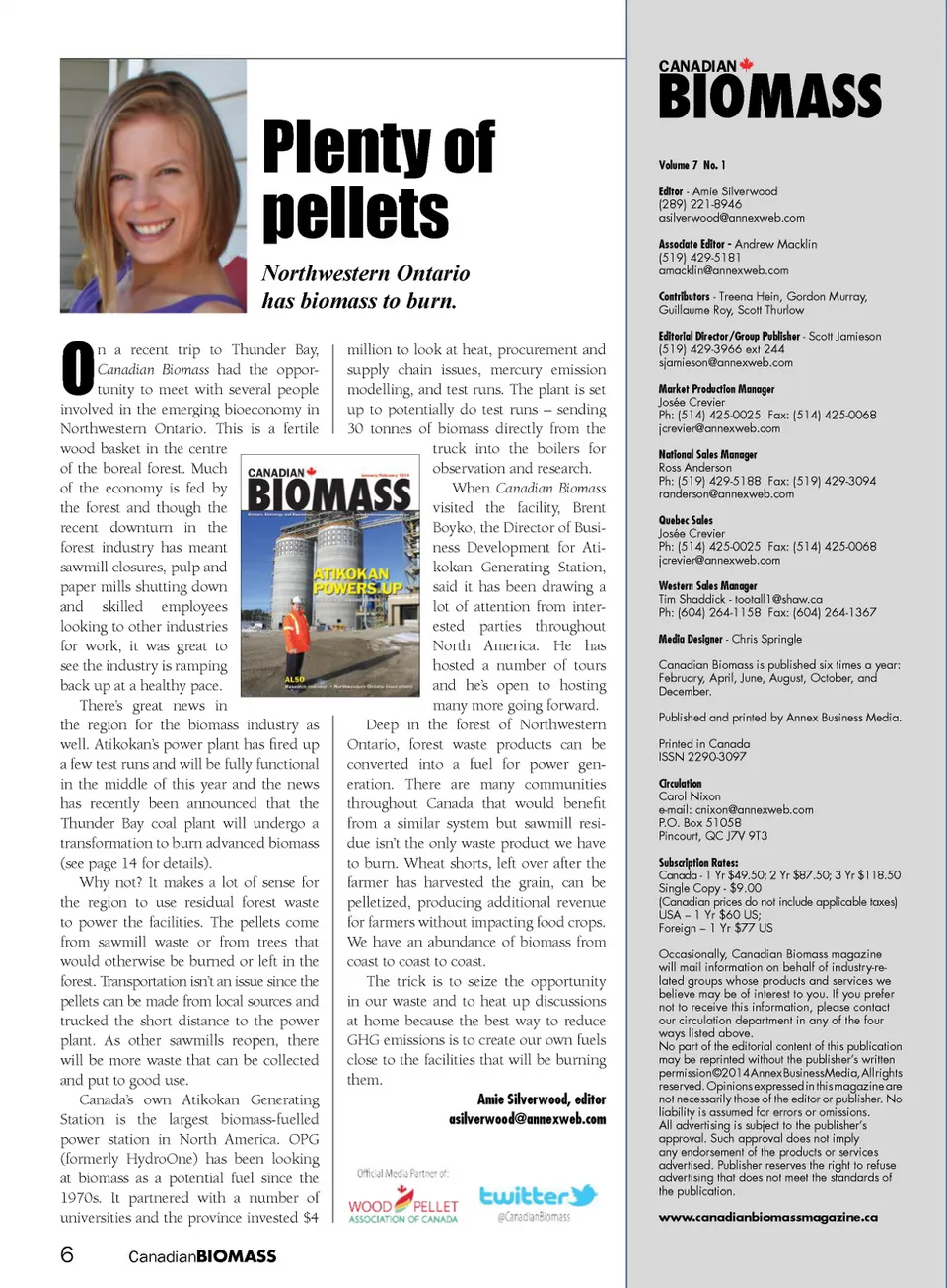
Plenty of pellets Northwestern Ontario has biomass to burn. BIOMASS CANADIAN Volume 7 No. 1 Editor -Amie Silverwood (289) 221-8946 [email protected] Associate Editor -Andrew Macklin (519) 429-5181 [email protected] Contributors -Treena Hein, Gordon Murray, Guillaume Roy, Scott Thurlow Editorial Director/Group Publisher -Scott Jamieson (519) 429-3966 ext 244 [email protected] Market Production Manager Josée Crevier Ph: (514) 425-0025 Fax: (514) 425-0068 [email protected] National Sales Manager Ross Anderson Ph: (519) 429-5188 Fax: (519) 429-3094 [email protected] Quebec Sales Josée Crevier Ph: (514) 425-0025 Fax: (514) 425-0068 [email protected] Western Sales Manager Tim Shaddick [email protected] Ph: (604) 264-1158 Fax: (604) 264-1367 Media Designer -Chris Springle Canadian Biomass is published six times a year: February, April, June, August, October, and December. Published and printed by Annex Business Media. Printed in Canada ISSN 2290-3097 Circulation Carol Nixon e-mail: [email protected] P.O. Box 51058 Pincourt, QC J7V 9T3 Subscription Rates: Canada -1 Yr $49.50; 2 Yr $87.50; 3 Yr $118.50 Single Copy -$9.00 (Canadian prices do not include applicable taxes) USA – 1 Yr $60 US; Foreign – 1 Yr $77 US Occasionally, Canadian Biomass magazine will mail information on behalf of industry-re-lated groups whose products and services we believe may be of interest to you. If you prefer not to receive this information, please contact our circulation department in any of the four ways listed above. No part of the editorial content of this publication may be reprinted without the publisher’s written permission ©2014 Annex Business Media, All rights reserved. Opinions expressed in this magazine are not necessarily those of the editor or publisher. No liability is assumed for errors or omissions. All advertising is subject to the publisher’s approval. Such approval does not imply any endorsement of the products or services advertised. Publisher reserves the right to refuse advertising that does not meet the standards of the publication. www.canadianbiomassmagazine.ca o n a recent trip to Thunder Bay, Canadian Biomass had the oppor-tunity to meet with several people involved in the emerging bioeconomy in Northwestern Ontario. This is a fertile wood basket in the centre of the boreal forest. Much of the economy is fed by the forest and though the recent downturn in the forest industry has meant sawmill closures, pulp and paper mills shutting down and skilled employees looking to other industries for work, it was great to see the industry is ramping back up at a healthy pace. There’s great news in the region for the biomass industry as well. Atikokan’s power plant has fired up a few test runs and will be fully functional in the middle of this year and the news has recently been announced that the Thunder Bay coal plant will undergo a transformation to burn advanced biomass (see page 14 for details). Why not? It makes a lot of sense for the region to use residual forest waste to power the facilities. The pellets come from sawmill waste or from trees that would otherwise be burned or left in the forest. Transportation isn’t an issue since the pellets can be made from local sources and trucked the short distance to the power plant. As other sawmills reopen, there will be more waste that can be collected and put to good use. Canada’s own Atikokan Generating Station is the largest biomass-fuelled power station in North America. OPG (formerly HydroOne) has been looking at biomass as a potential fuel since the 1970s. It partnered with a number of universities and the province invested $4 million to look at heat, procurement and supply chain issues, mercury emission modelling, and test runs. The plant is set up to potentially do test runs – sending 30 tonnes of biomass directly from the truck into the boilers for observation and research. When Canadian Biomass visited the facility, Brent Boyko, the Director of Busi-ness Development for Ati-kokan Generating Station, said it has been drawing a lot of attention from inter-ested parties throughout North America. He has hosted a number of tours and he’s open to hosting many more going forward. Deep in the forest of Northwestern Ontario, forest waste products can be converted into a fuel for power gen-eration. There are many communities throughout Canada that would benefit from a similar system but sawmill resi-due isn’t the only waste product we have to burn. Wheat shorts, left over after the farmer has harvested the grain, can be pelletized, producing additional revenue for farmers without impacting food crops. We have an abundance of biomass from coast to coast to coast. The trick is to seize the opportunity in our waste and to heat up discussions at home because the best way to reduce GHG emissions is to create our own fuels close to the facilities that will be burning them. Amie Silverwood, editor [email protected] 6 Canadian BIOMASS
Canadian Biomass January/February 2014: Page 6