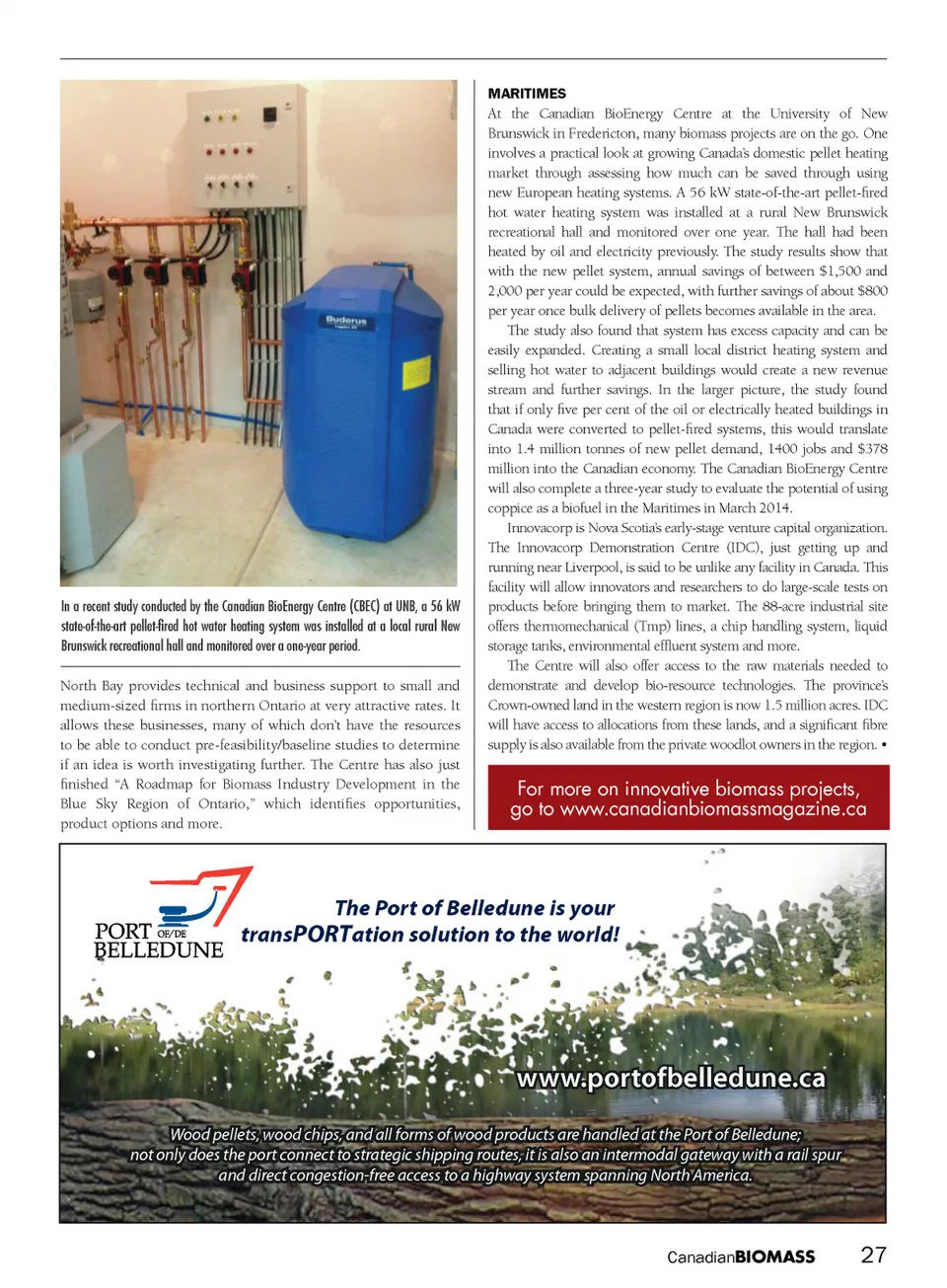
In a recent study conducted by the Canadian BioEnergy Centre (CBEC) at UNB, a 56 kW state-of-the-art pellet-fired hot water heating system was installed at a local rural New Brunswick recreational hall and monitored over a one-year period. North Bay provides technical and business support to small and medium-sized firms in northern Ontario at very attractive rates. It allows these businesses, many of which don’t have the resources to be able to conduct pre-feasibility/baseline studies to determine if an idea is worth investigating further. The Centre has also just finished “A Roadmap for Biomass Industry Development in the Blue Sky Region of Ontario,” which identifies opportunities, product options and more. maritimes At the Canadian BioEnergy Centre at the University of New Brunswick in Fredericton, many biomass projects are on the go. One involves a practical look at growing Canada’s domestic pellet heating market through assessing how much can be saved through using new European heating systems. A 56 kW state-of-the-art pellet-fired hot water heating system was installed at a rural New Brunswick recreational hall and monitored over one year. The hall had been heated by oil and electricity previously. The study results show that with the new pellet system, annual savings of between $1,500 and 2,000 per year could be expected, with further savings of about $800 per year once bulk delivery of pellets becomes available in the area. The study also found that system has excess capacity and can be easily expanded. Creating a small local district heating system and selling hot water to adjacent buildings would create a new revenue stream and further savings. In the larger picture, the study found that if only five per cent of the oil or electrically heated buildings in Canada were converted to pellet-fired systems, this would translate into 1.4 million tonnes of new pellet demand, 1400 jobs and $378 million into the Canadian economy. The Canadian BioEnergy Centre will also complete a three-year study to evaluate the potential of using coppice as a biofuel in the Maritimes in March 2014. Innovacorp is Nova Scotia’s early-stage venture capital organization. The Innovacorp Demonstration Centre (IDC), just getting up and running near Liverpool, is said to be unlike any facility in Canada. This facility will allow innovators and researchers to do large-scale tests on products before bringing them to market. The 88-acre industrial site offers thermomechanical (Tmp) lines, a chip handling system, liquid storage tanks, environmental effluent system and more. The Centre will also offer access to the raw materials needed to demonstrate and develop bio-resource technologies. The province’s Crown-owned land in the western region is now 1.5 million acres. IDC will have access to allocations from these lands, and a significant fibre supply is also available from the private woodlot owners in the region. • For more on innovative biomass projects, go to www.canadianbiomassmagazine.ca The Port of Belledune is your trans PORT ation solution to the world! www.portofbelledune.ca Wood pellets, wood chips, and all forms of wood products are handled at the Port of Belledune; not only does the port connect to strategic shipping routes, it is also an intermodal gateway with a rail spur and direct congestion-free access to a highway system spanning North America. Canadian BIOMASS 27
Canadian Biomass January/February 2014: Page 27