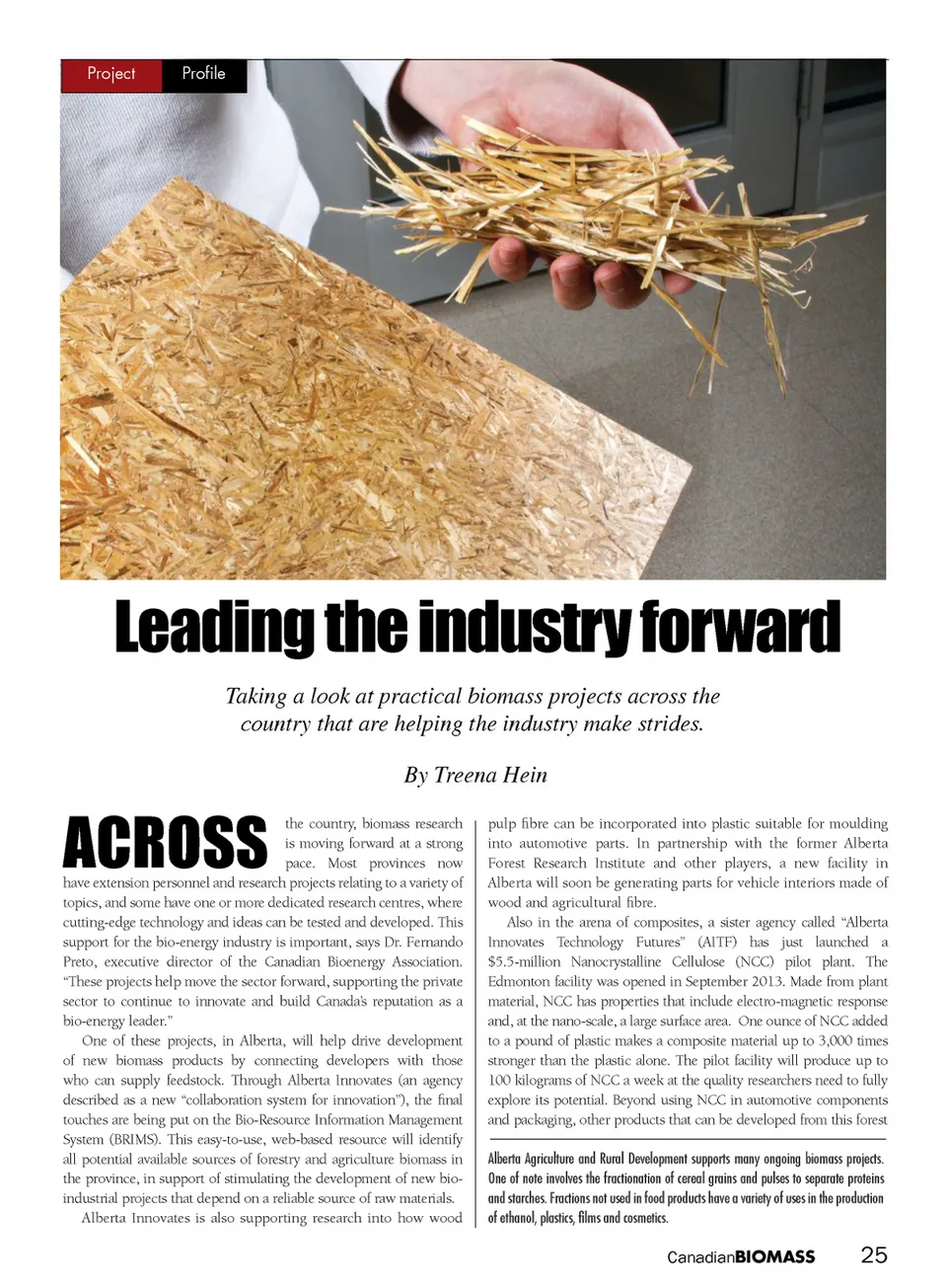
Project Profile Leading the industry forward Taking a look at practical biomass projects across the country that are helping the industry make strides. By Treena Hein the country, biomass research is moving forward at a strong pace. Most provinces now have extension personnel and research projects relating to a variety of topics, and some have one or more dedicated research centres, where cutting-edge technology and ideas can be tested and developed. This support for the bio-energy industry is important, says Dr. Fernando Preto, executive director of the Canadian Bioenergy Association. “These projects help move the sector forward, supporting the private sector to continue to innovate and build Canada’s reputation as a bio-energy leader.” One of these projects, in Alberta, will help drive development of new biomass products by connecting developers with those who can supply feedstock. Through Alberta Innovates (an agency described as a new “collaboration system for innovation”), the final touches are being put on the Bio-Resource Information Management System (BRIMS). This easy-to-use, web-based resource will identify all potential available sources of forestry and agriculture biomass in the province, in support of stimulating the development of new bio-industrial projects that depend on a reliable source of raw materials. Alberta Innovates is also supporting research into how wood ACRoss pulp fibre can be incorporated into plastic suitable for moulding into automotive parts. In partnership with the former Alberta Forest Research Institute and other players, a new facility in Alberta will soon be generating parts for vehicle interiors made of wood and agricultural fibre. Also in the arena of composites, a sister agency called “Alberta Innovates Technology Futures” (AITF) has just launched a $5.5-million Nanocrystalline Cellulose (NCC) pilot plant. The Edmonton facility was opened in September 2013. Made from plant material, NCC has properties that include electro-magnetic response and, at the nano-scale, a large surface area. One ounce of NCC added to a pound of plastic makes a composite material up to 3,000 times stronger than the plastic alone. The pilot facility will produce up to 100 kilograms of NCC a week at the quality researchers need to fully explore its potential. Beyond using NCC in automotive components and packaging, other products that can be developed from this forest Alberta Agriculture and Rural Development supports many ongoing biomass projects. One of note involves the fractionation of cereal grains and pulses to separate proteins and starches. Fractions not used in food products have a variety of uses in the production of ethanol, plastics, films and cosmetics. Canadian BIOMASS 25
Canadian Biomass January/February 2014: Page 25