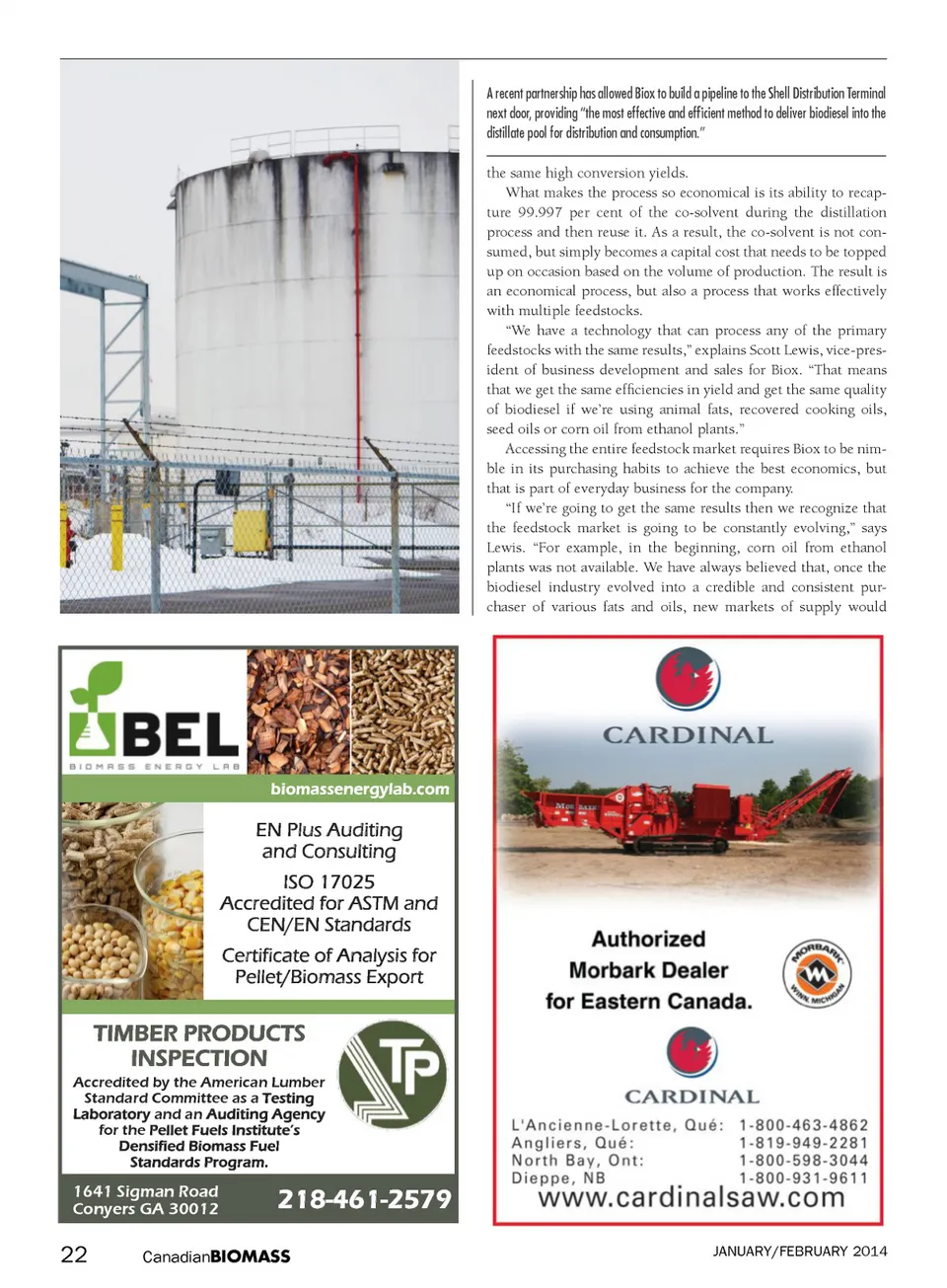
A recent partnership has allowed Biox to build a pipeline to the Shell Distribution Terminal next door, providing “the most effective and efficient method to deliver biodiesel into the distillate pool for distribution and consumption.” the same high conversion yields. What makes the process so economical is its ability to recap-ture 99.997 per cent of the co-solvent during the distillation process and then reuse it. As a result, the co-solvent is not con-sumed, but simply becomes a capital cost that needs to be topped up on occasion based on the volume of production. The result is an economical process, but also a process that works effectively with multiple feedstocks. “We have a technology that can process any of the primary feedstocks with the same results,” explains Scott Lewis, vice-pres-ident of business development and sales for Biox. “That means that we get the same efficiencies in yield and get the same quality of biodiesel if we’re using animal fats, recovered cooking oils, seed oils or corn oil from ethanol plants.” Accessing the entire feedstock market requires Biox to be nim-ble in its purchasing habits to achieve the best economics, but that is part of everyday business for the company. “If we’re going to get the same results then we recognize that the feedstock market is going to be constantly evolving,” says Lewis. “For example, in the beginning, corn oil from ethanol plants was not available. We have always believed that, once the biodiesel industry evolved into a credible and consistent pur-chaser of various fats and oils, new markets of supply would biomassenergylab.com EN Plus Auditing and Consulting ISO 17025 Accredited for ASTM and CEN/EN Standards Certificate of Analysis for Pellet/Biomass Export TIMBER PRODUCTS INSPECTION Accredited by the American Lumber Standard Committee as a Testing Laboratory and an Auditing Agency for the Pellet Fuels Institute’s Densified Biomass Fuel Standards Program. 1641 Sigman Road Conyers GA 30012 218-461-2579 January/February 2014 22 Canadian BIOMASS
Canadian Biomass January/February 2014: Page 22