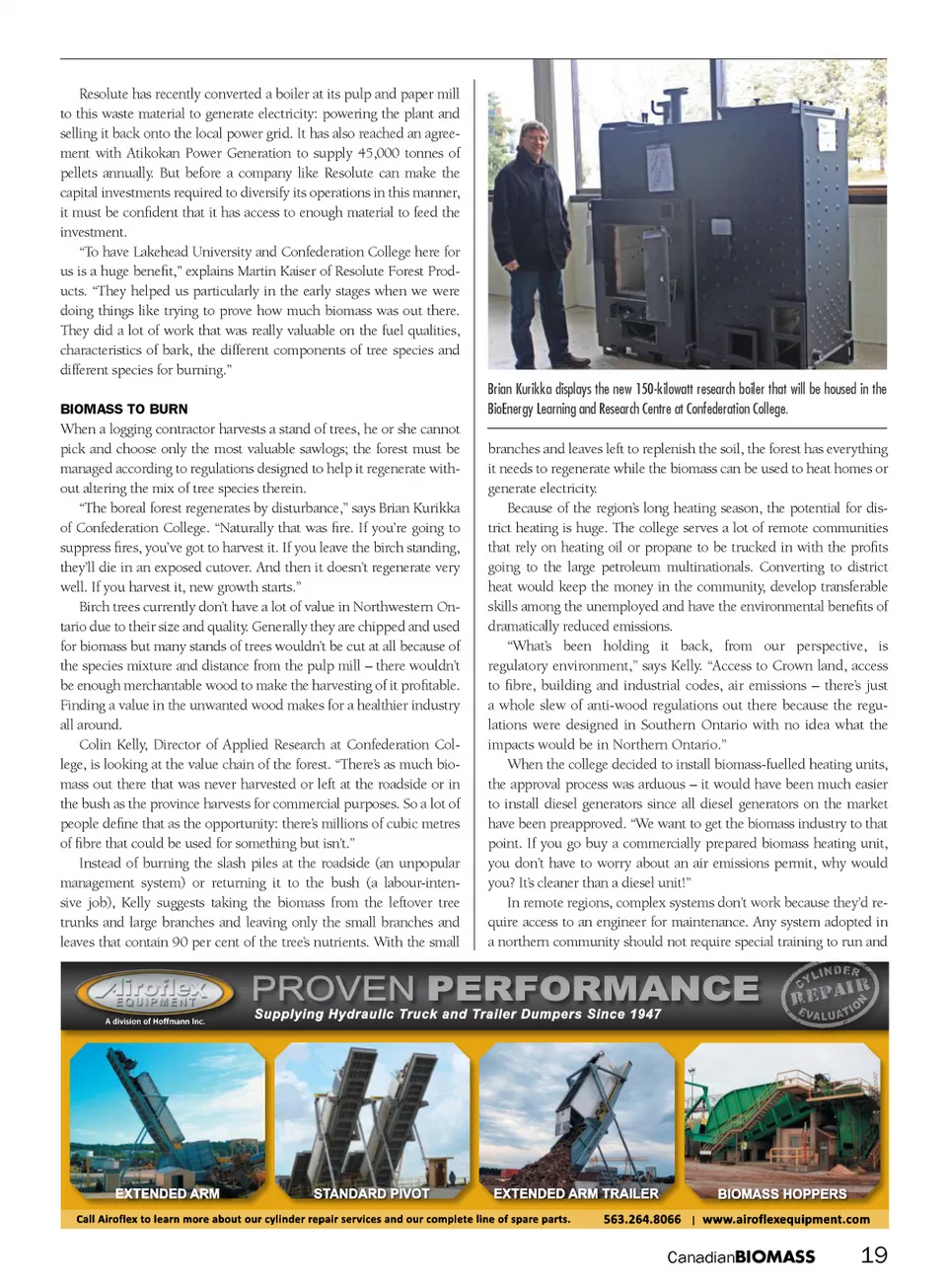
Resolute has recently converted a boiler at its pulp and paper mill to this waste material to generate electricity: powering the plant and selling it back onto the local power grid. It has also reached an agree-ment with Atikokan Power Generation to supply 45,000 tonnes of pellets annually. But before a company like Resolute can make the capital investments required to diversify its operations in this manner, it must be confident that it has access to enough material to feed the investment. “To have Lakehead University and Confederation College here for us is a huge benefit,” explains Martin Kaiser of Resolute Forest Prod-ucts. “They helped us particularly in the early stages when we were doing things like trying to prove how much biomass was out there. They did a lot of work that was really valuable on the fuel qualities, characteristics of bark, the different components of tree species and different species for burning.” biomass to burn When a logging contractor harvests a stand of trees, he or she cannot pick and choose only the most valuable sawlogs; the forest must be managed according to regulations designed to help it regenerate with-out altering the mix of tree species therein. “The boreal forest regenerates by disturbance,” says Brian Kurikka of Confederation College. “Naturally that was fire. If you’re going to suppress fires, you’ve got to harvest it. If you leave the birch standing, they’ll die in an exposed cutover. And then it doesn’t regenerate very well. If you harvest it, new growth starts.” Birch trees currently don’t have a lot of value in Northwestern On-tario due to their size and quality. Generally they are chipped and used for biomass but many stands of trees wouldn’t be cut at all because of the species mixture and distance from the pulp mill – there wouldn’t be enough merchantable wood to make the harvesting of it profitable. Finding a value in the unwanted wood makes for a healthier industry all around. Colin Kelly, Director of Applied Research at Confederation Col-lege, is looking at the value chain of the forest. “There’s as much bio-mass out there that was never harvested or left at the roadside or in the bush as the province harvests for commercial purposes. So a lot of people define that as the opportunity: there’s millions of cubic metres of fibre that could be used for something but isn’t.” Instead of burning the slash piles at the roadside (an unpopular management system) or returning it to the bush (a labour-inten-sive job), Kelly suggests taking the biomass from the leftover tree trunks and large branches and leaving only the small branches and leaves that contain 90 per cent of the tree’s nutrients. With the small Brian Kurikka displays the new 150-kilowatt research boiler that will be housed in the BioEnergy Learning and Research Centre at Confederation College. branches and leaves left to replenish the soil, the forest has everything it needs to regenerate while the biomass can be used to heat homes or generate electricity. Because of the region’s long heating season, the potential for dis-trict heating is huge. The college serves a lot of remote communities that rely on heating oil or propane to be trucked in with the profits going to the large petroleum multinationals. Converting to district heat would keep the money in the community, develop transferable skills among the unemployed and have the environmental benefits of dramatically reduced emissions. “What’s been holding it back, from our perspective, is regulatory environment,” says Kelly. “Access to Crown land, access to fibre, building and industrial codes, air emissions – there’s just a whole slew of anti-wood regulations out there because the regu-lations were designed in Southern Ontario with no idea what the impacts would be in Northern Ontario.” When the college decided to install biomass-fuelled heating units, the approval process was arduous – it would have been much easier to install diesel generators since all diesel generators on the market have been preapproved. “We want to get the biomass industry to that point. If you go buy a commercially prepared biomass heating unit, you don’t have to worry about an air emissions permit, why would you? It’s cleaner than a diesel unit!” In remote regions, complex systems don’t work because they’d re-quire access to an engineer for maintenance. Any system adopted in a northern community should not require special training to run and Canadian BIOMASS 19
Canadian Biomass January/February 2014: Page 19