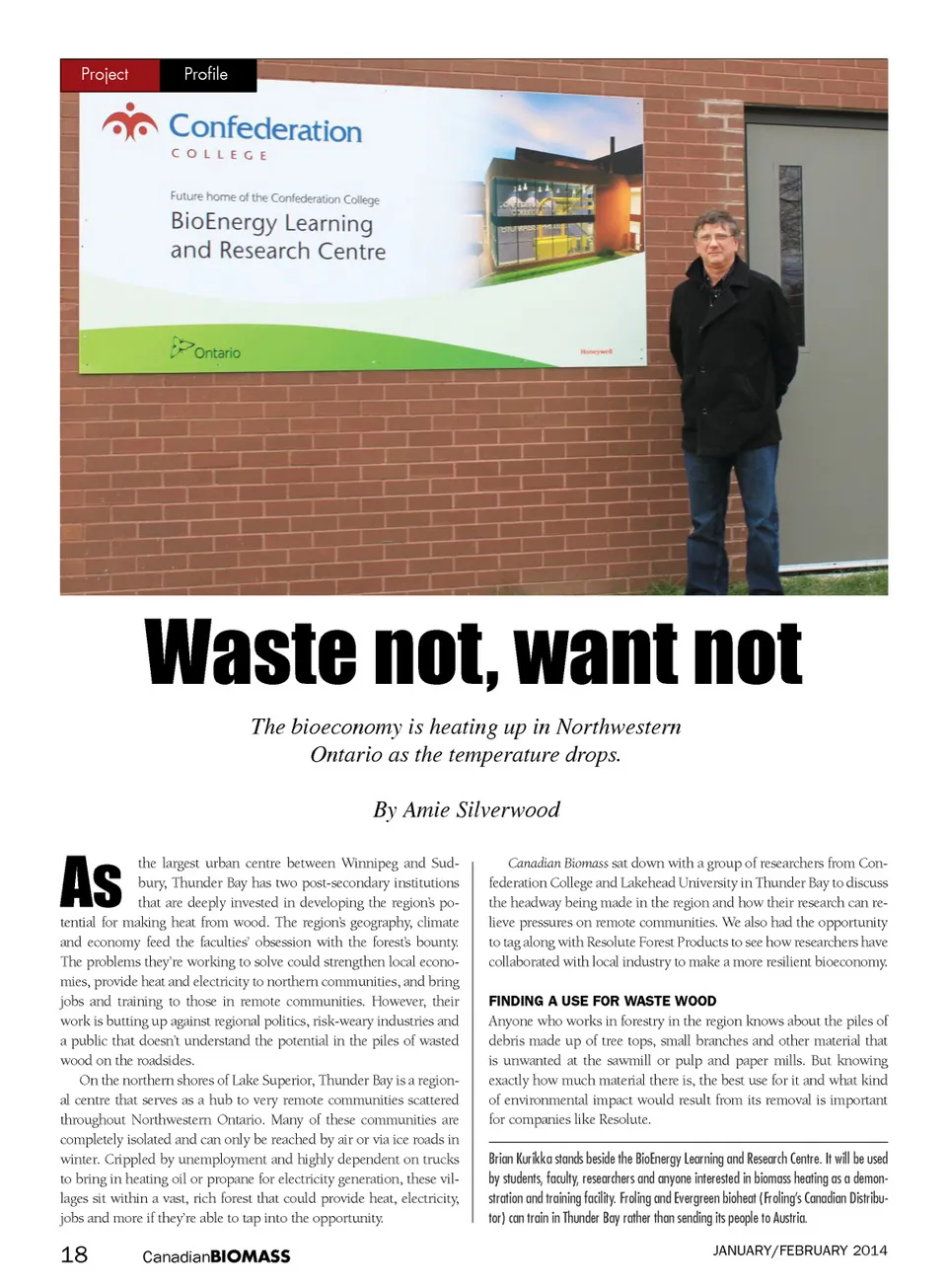
Project Profile Waste not, want not The bioeconomy is heating up in Northwestern Ontario as the temperature drops. By Amie Silverwood As the largest urban centre between Winnipeg and Sud-bury, Thunder Bay has two post-secondary institutions that are deeply invested in developing the region’s po-tential for making heat from wood. The region’s geography, climate and economy feed the faculties’ obsession with the forest’s bounty. The problems they’re working to solve could strengthen local econo-mies, provide heat and electricity to northern communities, and bring jobs and training to those in remote communities. However, their work is butting up against regional politics, risk-weary industries and a public that doesn’t understand the potential in the piles of wasted wood on the roadsides. On the northern shores of Lake Superior, Thunder Bay is a region-al centre that serves as a hub to very remote communities scattered throughout Northwestern Ontario. Many of these communities are completely isolated and can only be reached by air or via ice roads in winter. Crippled by unemployment and highly dependent on trucks to bring in heating oil or propane for electricity generation, these vil-lages sit within a vast, rich forest that could provide heat, electricity, jobs and more if they’re able to tap into the opportunity. Canadian Biomass sat down with a group of researchers from Con-federation College and Lakehead University in Thunder Bay to discuss the headway being made in the region and how their research can re-lieve pressures on remote communities. We also had the opportunity to tag along with Resolute Forest Products to see how researchers have collaborated with local industry to make a more resilient bioeconomy. finDing a use for waste wooD Anyone who works in forestry in the region knows about the piles of debris made up of tree tops, small branches and other material that is unwanted at the sawmill or pulp and paper mills. But knowing exactly how much material there is, the best use for it and what kind of environmental impact would result from its removal is important for companies like Resolute. Brian Kurikka stands beside the BioEnergy Learning and Research Centre. It will be used by students, faculty, researchers and anyone interested in biomass heating as a demon-stration and training facility. Froling and Evergreen bioheat (Froling’s Canadian Distribu-tor) can train in Thunder Bay rather than sending its people to Austria. January/February 2014 18 Canadian BIOMASS
Canadian Biomass January/February 2014: Page 18