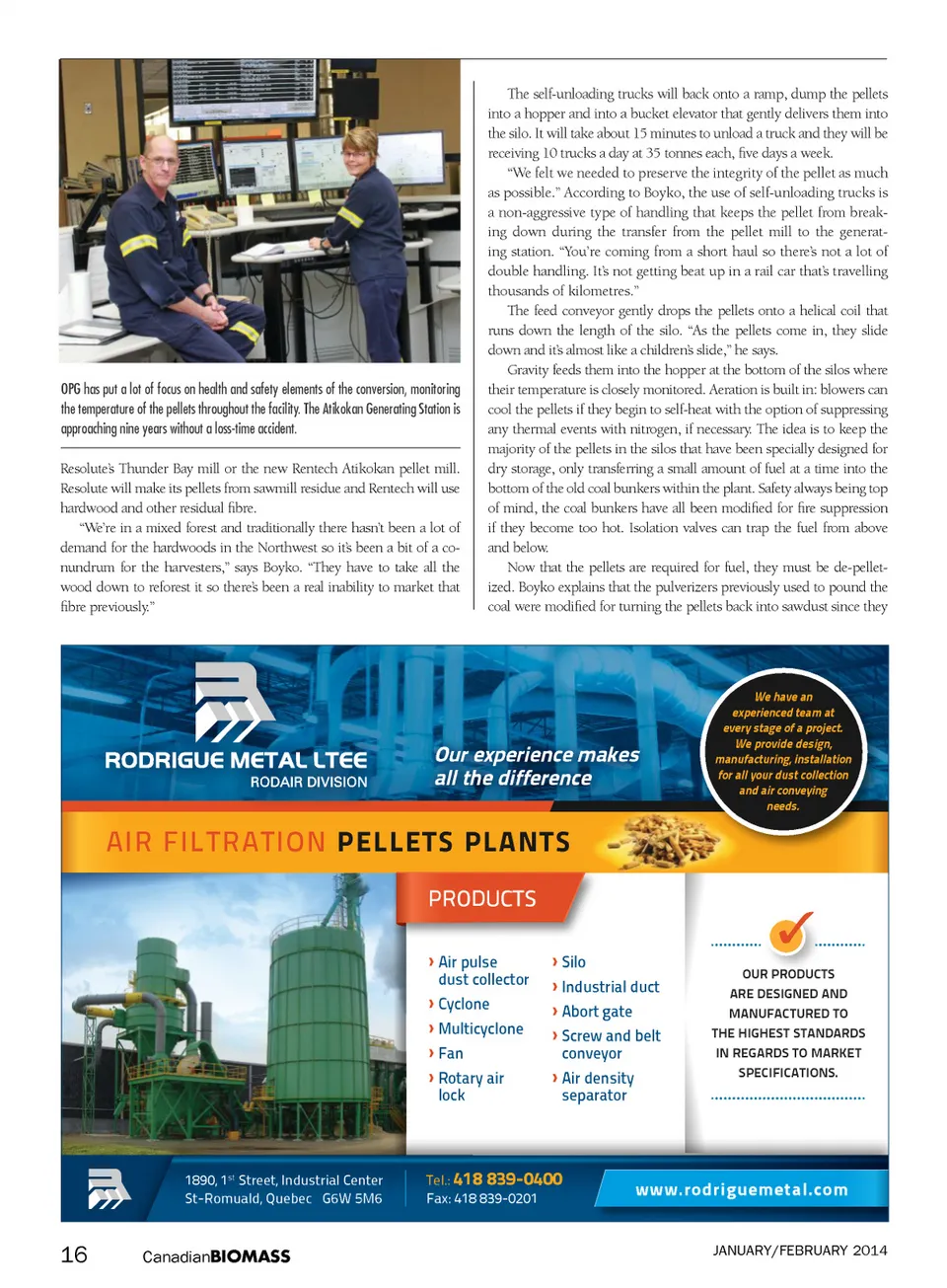
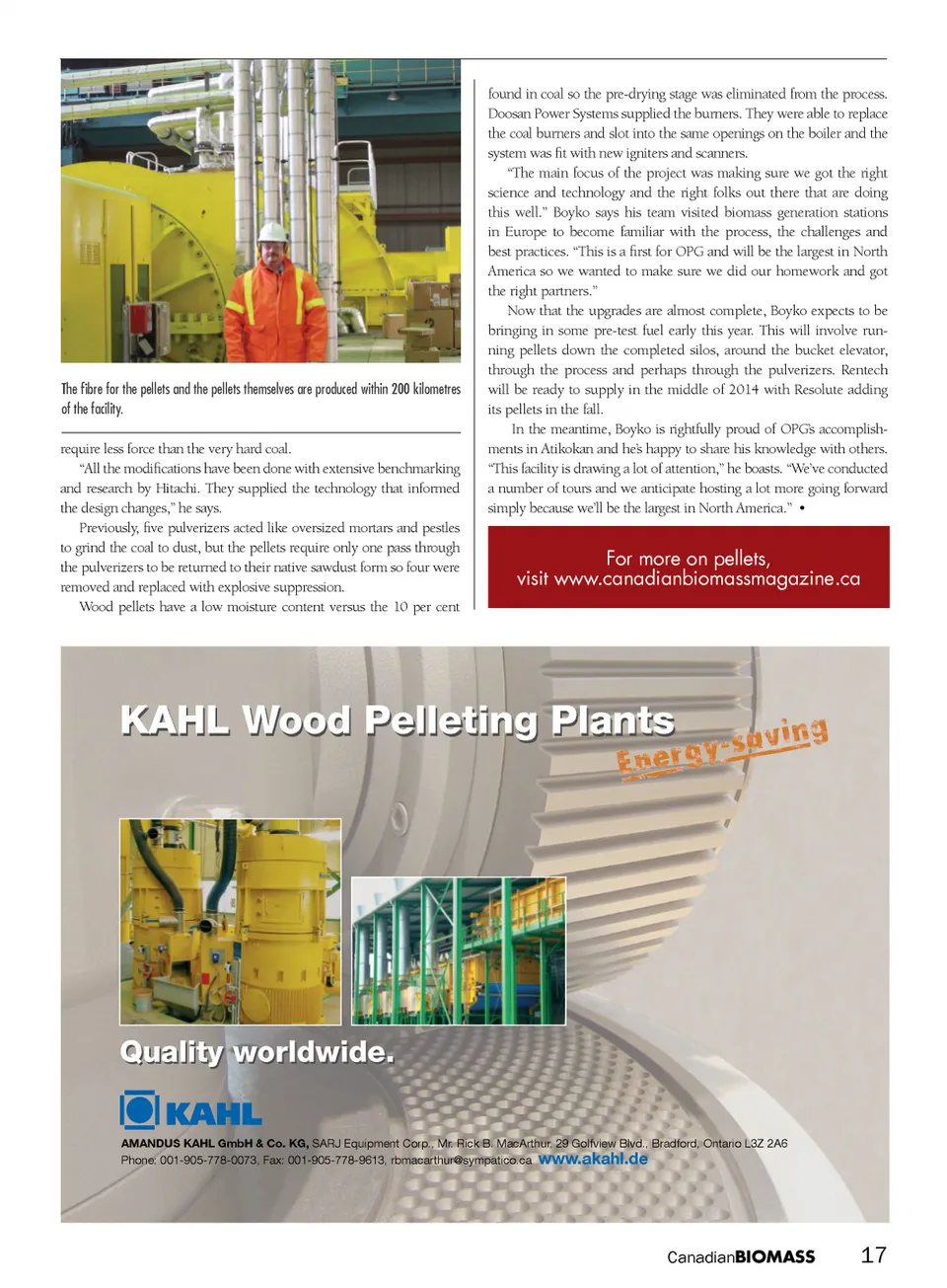
OPG has put a lot of focus on health and safety elements of the conversion, monitoring the temperature of the pellets throughout the facility. The Atikokan Generating Station is approaching nine years without a loss-time accident. Resolute’s Thunder Bay mill or the new Rentech Atikokan pellet mill. Resolute will make its pellets from sawmill residue and Rentech will use hardwood and other residual fibre. “We’re in a mixed forest and traditionally there hasn’t been a lot of demand for the hardwoods in the Northwest so it’s been a bit of a co-nundrum for the harvesters,” says Boyko. “They have to take all the wood down to reforest it so there’s been a real inability to market that fibre previously.” The self-unloading trucks will back onto a ramp, dump the pellets into a hopper and into a bucket elevator that gently delivers them into the silo. It will take about 15 minutes to unload a truck and they will be receiving 10 trucks a day at 35 tonnes each, five days a week. “We felt we needed to preserve the integrity of the pellet as much as possible.” According to Boyko, the use of self-unloading trucks is a non-aggressive type of handling that keeps the pellet from break-ing down during the transfer from the pellet mill to the generat-ing station. “You’re coming from a short haul so there’s not a lot of double handling. It’s not getting beat up in a rail car that’s travelling thousands of kilometres.” The feed conveyor gently drops the pellets onto a helical coil that runs down the length of the silo. “As the pellets come in, they slide down and it’s almost like a children’s slide,” he says. Gravity feeds them into the hopper at the bottom of the silos where their temperature is closely monitored. Aeration is built in: blowers can cool the pellets if they begin to self-heat with the option of suppressing any thermal events with nitrogen, if necessary. The idea is to keep the majority of the pellets in the silos that have been specially designed for dry storage, only transferring a small amount of fuel at a time into the bottom of the old coal bunkers within the plant. Safety always being top of mind, the coal bunkers have all been modified for fire suppression if they become too hot. Isolation valves can trap the fuel from above and below. Now that the pellets are required for fuel, they must be de-pellet-ized. Boyko explains that the pulverizers previously used to pound the coal were modified for turning the pellets back into sawdust since they Our experience makes all the difference We have an experienced team at every stage of a project. We provide design, manufacturing, installation for all your dust collection and air conveying needs. air Filtration pellets plants ProduCts › air pulse › silo › industrial duct › abort gate › screw and belt conveyor › air density separator ✓ Our prOducts are designed and manufactured tO the highest standards in regards tO market specificatiOns. dust collector › Cyclone › Multicyclone › Fan › rotary air lock 1890, 1 st Street, Industrial Center St-Romuald, Quebec G6W 5M6 Tel.: 418 839-0400 Fax: 418 839-0201 www.rodriguemetal.com January/February 2014 16 Canadian BIOMASS
Canadian Biomass January/February 2014: Page 16