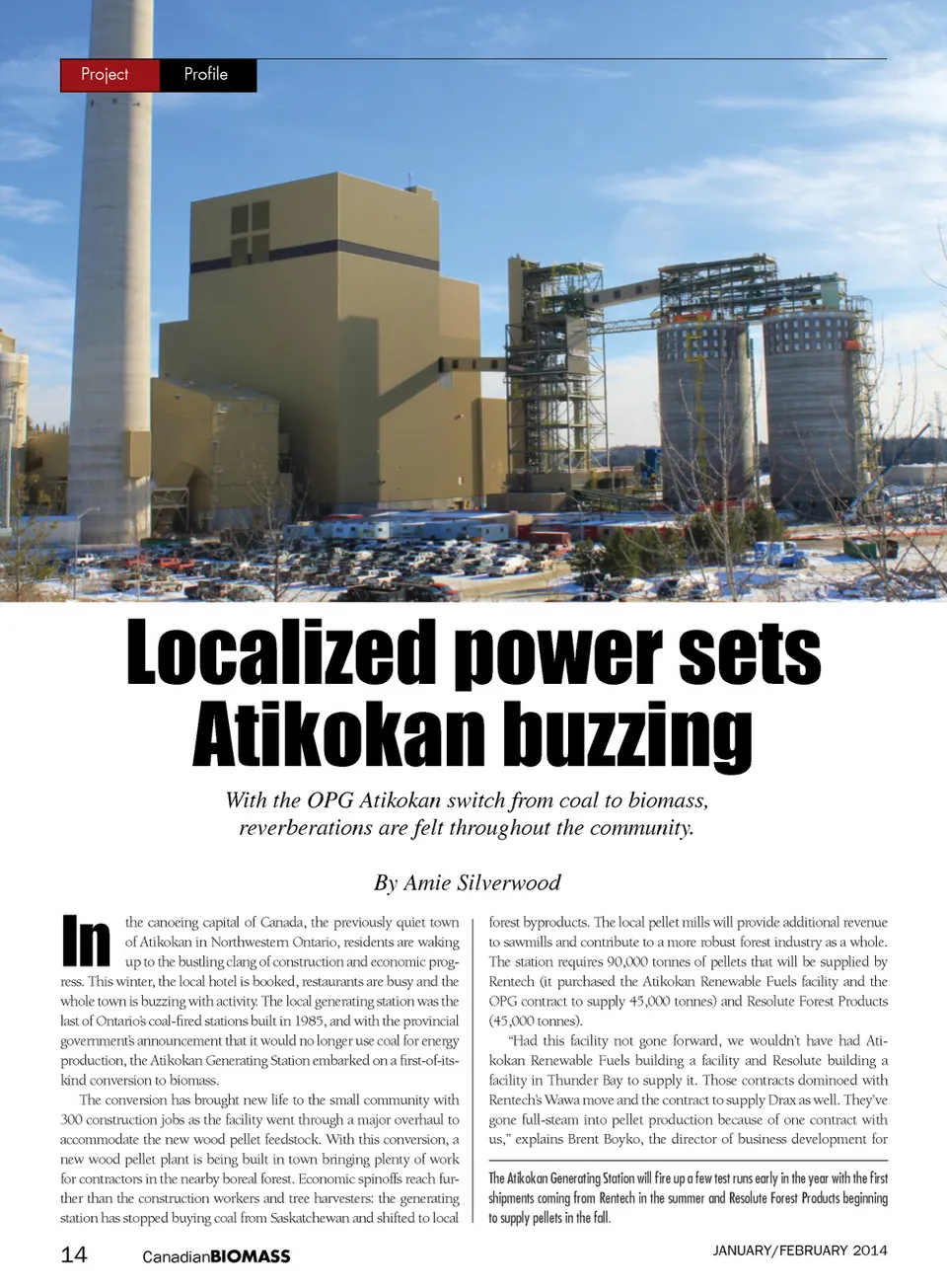
Atikokan Generating Station. When Atikokan Generating Station first became serious about burning wood pellets in 2008, there were no local pellet manufac-turers and very little local knowledge on the topic. But with some funding, researchers looked into whether there was enough wood to supply the power station, the cost of bringing in the new fuel and what it would require to convert. Test runs were done with different fuels, including wheat shorts and different kinds of pellets that were brought in from B.C. Initial results were positive and trials progressed incrementally until a fire broke out in December 2008. The facility wasn’t running at the time and there were no injuries but it put a hold on the biomass conversion program to allow the team to regroup and understand the elements that contributed to the explosion. It was important to build in the necessary safety features to prevent similar incidents down the road. “You need to respect it’s a fuel. Treat it accordingly and have proce-dures and mitigation devices in place,” says Boyko. “You want some-thing with a high heat content and low moisture so it’s a catch-22. You want it to burn but you want it to burn in the boiler.” When driving up to the updated facility, the most noticeable change is what appears to be two windowed silos connected to the building by a bridge. But these silos are more high-tech than the average grain silo. “We’ve incorporated the best practices from around the world for wood pellet storage,” Boyko explains. The material handling equipment was designed by Aecon to both preserve the integrity of the pellets and keep them from heating up. They will arrive at the generating station by truck from either thunder bay gets the green lIght to test advanced bIomass t hough power generation from wood pellets is still uncommon in the region, progress is coming. OPG has recently decided to do a trial with advanced bio-mass – either torrefied pellets or steam-treated biomass – in the Thunder Bay coal burning generation station. Since this project is in the experimental phase, being one of the first power plants in the world to replace coal with advanced biomass as its fuel, the goal is to produce about two per cent of the generator’s previous capacity or 15,000 tonnes a year for five years. “The driver (at Thunder Bay) is to go with a low capital conversion cost that will meet the market needs when we are mandated to be off coal in 2014,” says Brent Boyko, director of business development for Atikokan Generating Station. The advantage of the new generation of biomass is that they don’t take on moisture so they can be kept outdoors – making them easier to store. “They’re as coal-like as you can get with an engineered advanced biomass fuel.” Northeastern biomass janfeb14.indd 1 2013-12-16 Canadian BIOMASS 1:30 PM 15
Canadian Biomass January/February 2014: Page 15