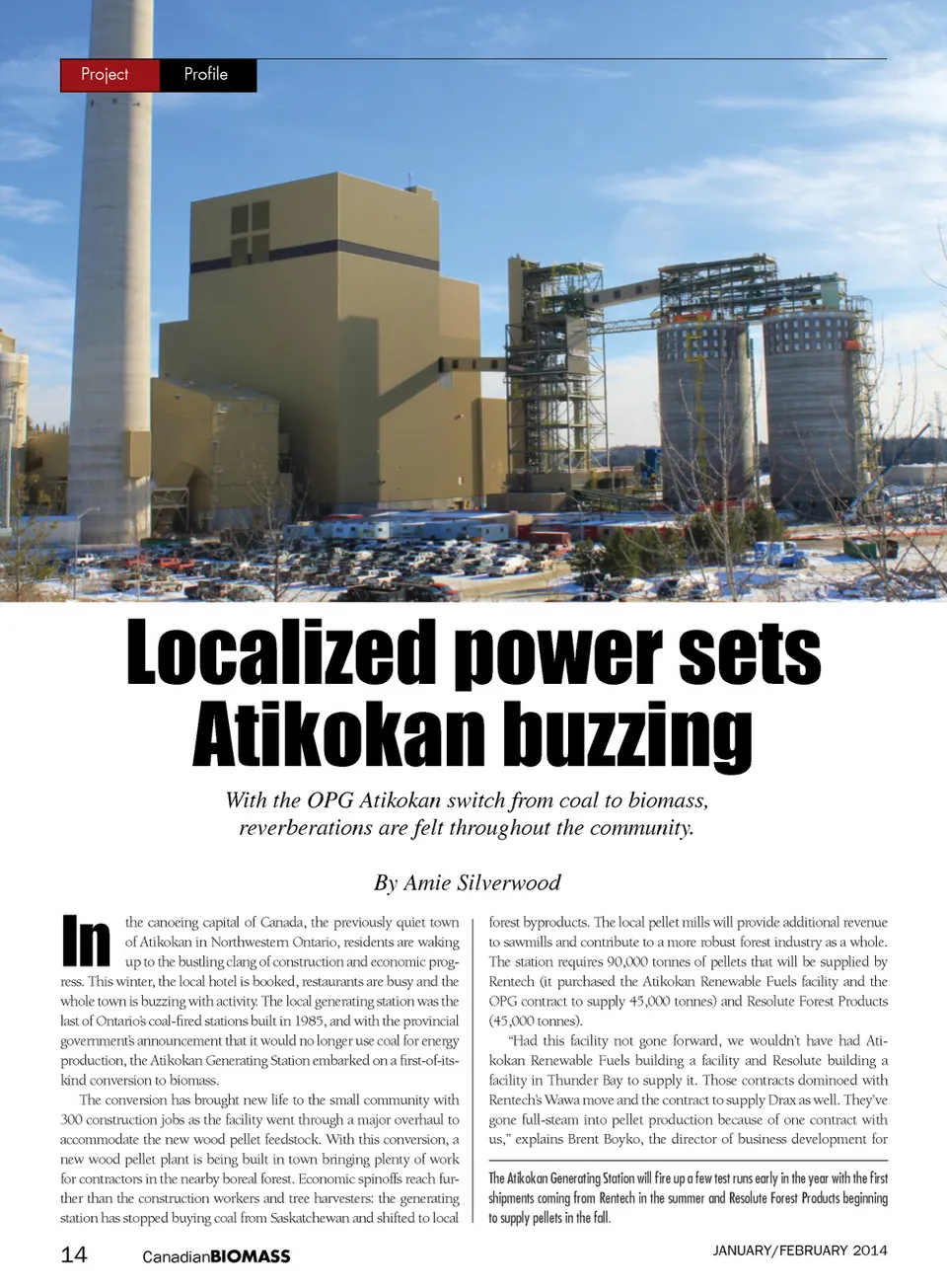
Project Profile Localized power sets Atikokan buzzing With the OPG Atikokan switch from coal to biomass, reverberations are felt throughout the community. By Amie Silverwood forest byproducts. The local pellet mills will provide additional revenue to sawmills and contribute to a more robust forest industry as a whole. The station requires 90,000 tonnes of pellets that will be supplied by Rentech (it purchased the Atikokan Renewable Fuels facility and the OPG contract to supply 45,000 tonnes) and Resolute Forest Products (45,000 tonnes). “Had this facility not gone forward, we wouldn’t have had Ati-kokan Renewable Fuels building a facility and Resolute building a facility in Thunder Bay to supply it. Those contracts dominoed with Rentech’s Wawa move and the contract to supply Drax as well. They’ve gone full-steam into pellet production because of one contract with us,” explains Brent Boyko, the director of business development for The Atikokan Generating Station will fire up a few test runs early in the year with the first shipments coming from Rentech in the summer and Resolute Forest Products beginning to supply pellets in the fall. January/February 2014 the canoeing capital of Canada, the previously quiet town of Atikokan in Northwestern Ontario, residents are waking up to the bustling clang of construction and economic prog-ress. This winter, the local hotel is booked, restaurants are busy and the whole town is buzzing with activity. The local generating station was the last of Ontario’s coal-fired stations built in 1985, and with the provincial government’s announcement that it would no longer use coal for energy production, the Atikokan Generating Station embarked on a first-of-its-kind conversion to biomass. The conversion has brought new life to the small community with 300 construction jobs as the facility went through a major overhaul to accommodate the new wood pellet feedstock. With this conversion, a new wood pellet plant is being built in town bringing plenty of work for contractors in the nearby boreal forest. Economic spinoffs reach fur-ther than the construction workers and tree harvesters: the generating station has stopped buying coal from Saskatchewan and shifted to local in 14 Canadian BIOMASS
Canadian Biomass January/February 2014: Page 14