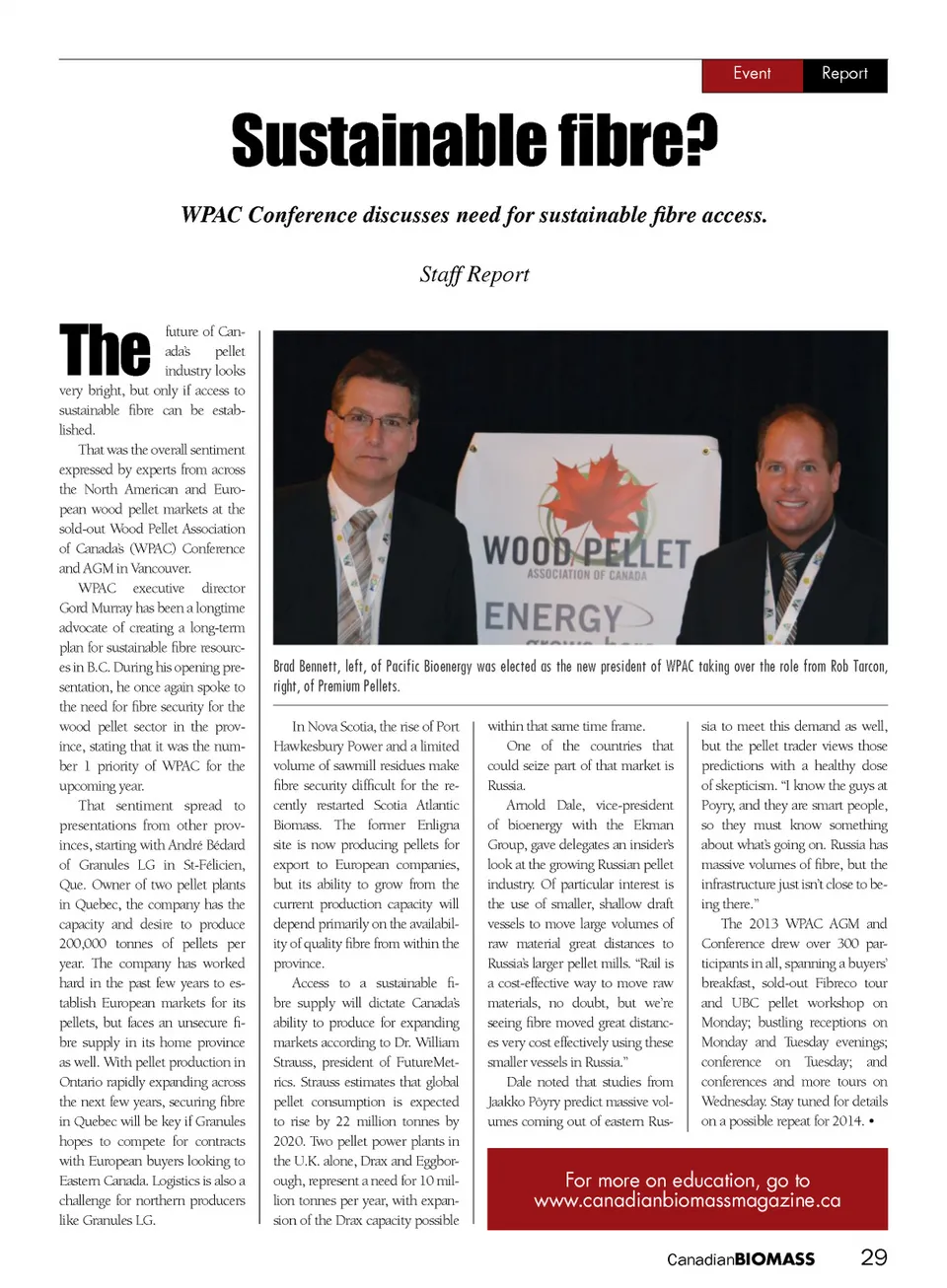
Event Report Sustainable fibre? WPAC Conference discusses need for sustainable fibre access. Staff Report the future of Can-ada’s pellet industry looks very bright, but only if access to sustainable fibre can be estab-lished. That was the overall sentiment expressed by experts from across the North American and Euro-pean wood pellet markets at the sold-out Wood Pellet Association of Canada’s (WPAC) Conference and AGM in Vancouver. WPAC executive director Gord Murray has been a longtime advocate of creating a long-term plan for sustainable fibre resourc-es in B.C. During his opening pre-sentation, he once again spoke to the need for fibre security for the wood pellet sector in the prov-ince, stating that it was the num-ber 1 priority of WPAC for the upcoming year. That sentiment spread to presentations from other prov-inces, starting with André Bédard of Granules LG in St-Félicien, Que. Owner of two pellet plants in Quebec, the company has the capacity and desire to produce 200,000 tonnes of pellets per year. The company has worked hard in the past few years to es-tablish European markets for its pellets, but faces an unsecure fi-bre supply in its home province as well. With pellet production in Ontario rapidly expanding across the next few years, securing fibre in Quebec will be key if Granules hopes to compete for contracts with European buyers looking to Eastern Canada. Logistics is also a challenge for northern producers like Granules LG. Brad Bennett, left, of Pacific Bioenergy was elected as the new president of WPAC taking over the role from Rob Tarcon, right, of Premium Pellets. In Nova Scotia, the rise of Port Hawkesbury Power and a limited volume of sawmill residues make fibre security difficult for the re-cently restarted Scotia Atlantic Biomass. The former Enligna site is now producing pellets for export to European companies, but its ability to grow from the current production capacity will depend primarily on the availabil-ity of quality fibre from within the province. Access to a sustainable fi-bre supply will dictate Canada’s ability to produce for expanding markets according to Dr. William Strauss, president of FutureMet-rics. Strauss estimates that global pellet consumption is expected to rise by 22 million tonnes by 2020. Two pellet power plants in the U.K. alone, Drax and Eggbor-ough, represent a need for 10 mil-lion tonnes per year, with expan-sion of the Drax capacity possible within that same time frame. One of the countries that could seize part of that market is Russia. Arnold Dale, vice-president of bioenergy with the Ekman Group, gave delegates an insider’s look at the growing Russian pellet industry. Of particular interest is the use of smaller, shallow draft vessels to move large volumes of raw material great distances to Russia’s larger pellet mills. “Rail is a cost-effective way to move raw materials, no doubt, but we’re seeing fibre moved great distanc-es very cost effectively using these smaller vessels in Russia.” Dale noted that studies from Jaakko Pöyry predict massive vol-umes coming out of eastern Rus-sia to meet this demand as well, but the pellet trader views those predictions with a healthy dose of skepticism. “I know the guys at Poyry, and they are smart people, so they must know something about what’s going on. Russia has massive volumes of fibre, but the infrastructure just isn’t close to be-ing there.” The 2013 WPAC AGM and Conference drew over 300 par-ticipants in all, spanning a buyers’ breakfast, sold-out Fibreco tour and UBC pellet workshop on Monday; bustling receptions on Monday and Tuesday evenings; conference on Tuesday; and conferences and more tours on Wednesday. Stay tuned for details on a possible repeat for 2014. • For more on education, go to www.canadianbiomassmagazine.ca Canadian BIOMASS 29
Canadian Biomass November/December 2013: Page 29