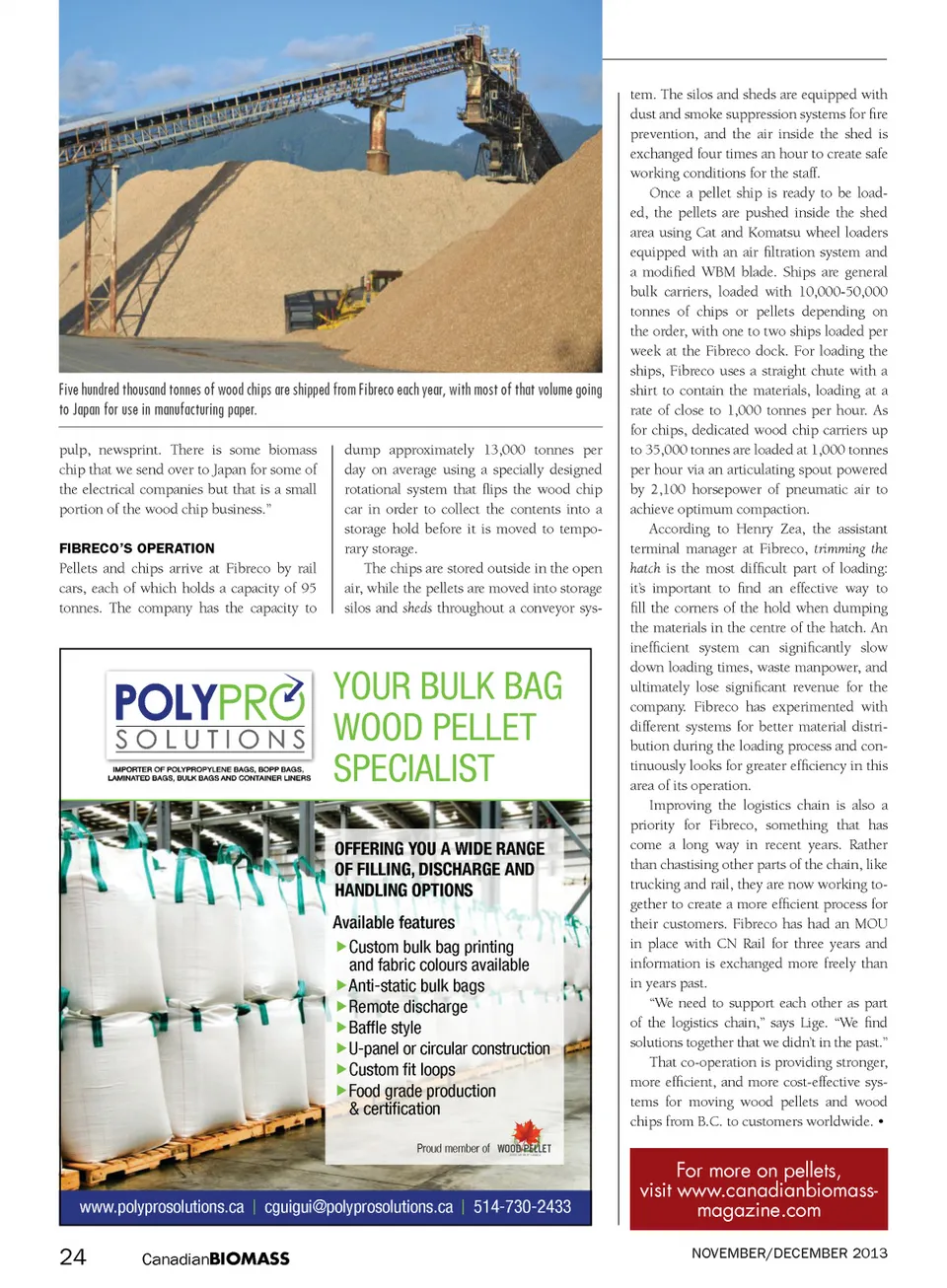
Five hundred thousand tonnes of wood chips are shipped from Fibreco each year, with most of that volume going to Japan for use in manufacturing paper. pulp, newsprint. There is some biomass chip that we send over to Japan for some of the electrical companies but that is a small portion of the wood chip business.” fiBreco’s operation Pellets and chips arrive at Fibreco by rail cars, each of which holds a capacity of 95 tonnes. The company has the capacity to dump approximately 13,000 tonnes per day on average using a specially designed rotational system that flips the wood chip car in order to collect the contents into a storage hold before it is moved to tempo-rary storage. The chips are stored outside in the open air, while the pellets are moved into storage silos and sheds throughout a conveyor sys-YOUR BULK BAG WOOD PELLET SPECIALIST OFFERING YOU A WIDE RANGE OF FILLING, DISCHARGE AND HANDLING OPTIONS Available features Custom bulk bag printing and fabric colours available Anti-static bulk bags Remote discharge Baffle style U-panel or circular construction Custom fit loops Food grade production & certification Proud member of WOOD PELLET ASSOCIATION OF CANADA tem. The silos and sheds are equipped with dust and smoke suppression systems for fire prevention, and the air inside the shed is exchanged four times an hour to create safe working conditions for the staff. Once a pellet ship is ready to be load-ed, the pellets are pushed inside the shed area using Cat and Komatsu wheel loaders equipped with an air filtration system and a modified WBM blade. Ships are general bulk carriers, loaded with 10,000-50,000 tonnes of chips or pellets depending on the order, with one to two ships loaded per week at the Fibreco dock. For loading the ships, Fibreco uses a straight chute with a shirt to contain the materials, loading at a rate of close to 1,000 tonnes per hour. As for chips, dedicated wood chip carriers up to 35,000 tonnes are loaded at 1,000 tonnes per hour via an articulating spout powered by 2,100 horsepower of pneumatic air to achieve optimum compaction. According to Henry Zea, the assistant terminal manager at Fibreco, trimming the hatch is the most difficult part of loading: it’s important to find an effective way to fill the corners of the hold when dumping the materials in the centre of the hatch. An inefficient system can significantly slow down loading times, waste manpower, and ultimately lose significant revenue for the company. Fibreco has experimented with different systems for better material distri-bution during the loading process and con-tinuously looks for greater efficiency in this area of its operation. Improving the logistics chain is also a priority for Fibreco, something that has come a long way in recent years. Rather than chastising other parts of the chain, like trucking and rail, they are now working to-gether to create a more efficient process for their customers. Fibreco has had an MOU in place with CN Rail for three years and information is exchanged more freely than in years past. “We need to support each other as part of the logistics chain,” says Lige. “We find solutions together that we didn’t in the past.” That co-operation is providing stronger, more efficient, and more cost-effective sys-tems for moving wood pellets and wood chips from B.C. to customers worldwide. • www.polyprosolutions.ca | [email protected] | 514-730-2433 For more on pellets, visit www.canadianbiomass-magazine.com NOVEMBER/DECEMBER 2013 24 Canadian BIOMASS
Canadian Biomass November/December 2013: Page 24