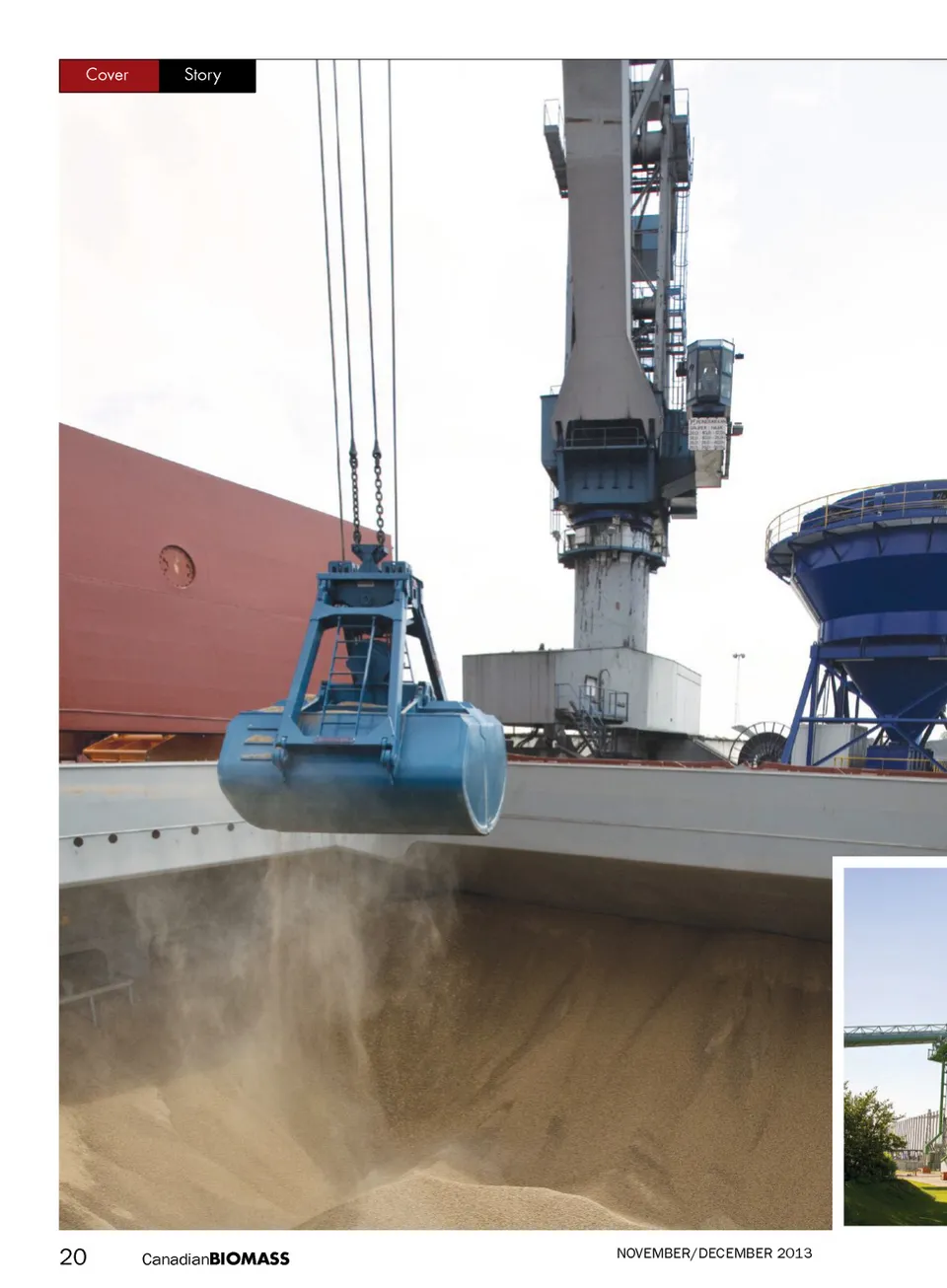
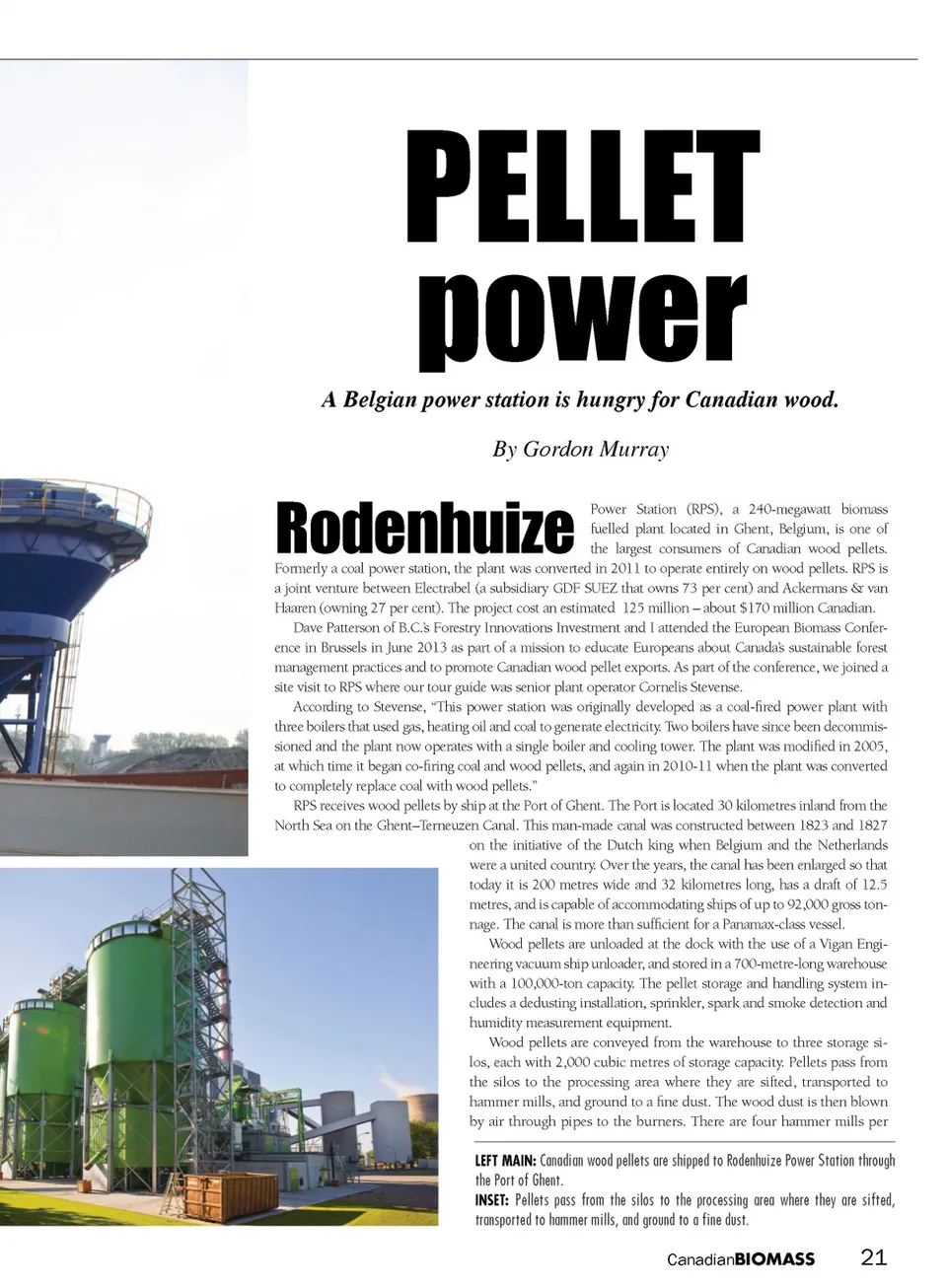
Pellet A Belgian power station is hungry for Canadian wood. By Gordon Murray power rodenhuize Power Station (RPS), a 240-megawatt biomass fuelled plant located in Ghent, Belgium, is one of the largest consumers of Canadian wood pellets. Formerly a coal power station, the plant was converted in 2011 to operate entirely on wood pellets. RPS is a joint venture between Electrabel (a subsidiary GDF SUEZ that owns 73 per cent) and Ackermans & van Haaren (owning 27 per cent). The project cost an estimated €125 million – about $170 million Canadian. Dave Patterson of B.C.’s Forestry Innovations Investment and I attended the European Biomass Confer-ence in Brussels in June 2013 as part of a mission to educate Europeans about Canada’s sustainable forest management practices and to promote Canadian wood pellet exports. As part of the conference, we joined a site visit to RPS where our tour guide was senior plant operator Cornelis Stevense. According to Stevense, “This power station was originally developed as a coal-fired power plant with three boilers that used gas, heating oil and coal to generate electricity. Two boilers have since been decommis-sioned and the plant now operates with a single boiler and cooling tower. The plant was modified in 2005, at which time it began co-firing coal and wood pellets, and again in 2010-11 when the plant was converted to completely replace coal with wood pellets.” RPS receives wood pellets by ship at the Port of Ghent. The Port is located 30 kilometres inland from the North Sea on the Ghent–Terneuzen Canal. This man-made canal was constructed between 1823 and 1827 on the initiative of the Dutch king when Belgium and the Netherlands were a united country. Over the years, the canal has been enlarged so that today it is 200 metres wide and 32 kilometres long, has a draft of 12.5 metres, and is capable of accommodating ships of up to 92,000 gross ton-nage. The canal is more than sufficient for a Panamax-class vessel. Wood pellets are unloaded at the dock with the use of a Vigan Engi-neering vacuum ship unloader, and stored in a 700-metre-long warehouse with a 100,000-ton capacity. The pellet storage and handling system in-cludes a dedusting installation, sprinkler, spark and smoke detection and humidity measurement equipment. Wood pellets are conveyed from the warehouse to three storage si-los, each with 2,000 cubic metres of storage capacity. Pellets pass from the silos to the processing area where they are sifted, transported to hammer mills, and ground to a fine dust. The wood dust is then blown by air through pipes to the burners. There are four hammer mills per LEFT MAIN: Canadian wood pellets are shipped to Rodenhuize Power Station through the Port of Ghent. INSET: Pellets pass from the silos to the processing area where they are sifted, transported to hammer mills, and ground to a fine dust. Canadian BIOMASS 21
Canadian Biomass November/December 2013: Page 21