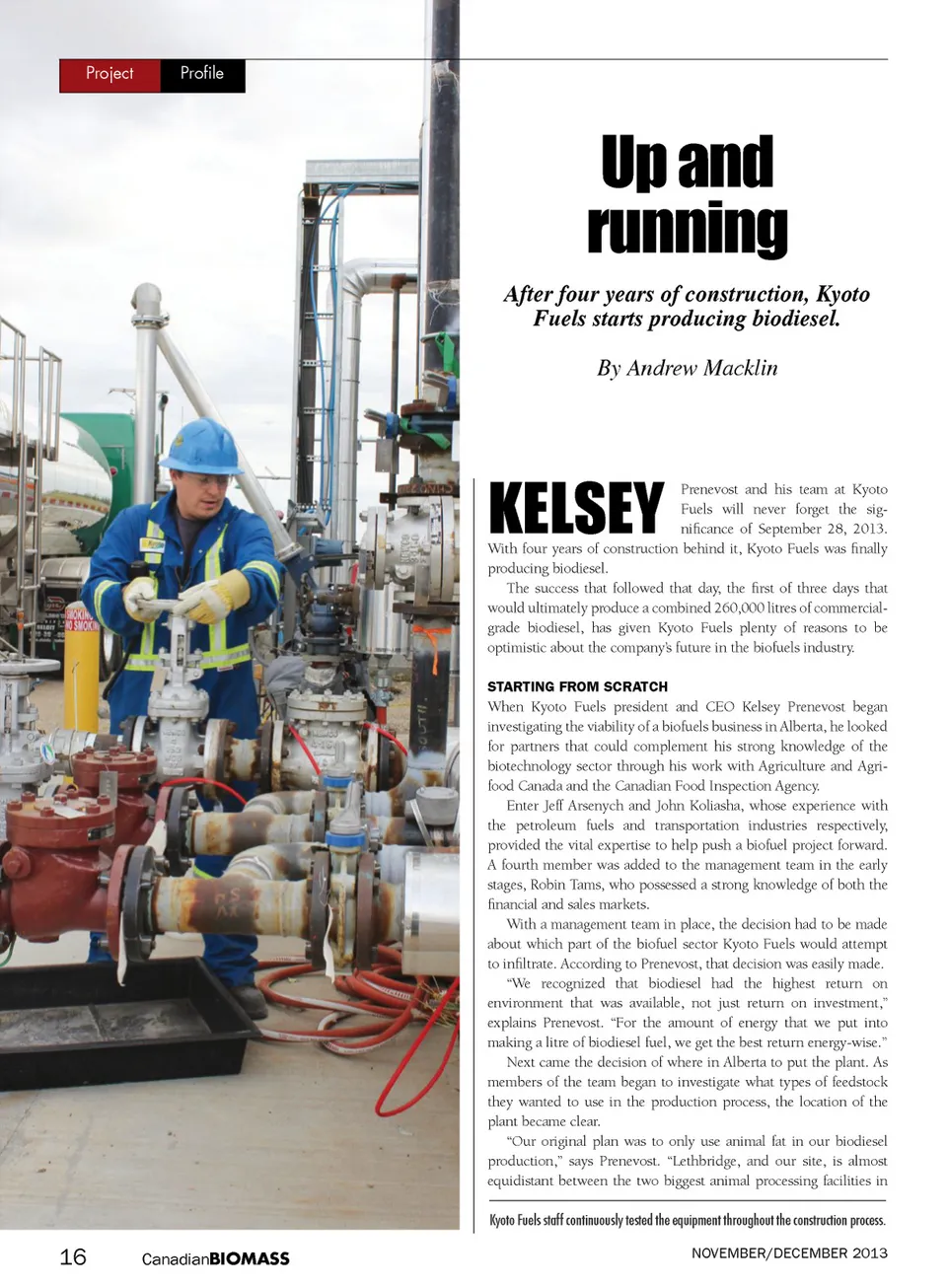
Project Profile Up and running After four years of construction, Kyoto Fuels starts producing biodiesel. By Andrew Macklin Prenevost and his team at Kyoto Fuels will never forget the sig-nificance of September 28, 2013. With four years of construction behind it, Kyoto Fuels was finally producing biodiesel. The success that followed that day, the first of three days that would ultimately produce a combined 260,000 litres of commercial-grade biodiesel, has given Kyoto Fuels plenty of reasons to be optimistic about the company’s future in the biofuels industry. starting from scratch When Kyoto Fuels president and CEO Kelsey Prenevost began investigating the viability of a biofuels business in Alberta, he looked for partners that could complement his strong knowledge of the biotechnology sector through his work with Agriculture and Agri-food Canada and the Canadian Food Inspection Agency. Enter Jeff Arsenych and John Koliasha, whose experience with the petroleum fuels and transportation industries respectively, provided the vital expertise to help push a biofuel project forward. A fourth member was added to the management team in the early stages, Robin Tams, who possessed a strong knowledge of both the financial and sales markets. With a management team in place, the decision had to be made about which part of the biofuel sector Kyoto Fuels would attempt to infiltrate. According to Prenevost, that decision was easily made. “We recognized that biodiesel had the highest return on environment that was available, not just return on investment,” explains Prenevost. “For the amount of energy that we put into making a litre of biodiesel fuel, we get the best return energy-wise.” Next came the decision of where in Alberta to put the plant. As members of the team began to investigate what types of feedstock they wanted to use in the production process, the location of the plant became clear. “Our original plan was to only use animal fat in our biodiesel production,” says Prenevost. “Lethbridge, and our site, is almost equidistant between the two biggest animal processing facilities in Kyoto Fuels staff continuously tested the equipment throughout the construction process. KelSey 16 Canadian BIOMASS NOVEMBER/DECEMBER 2013
Canadian Biomass November/December 2013: Page 16