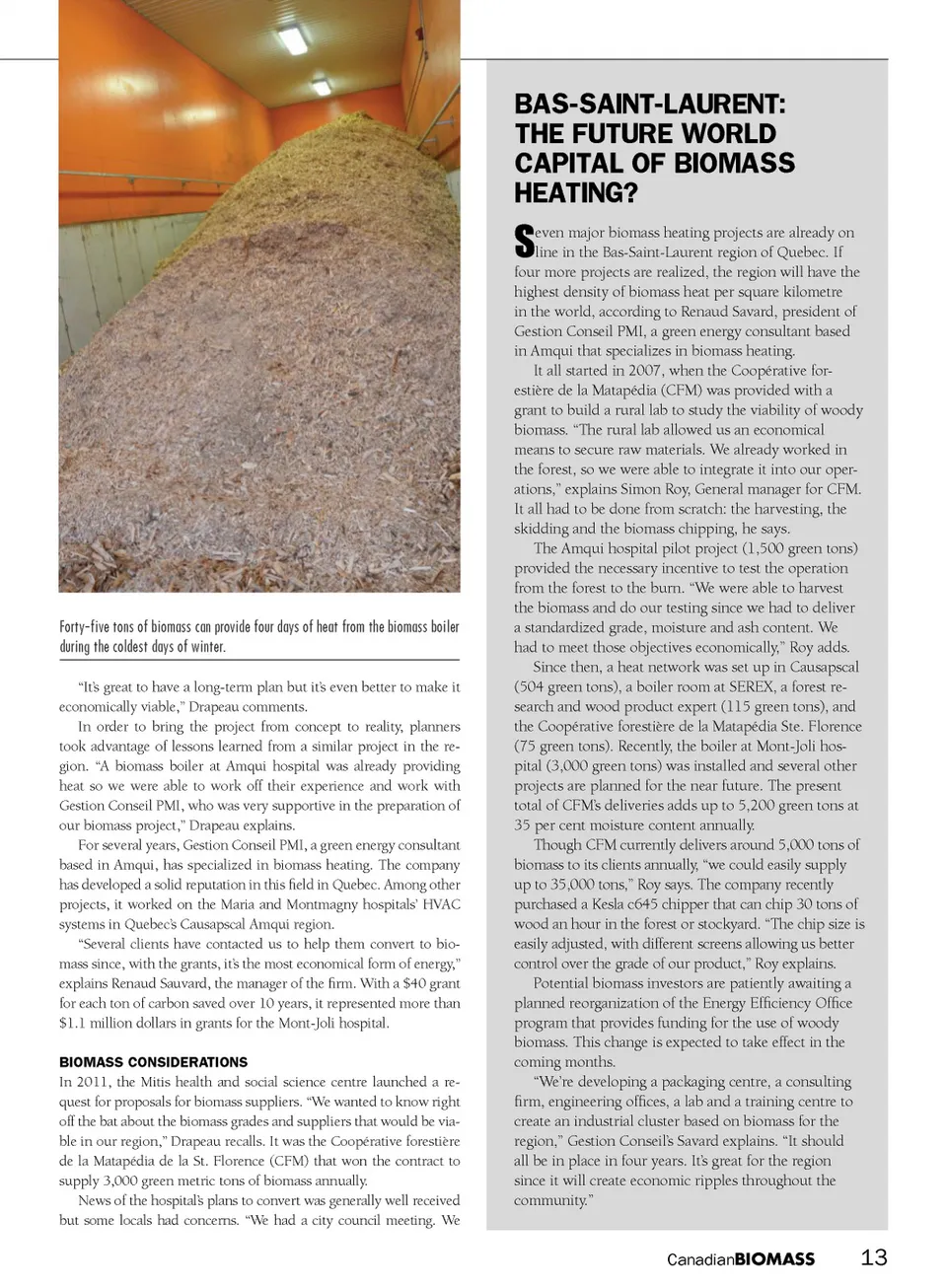
bas-saint-laurent: tHe future world caPital of biomass Heating? S Forty-five tons of biomass can provide four days of heat from the biomass boiler during the coldest days of winter. “It’s great to have a long-term plan but it’s even better to make it economically viable,” Drapeau comments. In order to bring the project from concept to reality, planners took advantage of lessons learned from a similar project in the re-gion. “A biomass boiler at Amqui hospital was already providing heat so we were able to work off their experience and work with Gestion Conseil PMI, who was very supportive in the preparation of our biomass project,” Drapeau explains. For several years, Gestion Conseil PMI, a green energy consultant based in Amqui, has specialized in biomass heating. The company has developed a solid reputation in this field in Quebec. Among other projects, it worked on the Maria and Montmagny hospitals’ HVAC systems in Quebec’s Causapscal Amqui region. “Several clients have contacted us to help them convert to bio-mass since, with the grants, it’s the most economical form of energy,” explains Renaud Sauvard, the manager of the firm. With a $40 grant for each ton of carbon saved over 10 years, it represented more than $1.1 million dollars in grants for the Mont-Joli hospital. Biomass considerations In 2011, the Mitis health and social science centre launched a re-quest for proposals for biomass suppliers. “We wanted to know right off the bat about the biomass grades and suppliers that would be via-ble in our region,” Drapeau recalls. It was the Coopérative forestière de la Matapédia de la St. Florence (CFM) that won the contract to supply 3,000 green metric tons of biomass annually. News of the hospital’s plans to convert was generally well received but some locals had concerns. “We had a city council meeting. We even major biomass heating projects are already on line in the Bas-Saint-Laurent region of Quebec. If four more projects are realized, the region will have the highest density of biomass heat per square kilometre in the world, according to Renaud Savard, president of Gestion Conseil PMI, a green energy consultant based in Amqui that specializes in biomass heating. It all started in 2007, when the Coopérative for-estière de la Matapédia (CFM) was provided with a grant to build a rural lab to study the viability of woody biomass. “The rural lab allowed us an economical means to secure raw materials. We already worked in the forest, so we were able to integrate it into our oper-ations,” explains Simon Roy, General manager for CFM. It all had to be done from scratch: the harvesting, the skidding and the biomass chipping, he says. The Amqui hospital pilot project (1,500 green tons) provided the necessary incentive to test the operation from the forest to the burn. “We were able to harvest the biomass and do our testing since we had to deliver a standardized grade, moisture and ash content. We had to meet those objectives economically,” Roy adds. Since then, a heat network was set up in Causapscal (504 green tons), a boiler room at SEREX, a forest re-search and wood product expert (115 green tons), and the Coopérative forestière de la Matapédia Ste. Florence (75 green tons). Recently, the boiler at Mont-Joli hos-pital (3,000 green tons) was installed and several other projects are planned for the near future. The present total of CFM’s deliveries adds up to 5,200 green tons at 35 per cent moisture content annually. Though CFM currently delivers around 5,000 tons of biomass to its clients annually, “we could easily supply up to 35,000 tons,” Roy says. The company recently purchased a Kesla c645 chipper that can chip 30 tons of wood an hour in the forest or stockyard. “The chip size is easily adjusted, with different screens allowing us better control over the grade of our product,” Roy explains. Potential biomass investors are patiently awaiting a planned reorganization of the Energy Efficiency Office program that provides funding for the use of woody biomass. This change is expected to take effect in the coming months. “We’re developing a packaging centre, a consulting firm, engineering offices, a lab and a training centre to create an industrial cluster based on biomass for the region,” Gestion Conseil’s Savard explains. “It should all be in place in four years. It’s great for the region since it will create economic ripples throughout the community.” Canadian BIOMASS 13
Canadian Biomass November/December 2013: Page 13