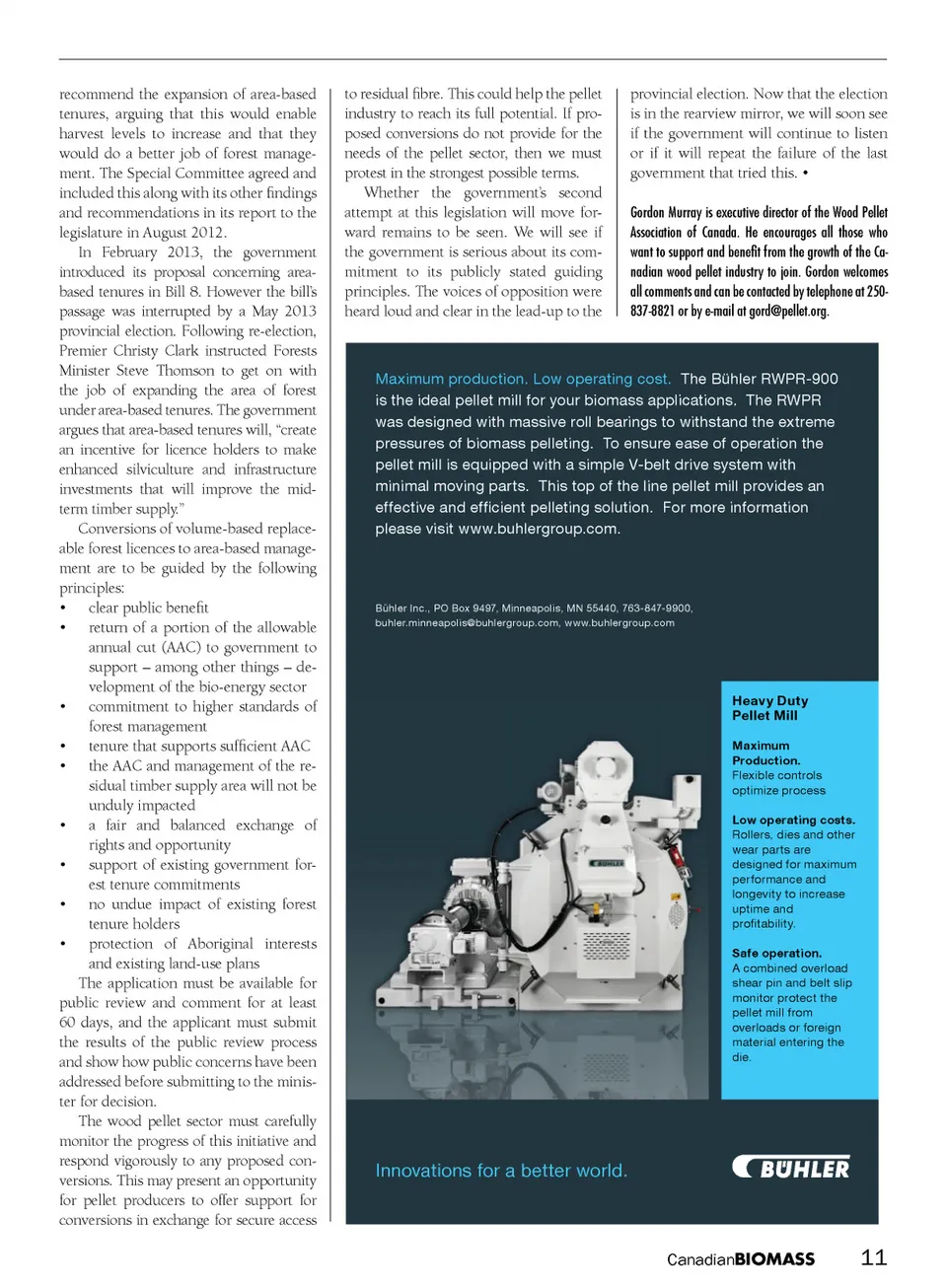
WPAC Report Voicing opposition The wood pellet sector must monitor the progress of government initiatives that may limit fibre supply. By Gordon Murray hilosopher George Santayana fa-mously said, “Those who cannot remember the past are condemned to repeat it.” British Columbia’s forests are owned mostly by the Province: with about 95 per cent being in public ownership. Ap-proximately 80 per cent of forests are under “volume-based” tenures, where a tenure holder is typically one of many P having rights to a specific volume of tim-ber within a timber supply area. The re-maining 20 per cent of forests are under “area-based” tenures – in First Nations woodland licences, tree farm licences, community forest agreements or woodlot licences. The Social Credit party governed B.C. during the 1980s. In 1983, Premier Bill Bennett and the B.C. Council of Forest Industries met secretly to hatch a plan to convert volume-based forest licences to area-based tree farm licences. While it took some time for the plan to ma-terialize, by 1988-89, the government began encouraging the industry to sub-mit applications to roll over their forest licences into tree farm licences. How-ever, the government was met with pub-lic outrage at what was perceived to be a massive giveaway of the public’s resource. Then-provincial for-est critic and MLA for Prince Rupert, Dan Miller, called it “privatization on a massive scale” and warned: “Never be-fore in the history of the province has this kind of giveaway been contemplated.” The Socreds were forced to hold a se-ries of public meet-ings throughout the province, and For-ests Minister David Parker was not only forced to disclose to the public the names of the 54 companies involved in the 122 applications, but also to release a “secret” map showing their areas. Unrelenting opposition from First Nations, hundreds of community and environmental organizations, academics, professionals, forestry workers, the NDP opposition, and the general public resulted in a media backlash, stopped the roll-over process, and ultimately precipitated the defeat of the government and the ul-timate disintegration of the Social Credit party in September 1991. Now, a quarter of a century later, the Liberal party is in power in B.C. and embarking on the very same initiative. After being lobbied by B.C.’s largest forest companies, the Liberals are now work-ing to enable them to convert their vol-ume-based forest licences to area-based tree farm licences. Premier Christy Clark has instructed Forests Minister Steve Thomson to pursue this as a high priority. So why does this matter to the wood pellet industry? The answer is simple. Just five companies dominate control over B.C.’s public forests – Canadian Forest Products, West Fraser Timber, International Forest Products, Tolko In-dustries and Western Forest Products. Converting volume-based forest licences to area-based tree farm licences will in-crease the power and control of these five companies and has the potential to fur-ther deteriorate the pellet sector’s ability to access the low-quality fibre it needs as feedstock. How did the government come to resurrect this old initative? It started on May 16, 2012, when B.C.’s Legislative Assembly appointed a Special Commit-tee on Timber Supply to “examine and make recommendations with respect to mid-term timber supply for British Co-lumbia resulting from the pine beetle epi-demic-related loss of timber supply in the central interior, and to conduct consulta-tions on this issue with the public and lo-cal governments, including communities and First Nations, by means the Special Committee considers appropriate...” Major firms, such as West Fraser Mills Ltd., lobbied the Special Committee to NOVEMBER/DECEMBER 2013 10 Canadian BIOMASS
Canadian Biomass November/December 2013: Page 10