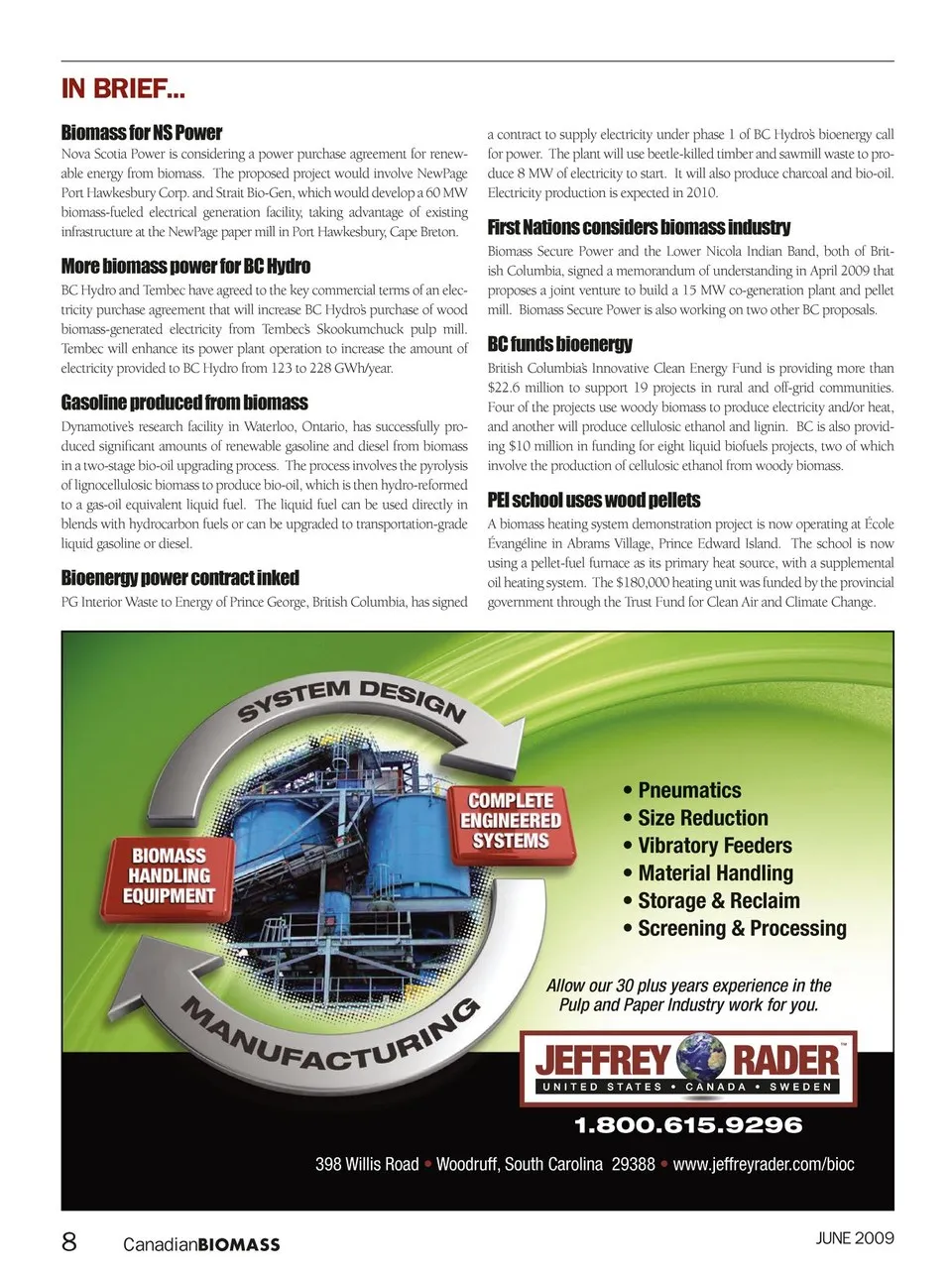
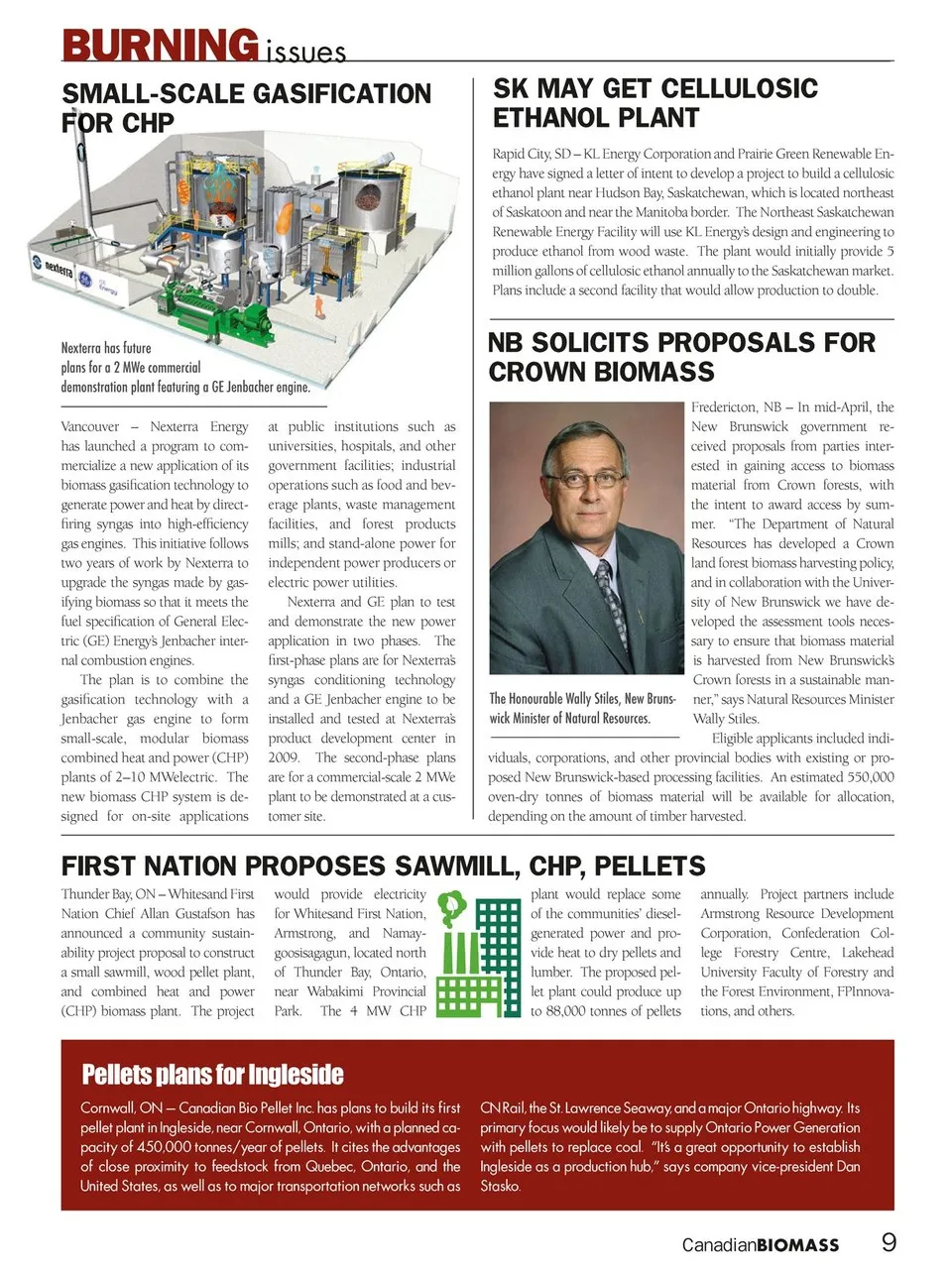
BURNINGissues Small-Scale gaSification for chp Sk may get celluloSic ethanol plant Rapid City, SD – KL Energy Corporation and Prairie Green Renewable En- ergy have signed a letter of intent to develop a project to build a cellulosic ethanol plant near Hudson Bay, Saskatchewan, which is located northeast of Saskatoon and near the Manitoba border. The Northeast Saskatchewan Renewable Energy Facility will use KL Energy’s design and engineering to produce ethanol from wood waste. The plant would initially provide 5 million gallons of cellulosic ethanol annually to the Saskatchewan market. Plans include a second facility that would allow production to double. Nexterra has future plans for a 2 MWe commercial demonstration plant featuring a GE Jenbacher engine. Vancouver – Nexterra Energy has launched a program to com- mercialize a new application of its biomass gasification technology to generate power and heat by direct- firing syngas into high-efficiency gas engines. This initiative follows two years of work by Nexterra to upgrade the syngas made by gas- ifying biomass so that it meets the fuel specification of General Elec- tric (GE) Energy’s Jenbacher inter- nal combustion engines. The plan is to combine the gasification technology with a Jenbacher gas engine to form small-scale, modular biomass combined heat and power (CHP) plants of 2–10 MWelectric. The new biomass CHP system is de- signed for on-site applications at public institutions such as universities, hospitals, and other government facilities; industrial operations such as food and bev- erage plants, waste management facilities, and forest products mills; and stand-alone power for independent power producers or electric power utilities. Nexterra and GE plan to test and demonstrate the new power application in two phases. The first-phase plans are for Nexterra’s syngas conditioning technology and a GE Jenbacher engine to be installed and tested at Nexterra’s product development center in 2009. The second-phase plans are for a commercial-scale 2 MWe plant to be demonstrated at a cus- tomer site. nB SolicitS propoSalS for crown BiomaSS The Honourable Wally Stiles, New Bruns- wick Minister of Natural Resources. Fredericton, NB – In mid-April, the New Brunswick government re- ceived proposals from parties inter- ested in gaining access to biomass material from Crown forests, with the intent to award access by sum- mer. “The Department of Natural Resources has developed a Crown land forest biomass harvesting policy, and in collaboration with the Univer- sity of New Brunswick we have de- veloped the assessment tools neces- sary to ensure that biomass material is harvested from New Brunswick’s Crown forests in a sustainable man- ner,” says Natural Resources Minister Wally Stiles. Eligible applicants included indi- viduals, corporations, and other provincial bodies with existing or pro- posed New Brunswick-based processing facilities. An estimated 550,000 oven-dry tonnes of biomass material will be available for allocation, depending on the amount of timber harvested. firSt nation propoSeS Sawmill, chp, pelletS Thunder Bay, ON – Whitesand First Nation Chief Allan Gustafson has announced a community sustain- ability project proposal to construct a small sawmill, wood pellet plant, and combined heat and power (CHP) biomass plant. The project would provide electricity for Whitesand First Nation, Armstrong, and Namay- goosisagagun, located north of Thunder Bay, Ontario, near Wabakimi Provincial Park. The 4 MW CHP Pellets plans for Ingleside Cornwall, ON – Canadian Bio Pellet Inc. has plans to build its first pellet plant in Ingleside, near Cornwall, Ontario, with a planned ca- pacity of 450,000 tonnes/year of pellets. It cites the advantages of close proximity to feedstock from Quebec, Ontario, and the United States, as well as to major transportation networks such as CN Rail, the St. Lawrence Seaway, and a major Ontario highway. Its primary focus would likely be to supply Ontario Power Generation with pellets to replace coal. “It’s a great opportunity to establish Ingleside as a production hub,” says company vice-president Dan Stasko. CanadianBIOMASS 9 plant would replace some of the communities’ diesel- generated power and pro- vide heat to dry pellets and lumber. The proposed pel- let plant could produce up to 88,000 tonnes of pellets annually. Project partners include Armstrong Resource Development Corporation, Confederation Col- lege Forestry Centre, Lakehead University Faculty of Forestry and the Forest Environment, FPInnova- tions, and others.
Canadian Biomass June 2009: Page 9