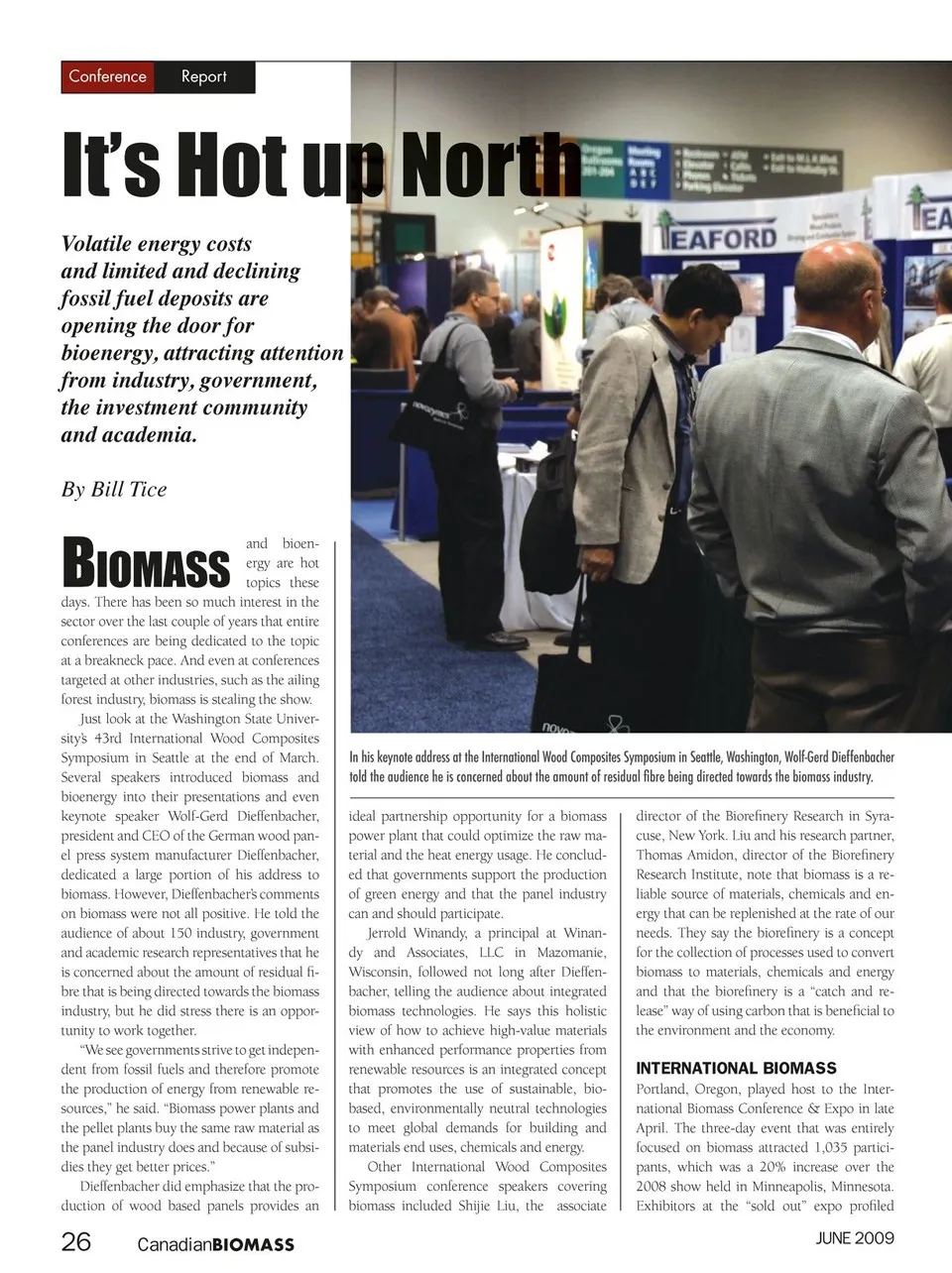
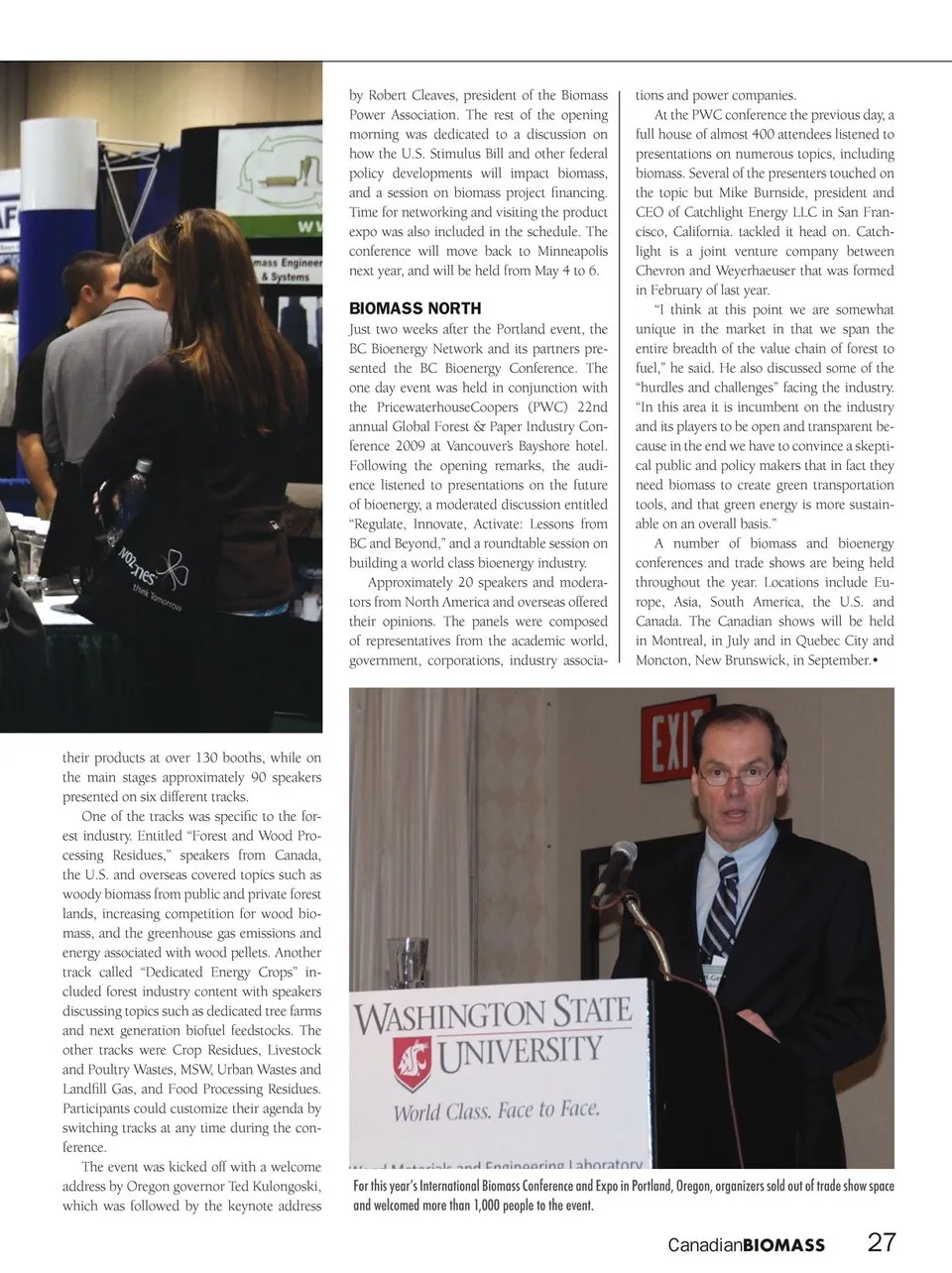
by Robert Cleaves, president of the Biomass Power Association. The rest of the opening morning was dedicated to a discussion on how the U.S. Stimulus Bill and other federal policy developments will impact biomass, and a session on biomass project financing. Time for networking and visiting the product expo was also included in the schedule. The conference will move back to Minneapolis next year, and will be held from May 4 to 6. BiomaSS north Just two weeks after the Portland event, the BC Bioenergy Network and its partners pre- sented the BC Bioenergy Conference. The one day event was held in conjunction with the PricewaterhouseCoopers (PWC) 22nd annual Global Forest & Paper Industry Con- ference 2009 at Vancouver’s Bayshore hotel. Following the opening remarks, the audi- ence listened to presentations on the future of bioenergy, a moderated discussion entitled “Regulate, Innovate, Activate: Lessons from BC and Beyond,” and a roundtable session on building a world class bioenergy industry. Approximately 20 speakers and modera- tors from North America and overseas offered their opinions. The panels were composed of representatives from the academic world, government, corporations, industry associa- tions and power companies. At the PWC conference the previous day, a full house of almost 400 attendees listened to presentations on numerous topics, including biomass. Several of the presenters touched on the topic but Mike Burnside, president and CEO of Catchlight Energy LLC in San Fran- cisco, California. tackled it head on. Catch- light is a joint venture company between Chevron and Weyerhaeuser that was formed in February of last year. “I think at this point we are somewhat unique in the market in that we span the entire breadth of the value chain of forest to fuel,” he said. He also discussed some of the “hurdles and challenges” facing the industry. “In this area it is incumbent on the industry and its players to be open and transparent be- cause in the end we have to convince a skepti- cal public and policy makers that in fact they need biomass to create green transportation tools, and that green energy is more sustain- able on an overall basis.” A number of biomass and bioenergy conferences and trade shows are being held throughout the year. Locations include Eu- rope, Asia, South America, the U.S. and Canada. The Canadian shows will be held in Montreal, in July and in Quebec City and Moncton, New Brunswick, in September.• their products at over 130 booths, while on the main stages approximately 90 speakers presented on six different tracks. One of the tracks was specific to the for- est industry. Entitled “Forest and Wood Pro- cessing Residues,” speakers from Canada, the U.S. and overseas covered topics such as woody biomass from public and private forest lands, increasing competition for wood bio- mass, and the greenhouse gas emissions and energy associated with wood pellets. Another track called “Dedicated Energy Crops” in- cluded forest industry content with speakers discussing topics such as dedicated tree farms and next generation biofuel feedstocks. The other tracks were Crop Residues, Livestock and Poultry Wastes, MSW, Urban Wastes and Landfill Gas, and Food Processing Residues. Participants could customize their agenda by switching tracks at any time during the con- ference. The event was kicked off with a welcome address by Oregon governor Ted Kulongoski, which was followed by the keynote address For this year’s International Biomass Conference and Expo in Portland, Oregon, organizers sold out of trade show space and welcomed more than 1,000 people to the event. CanadianBIOMASS 27
Canadian Biomass June 2009: Page 27