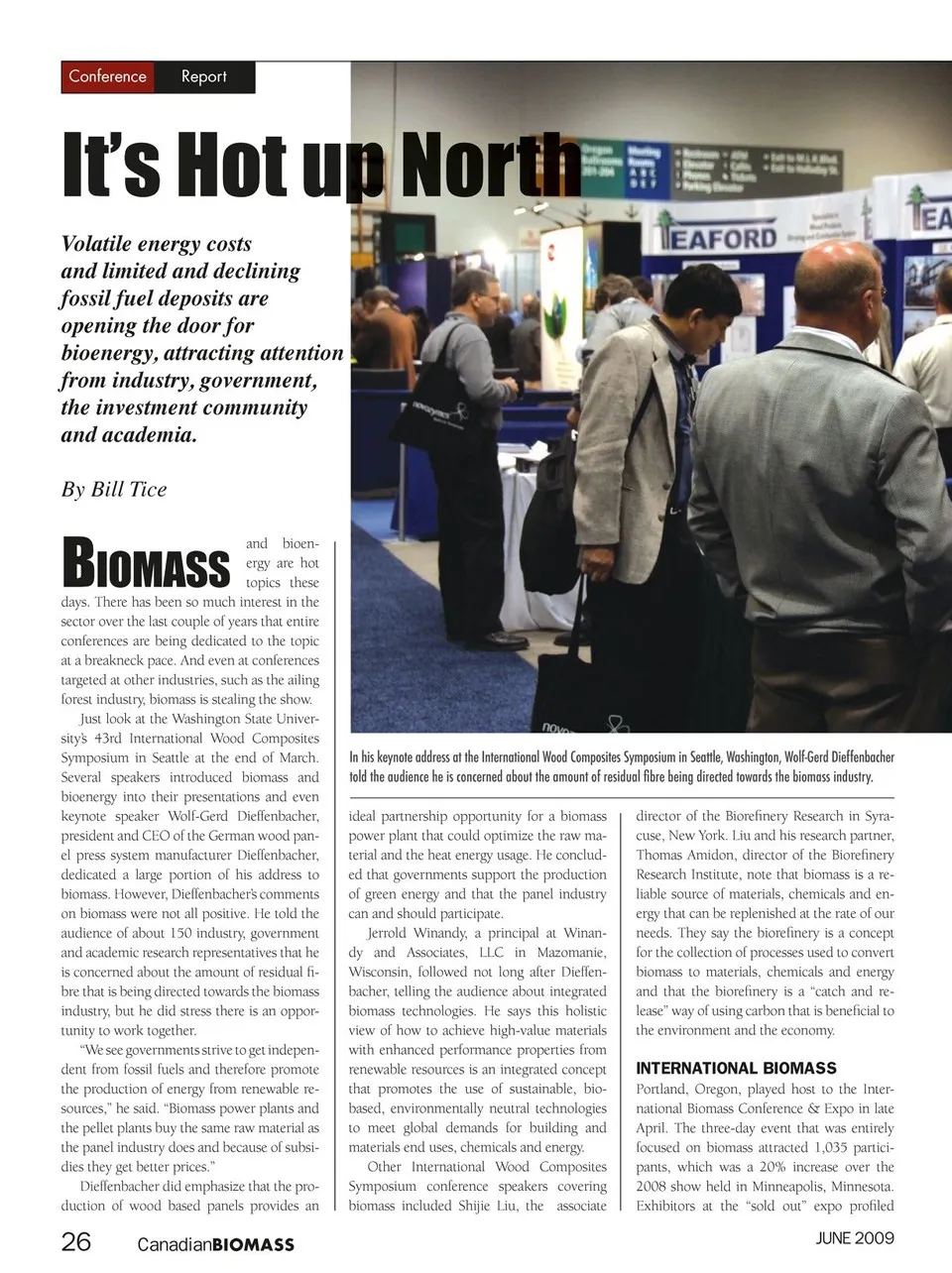
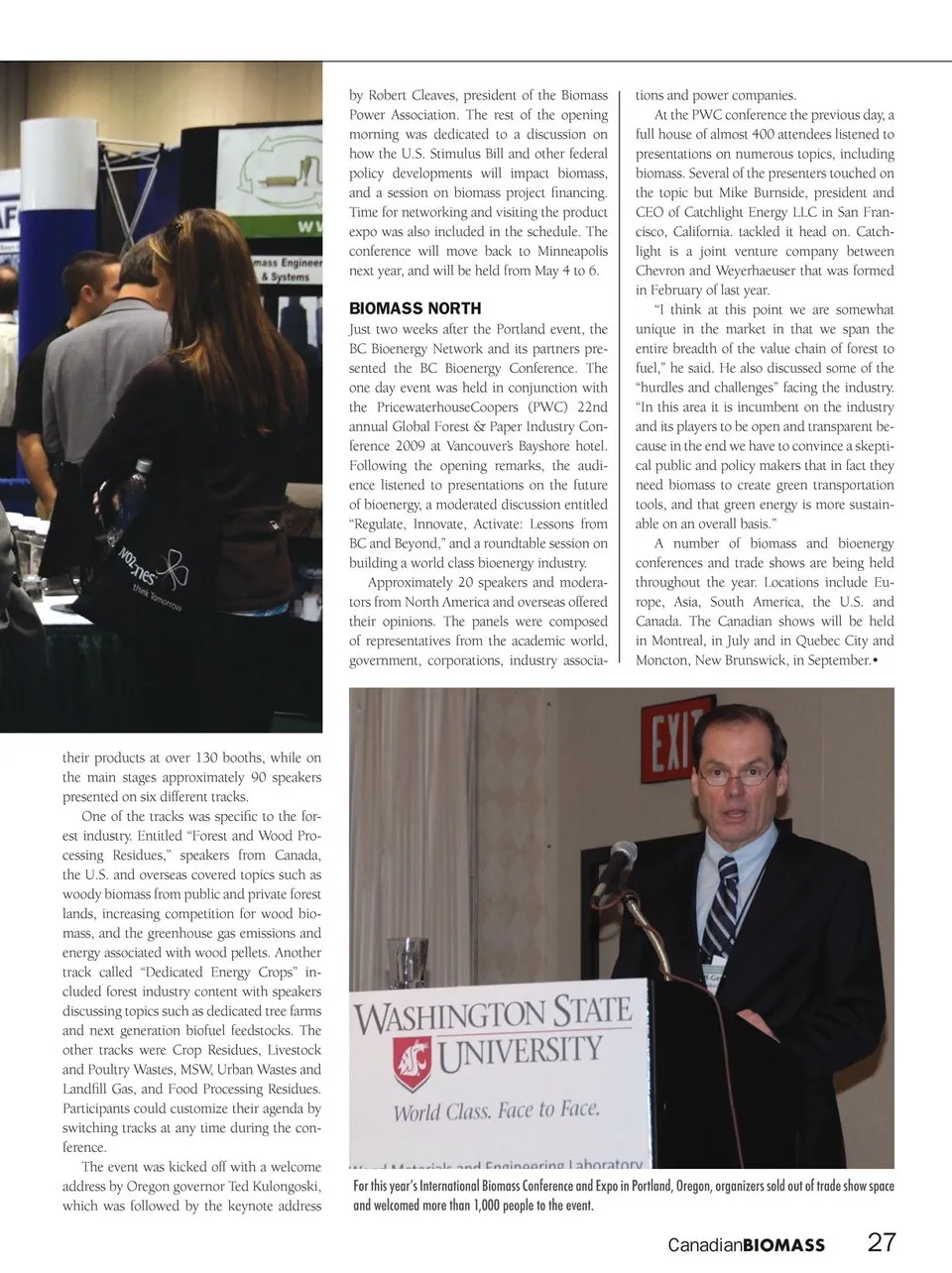
Conference Report It’s Hot up North Volatile energy costs and limited and declining fossil fuel deposits are opening the door for bioenergy, attracting attention from industry, government, the investment community and academia. By Bill Tice days. There has been so much interest in the sector over the last couple of years that entire conferences are being dedicated to the topic at a breakneck pace. And even at conferences targeted at other industries, such as the ailing forest industry, biomass is stealing the show. Just look at the Washington State Univer- BIomass sity’s 43rd International Wood Composites Symposium in Seattle at the end of March. Several speakers introduced biomass and bioenergy into their presentations and even keynote speaker Wolf-Gerd Dieffenbacher, president and CEO of the German wood pan- el press system manufacturer Dieffenbacher, dedicated a large portion of his address to biomass. However, Dieffenbacher’s comments on biomass were not all positive. He told the audience of about 150 industry, government and academic research representatives that he is concerned about the amount of residual fi- bre that is being directed towards the biomass industry, but he did stress there is an oppor- tunity to work together. “We see governments strive to get indepen- dent from fossil fuels and therefore promote the production of energy from renewable re- sources,” he said. “Biomass power plants and the pellet plants buy the same raw material as the panel industry does and because of subsi- dies they get better prices.” Dieffenbacher did emphasize that the pro- duction of wood based panels provides an 26 CanadianBIOMASS In his keynote address at the International Wood Composites Symposium in Seattle, Washington, Wolf-Gerd Dieffenbacher told the audience he is concerned about the amount of residual fibre being directed towards the biomass industry. ideal partnership opportunity for a biomass power plant that could optimize the raw ma- terial and the heat energy usage. He conclud- ed that governments support the production of green energy and that the panel industry can and should participate. Jerrold Winandy, a principal at Winan- dy and Associates, LLC in Mazomanie, Wisconsin, followed not long after Dieffen- bacher, telling the audience about integrated biomass technologies. He says this holistic view of how to achieve high-value materials with enhanced performance properties from renewable resources is an integrated concept that promotes the use of sustainable, bio- based, environmentally neutral technologies to meet global demands for building and materials end uses, chemicals and energy. Other International Wood Composites Symposium conference speakers covering biomass included Shijie Liu, the associate director of the Biorefinery Research in Syra- cuse, New York. Liu and his research partner, Thomas Amidon, director of the Biorefinery Research Institute, note that biomass is a re- liable source of materials, chemicals and en- ergy that can be replenished at the rate of our needs. They say the biorefinery is a concept for the collection of processes used to convert biomass to materials, chemicals and energy and that the biorefinery is a “catch and re- lease” way of using carbon that is beneficial to the environment and the economy. international BiomaSS Portland, Oregon, played host to the Inter- national Biomass Conference & Expo in late April. The three-day event that was entirely focused on biomass attracted 1,035 partici- pants, which was a 20% increase over the 2008 show held in Minneapolis, Minnesota. Exhibitors at the “sold out” expo profiled JUNE 2009 and bioen- ergy are hot topics these
Canadian Biomass June 2009: Page 26