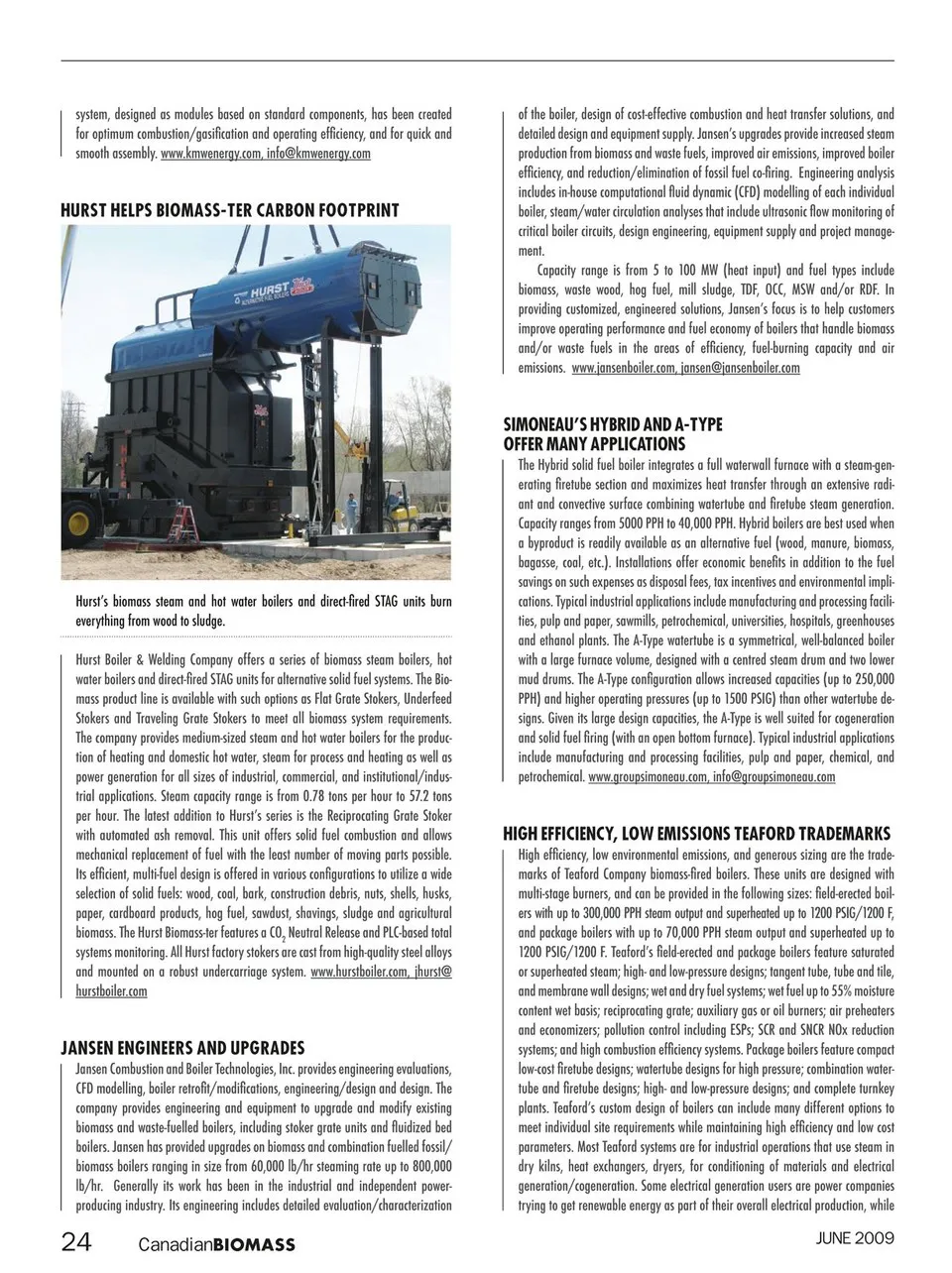
system, designed as modules based on standard components, has been created for optimum combustion/gasification and operating efficiency, and for quick and smooth assembly. www.kmwenergy.com, [email protected] HURST HELPS BIOMASS-TER CARBON FOOTPRINT of the boiler, design of cost-effective combustion and heat transfer solutions, and detailed design and equipment supply. Jansen’s upgrades provide increased steam production from biomass and waste fuels, improved air emissions, improved boiler efficiency, and reduction/elimination of fossil fuel co-firing. Engineering analysis includes in-house computational fluid dynamic (CFD) modelling of each individual boiler, steam/water circulation analyses that include ultrasonic flow monitoring of critical boiler circuits, design engineering, equipment supply and project manage- ment. Capacity range is from 5 to 100 MW (heat input) and fuel types include biomass, waste wood, hog fuel, mill sludge, TDF, OCC, MSW and/or RDF. In providing customized, engineered solutions, Jansen’s focus is to help customers improve operating performance and fuel economy of boilers that handle biomass and/or waste fuels in the areas of efficiency, fuel-burning capacity and air emissions. www.jansenboiler.com, [email protected] Hurst’s biomass steam and hot water boilers and direct-fired STAG units burn everything from wood to sludge. Hurst Boiler & Welding Company offers a series of biomass steam boilers, hot water boilers and direct-fired STAG units for alternative solid fuel systems. The Bio- mass product line is available with such options as Flat Grate Stokers, Underfeed Stokers and Traveling Grate Stokers to meet all biomass system requirements. The company provides medium-sized steam and hot water boilers for the produc- tion of heating and domestic hot water, steam for process and heating as well as power generation for all sizes of industrial, commercial, and institutional/indus- trial applications. Steam capacity range is from 0.78 tons per hour to 57.2 tons per hour. The latest addition to Hurst’s series is the Reciprocating Grate Stoker with automated ash removal. This unit offers solid fuel combustion and allows mechanical replacement of fuel with the least number of moving parts possible. Its efficient, multi-fuel design is offered in various configurations to utilize a wide selection of solid fuels: wood, coal, bark, construction debris, nuts, shells, husks, paper, cardboard products, hog fuel, sawdust, shavings, sludge and agricultural biomass. The Hurst Biomass-ter features a CO2 Neutral Release and PLC-based total systems monitoring. All Hurst factory stokers are cast from high-quality steel alloys and mounted on a robust undercarriage system. www.hurstboiler.com, jhurst@ hurstboiler.com JANSEN ENGINEERS AND UPGRADES Jansen Combustion and Boiler Technologies, Inc. provides engineering evaluations, CFD modelling, boiler retrofit/modifications, engineering/design and design. The company provides engineering and equipment to upgrade and modify existing biomass and waste-fuelled boilers, including stoker grate units and fluidized bed boilers. Jansen has provided upgrades on biomass and combination fuelled fossil/ biomass boilers ranging in size from 60,000 lb/hr steaming rate up to 800,000 lb/hr. Generally its work has been in the industrial and independent power- producing industry. Its engineering includes detailed evaluation/characterization 24 CanadianBIOMASS SIMONEAU’S HYBRID AND A-TYPE OFFER MANY APPLICATIONS The Hybrid solid fuel boiler integrates a full waterwall furnace with a steam-gen- erating firetube section and maximizes heat transfer through an extensive radi- ant and convective surface combining watertube and firetube steam generation. Capacity ranges from 5000 PPH to 40,000 PPH. Hybrid boilers are best used when a byproduct is readily available as an alternative fuel (wood, manure, biomass, bagasse, coal, etc.). Installations offer economic benefits in addition to the fuel savings on such expenses as disposal fees, tax incentives and environmental impli- cations. Typical industrial applications include manufacturing and processing facili- ties, pulp and paper, sawmills, petrochemical, universities, hospitals, greenhouses and ethanol plants. The A-Type watertube is a symmetrical, well-balanced boiler with a large furnace volume, designed with a centred steam drum and two lower mud drums. The A-Type configuration allows increased capacities (up to 250,000 PPH) and higher operating pressures (up to 1500 PSIG) than other watertube de- signs. Given its large design capacities, the A-Type is well suited for cogeneration and solid fuel firing (with an open bottom furnace). Typical industrial applications include manufacturing and processing facilities, pulp and paper, chemical, and petrochemical. www.groupsimoneau.com, [email protected] HIGH EFFICIENCY, LOW EMISSIONS TEAFORD TRADEMARKS High efficiency, low environmental emissions, and generous sizing are the trade- marks of Teaford Company biomass-fired boilers. These units are designed with multi-stage burners, and can be provided in the following sizes: field-erected boil- ers with up to 300,000 PPH steam output and superheated up to 1200 PSIG/1200 F, and package boilers with up to 70,000 PPH steam output and superheated up to 1200 PSIG/1200 F. Teaford’s field-erected and package boilers feature saturated or superheated steam; high- and low-pressure designs; tangent tube, tube and tile, and membrane wall designs; wet and dry fuel systems; wet fuel up to 55% moisture content wet basis; reciprocating grate; auxiliary gas or oil burners; air preheaters and economizers; pollution control including ESPs; SCR and SNCR NOx reduction systems; and high combustion efficiency systems. Package boilers feature compact low-cost firetube designs; watertube designs for high pressure; combination water- tube and firetube designs; high- and low-pressure designs; and complete turnkey plants. Teaford’s custom design of boilers can include many different options to meet individual site requirements while maintaining high efficiency and low cost parameters. Most Teaford systems are for industrial operations that use steam in dry kilns, heat exchangers, dryers, for conditioning of materials and electrical generation/cogeneration. Some electrical generation users are power companies trying to get renewable energy as part of their overall electrical production, while JUNE 2009
Canadian Biomass June 2009: Page 24