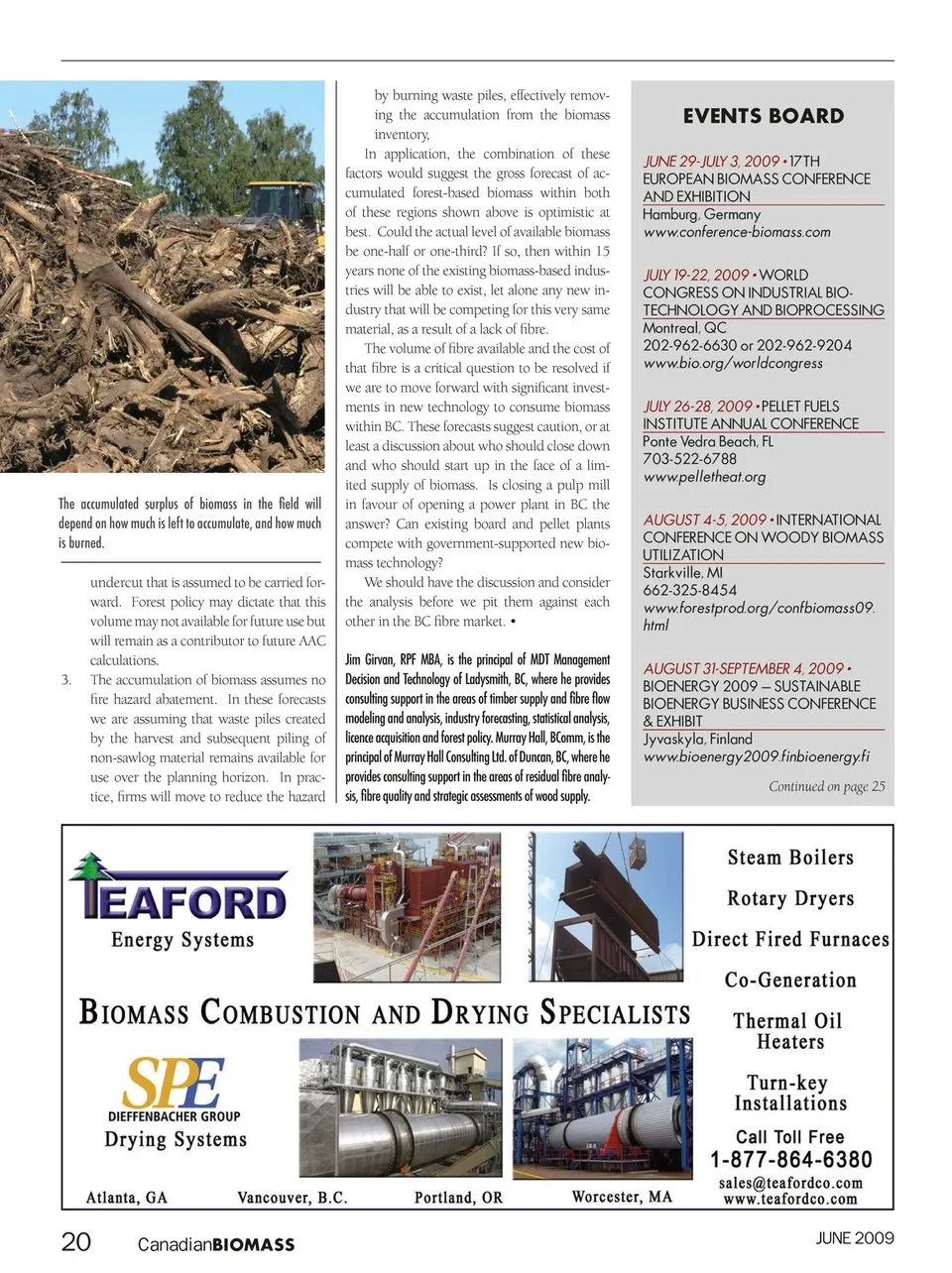
by burning waste piles, effectively remov- ing the accumulation from the biomass inventory, In application, the combination of these factors would suggest the gross forecast of ac- cumulated forest-based biomass within both of these regions shown above is optimistic at best. Could the actual level of available biomass be one-half or one-third? If so, then within 15 years none of the existing biomass-based indus- tries will be able to exist, let alone any new in- dustry that will be competing for this very same material, as a result of a lack of fibre. The volume of fibre available and the cost of The accumulated surplus of biomass in the field will depend on how much is left to accumulate, and how much is burned. undercut that is assumed to be carried for- ward. Forest policy may dictate that this volume may not available for future use but will remain as a contributor to future AAC calculations. 3. The accumulation of biomass assumes no fire hazard abatement. In these forecasts we are assuming that waste piles created by the harvest and subsequent piling of non-sawlog material remains available for use over the planning horizon. In prac- tice, firms will move to reduce the hazard that fibre is a critical question to be resolved if we are to move forward with significant invest- ments in new technology to consume biomass within BC. These forecasts suggest caution, or at least a discussion about who should close down and who should start up in the face of a lim- ited supply of biomass. Is closing a pulp mill in favour of opening a power plant in BC the answer? Can existing board and pellet plants compete with government-supported new bio- mass technology? We should have the discussion and consider the analysis before we pit them against each other in the BC fibre market. • Jim Girvan, RPF MBA, is the principal of MDT Management Decision and Technology of Ladysmith, BC, where he provides consulting support in the areas of timber supply and fibre flow modeling and analysis, industry forecasting, statistical analysis, licence acquisition and forest policy. Murray Hall, BComm, is the principal of Murray Hall Consulting Ltd. of Duncan, BC, where he provides consulting support in the areas of residual fibre analy- sis, fibre quality and strategic assessments of wood supply. EVENTS BOARD JUNE 29-JULY 3, 2009 • 17TH EUROPEAN BIOMASSCONFERENCE ANDEXHIBITION Hamburg, Germany www.conference-biomass.com JULY 19-22, 2009 • WORLD CONGRESS ONINDUSTRIAL BIO- TECHNOLOGY AND BIOPROCESSING Montreal, QC 202-962-6630 or 202-962-9204 www.bio.org/worldcongress JULY 26-28, 2009 • PELLET FUELS INSTITUTEANNUALCONFERENCE Ponte Vedra Beach, FL 703-522-6788 www.pelletheat.org AUGUST 4-5, 2009 • INTERNATIONAL CONFERENCE ONWOODYBIOMASS UTILIzATION Starkville, MI 662-325-8454 www.forestprod.org/confbiomass09. html AUGUST 31-SEPTEMBER 4, 2009 • BIOENERGY2009 – SUSTAINABLE BIOENERGY BUSINESSCONFERENCE & EXHIBIT Jyvaskyla, Finland www.bioenergy2009.finbioenergy.fi Continued on page 25 20 CanadianBIOMASS JUNE 2009
Canadian Biomass June 2009: Page 20