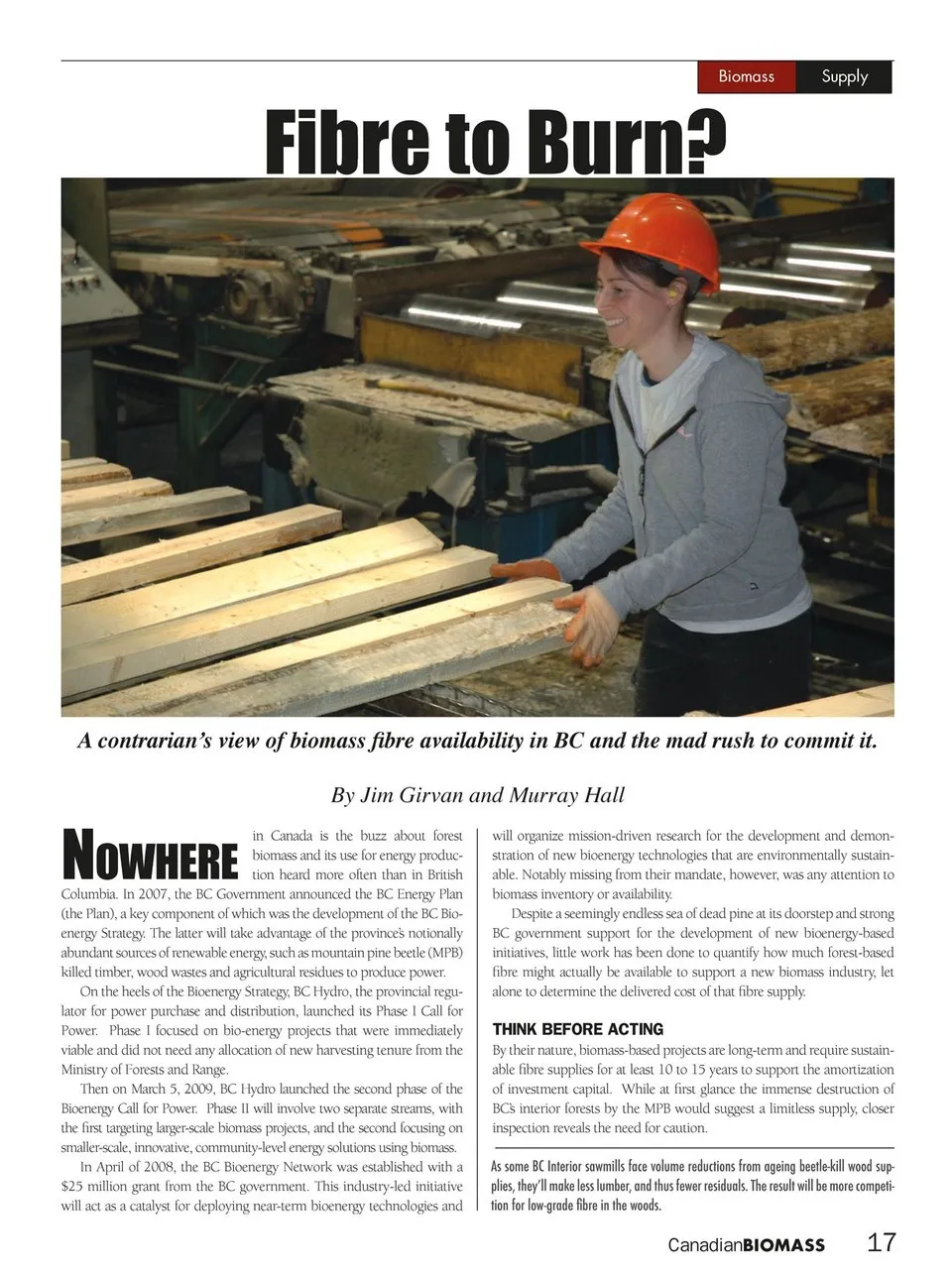
Biomass Fibre to Burn? Supply Acontrarian’s view of biomass fibre availability in BC and the mad rush to commit it. By Jim Girvan and Murray Hall Columbia. In 2007, the BC Government announced the BC Energy Plan (the Plan), a key component of which was the development of the BC Bio- energy Strategy. The latter will take advantage of the province’s notionally abundant sources of renewable energy, such as mountain pine beetle (MPB) killed timber, wood wastes and agricultural residues to produce power. On the heels of the Bioenergy Strategy, BC Hydro, the provincial regu- Nowhere lator for power purchase and distribution, launched its Phase I Call for Power. Phase I focused on bio-energy projects that were immediately viable and did not need any allocation of new harvesting tenure from the Ministry of Forests and Range. Then on March 5, 2009, BC Hydro launched the second phase of the Bioenergy Call for Power. Phase II will involve two separate streams, with the first targeting larger-scale biomass projects, and the second focusing on smaller-scale, innovative, community-level energy solutions using biomass. In April of 2008, the BC Bioenergy Network was established with a $25 million grant from the BC government. This industry-led initiative will act as a catalyst for deploying near-term bioenergy technologies and in Canada is the buzz about forest biomass and its use for energy produc- tion heard more often than in British will organize mission-driven research for the development and demon- stration of new bioenergy technologies that are environmentally sustain- able. Notably missing from their mandate, however, was any attention to biomass inventory or availability. Despite a seemingly endless sea of dead pine at its doorstep and strong BC government support for the development of new bioenergy-based initiatives, little work has been done to quantify how much forest-based fibre might actually be available to support a new biomass industry, let alone to determine the delivered cost of that fibre supply. think Before acting By their nature, biomass-based projects are long-term and require sustain- able fibre supplies for at least 10 to 15 years to support the amortization of investment capital. While at first glance the immense destruction of BC’s interior forests by the MPB would suggest a limitless supply, closer inspection reveals the need for caution. As some BC Interior sawmills face volume reductions from ageing beetle-kill wood sup- plies, they’ll make less lumber, and thus fewer residuals. The result will be more competi- tion for low-grade fibre in the woods. CanadianBIOMASS 17
Canadian Biomass June 2009: Page 17