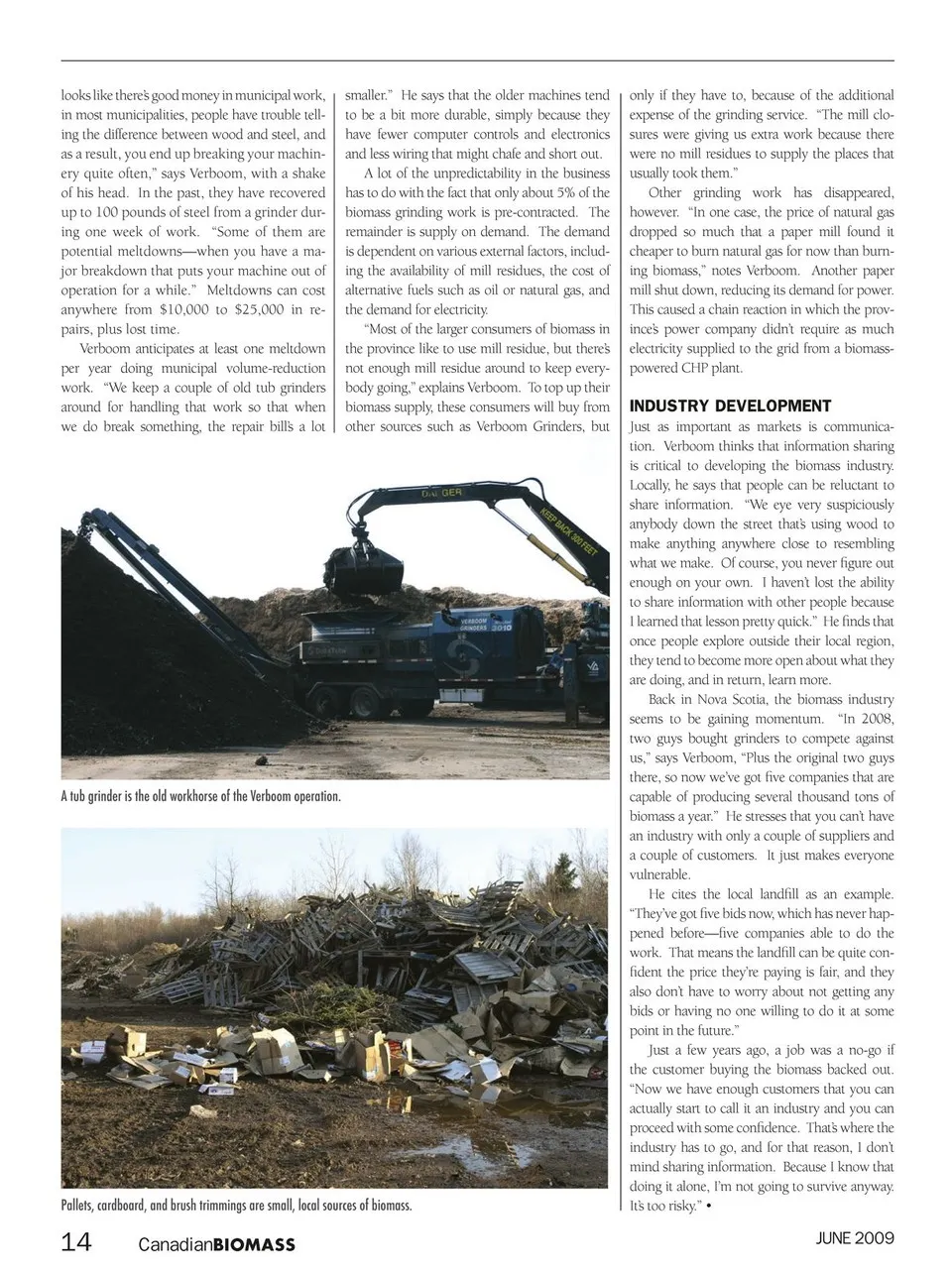
looks like there’s good money in municipal work, in most municipalities, people have trouble tell- ing the difference between wood and steel, and as a result, you end up breaking your machin- ery quite often,” says Verboom, with a shake of his head. In the past, they have recovered up to 100 pounds of steel from a grinder dur- ing one week of work. “Some of them are potential meltdowns—when you have a ma- jor breakdown that puts your machine out of operation for a while.” Meltdowns can cost anywhere from $10,000 to $25,000 in re- pairs, plus lost time. Verboom anticipates at least one meltdown per year doing municipal volume-reduction work. “We keep a couple of old tub grinders around for handling that work so that when we do break something, the repair bill’s a lot smaller.” He says that the older machines tend to be a bit more durable, simply because they have fewer computer controls and electronics and less wiring that might chafe and short out. A lot of the unpredictability in the business has to do with the fact that only about 5% of the biomass grinding work is pre-contracted. The remainder is supply on demand. The demand is dependent on various external factors, includ- ing the availability of mill residues, the cost of alternative fuels such as oil or natural gas, and the demand for electricity. “Most of the larger consumers of biomass in the province like to use mill residue, but there’s not enough mill residue around to keep every- body going,” explains Verboom. To top up their biomass supply, these consumers will buy from other sources such as Verboom Grinders, but only if they have to, because of the additional expense of the grinding service. “The mill clo- sures were giving us extra work because there were no mill residues to supply the places that usually took them.” Other grinding work has disappeared, however. “In one case, the price of natural gas dropped so much that a paper mill found it cheaper to burn natural gas for now than burn- ing biomass,” notes Verboom. Another paper mill shut down, reducing its demand for power. This caused a chain reaction in which the prov- ince’s power company didn’t require as much electricity supplied to the grid from a biomass- powered CHP plant. induStry development Just as important as markets is communica- tion. Verboom thinks that information sharing is critical to developing the biomass industry. Locally, he says that people can be reluctant to share information. “We eye very suspiciously anybody down the street that’s using wood to make anything anywhere close to resembling what we make. Of course, you never figure out enough on your own. I haven’t lost the ability to share information with other people because I learned that lesson pretty quick.” He finds that once people explore outside their local region, they tend to become more open about what they are doing, and in return, learn more. Back in Nova Scotia, the biomass industry A tub grinder is the old workhorse of the Verboom operation. seems to be gaining momentum. “In 2008, two guys bought grinders to compete against looks lik looks lik looks lik looks lik looks lik looks lik looks lik looks lik looks lik looks lik looks lik looks lik looks lik looks lik there’s good money in municipal work, in most municipalities, people have trouble tell- ing the difference between wood and steel, and as a result, you end up breaking your machin- ery quite often ke there’s good money in municipal work, in most municipalities, people have trouble tell- ing the difference between wood and steel, and as a result, you end up breaking your machin- ery quite often,” says Verboom, with a shake of his head. In the past, they have recovered up to 100 pounds of steel from a grinder dur- ing one week of work. “Some of them are potential meltdowns—when you have a ma- jor breakdown that puts your machine out of operation for a while.” Meltdowns can cost anywhere from $10,000 to $25,000 in re- pairs, plus lost time. Verboom anticipates at least one meltdown per year doing municipal volume-reduction work. “We keep a couple of old tub grinders around for handling that work so that when we do break something, the repair bill’s a lot smaller.” He says that the older machines tend to be a bit more durable, simply because they have fewer computer controls and electronics and less wiring that might chafe and short out. A lot of the unpredictability in the business has to do with the fact that only about 5% of the biomass grinding work is pre-contracted. The remainder is supply on demand. The demand is dependent on various external factors, includ- ing the availability of mill residues, the cost of alternative fuels such as oil or natural gas, and the demand for electricity. “Most of the larger consumers of biomass in the province like to use mill residue, but there’s not enough mill residue around to keep every- body going,” explains Verboom. To top up their biomass supply, these consumers will buy from other sources such as Verboom Grinders, but only if they have to, because of the additional expense of the grinding service. “The mill clo- sures were giving us extra work because there were no mill residues to supply the places that usually took them.” Other grinding work has disappeared, however. “In one case, the price of natural gas dropped so much that a paper mill found it cheaper to burn natural gas for now than burn- ing biomass,” notes Verboom. Another paper mill shut down, reducing its demand for power. This caused a chain reaction in which the prov- ince’s power company didn’t require as much electricity supplied to the grid from a biomass- powered CHP plant. induStry development Just as important as markets is communica- tion. Verboom thinks that information sharing is critical to developing the biomass industry. Locally, he says that people can be reluctant to share information. “We eye very suspiciously anybody down the street that’s using wood to make anything anywhere close to resembling what we make. Of course, you never figure out enough on your own. I haven’t lost the ability to share information with other people because I learned that lesson pretty quick.” He finds that once people explore outside their local region, they tend to become more open about what they are doing, and in return, learn more. Back in Nova Scotia, the biomass industry A tub grinder is the old workhorse of the Verboom operation. seems to be gaining momentum. “In 2008, two guys bought grinders to compete against Pallets, Pallets, cardboard, and brush trimmings are small, local sources of biomass. 14 CanadianBIOMASS looks lik looks lik looks lik looks lik looks lik looks lik looks lik
Canadian Biomass June 2009: Page 14