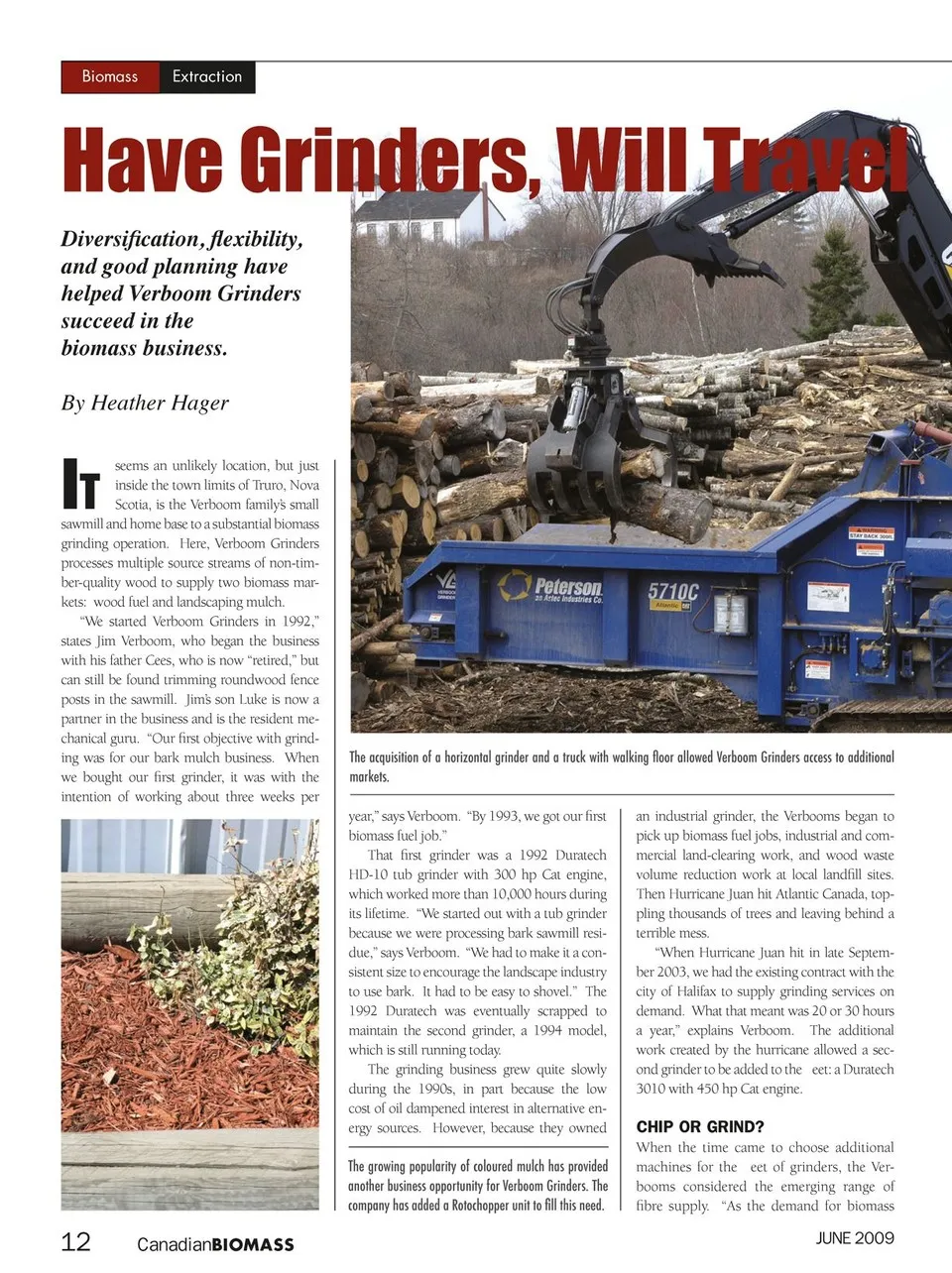
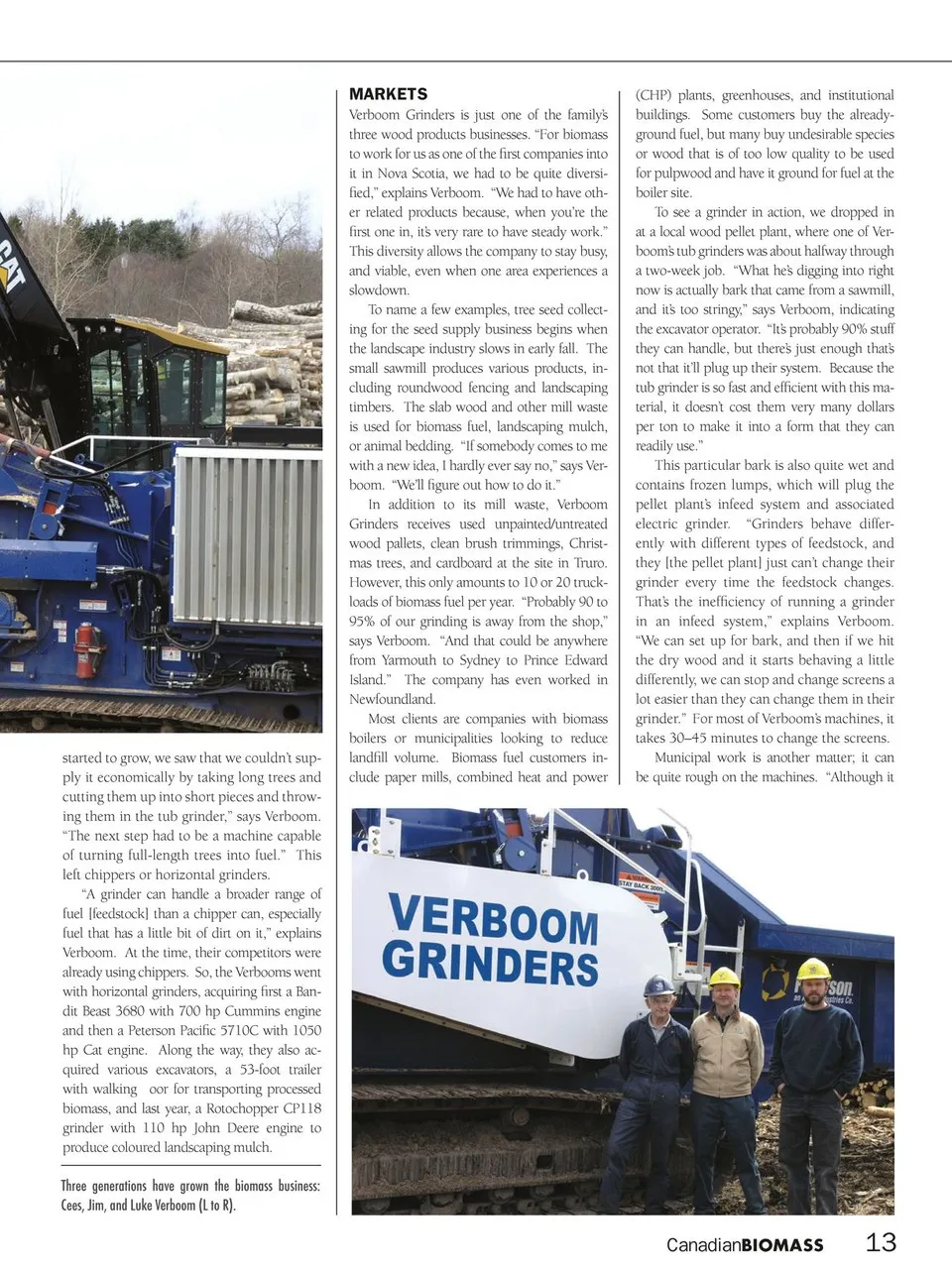
marketS Verboom Grinders is just one of the family’s three wood products businesses. “For biomass to work for us as one of the first companies into it in Nova Scotia, we had to be quite diversi- fied,” explains Verboom. “We had to have oth- er related products because, when you’re the first one in, it’s very rare to have steady work.” This diversity allows the company to stay busy, and viable, even when one area experiences a slowdown. To name a few examples, tree seed collect- ing for the seed supply business begins when the landscape industry slows in early fall. The small sawmill produces various products, in- cluding roundwood fencing and landscaping timbers. The slab wood and other mill waste is used for biomass fuel, landscaping mulch, or animal bedding. “If somebody comes to me with a new idea, I hardly ever say no,” says Ver- boom. “We’ll figure out how to do it.” In addition to its mill waste, Verboom Grinders receives used unpainted/untreated wood pallets, clean brush trimmings, Christ- mas trees, and cardboard at the site in Truro. However, this only amounts to 10 or 20 truck- loads of biomass fuel per year. “Probably 90 to 95% of our grinding is away from the shop,” says Verboom. “And that could be anywhere from Yarmouth to Sydney to Prince Edward Island.” The company has even worked in Newfoundland. Most clients are companies with biomass started to grow, we saw that we couldn’t sup- ply it economically by taking long trees and cutting them up into short pieces and throw- ing them in the tub grinder,” says Verboom. “The next step had to be a machine capable of turning full-length trees into fuel.” This left chippers or horizontal grinders. “A grinder can handle a broader range of fuel [feedstock] than a chipper can, especially fuel that has a little bit of dirt on it,” explains Verboom. At the time, their competitors were already using chippers. So, the Verbooms went with horizontal grinders, acquiring first a Ban- dit Beast 3680 with 700 hp Cummins engine and then a Peterson Pacific 5710C with 1050 hp Cat engine. Along the way, they also ac- quired various excavators, a 53-foot trailer with walking floor for transporting processed biomass, and last year, a Rotochopper CP118 grinder with 110 hp John Deere engine to produce coloured landscaping mulch. Three generations have grown the biomass business: Cees, Jim, and Luke Verboom (L to R). CanadianBIOMASS 13 boilers or municipalities looking to reduce landfill volume. Biomass fuel customers in- clude paper mills, combined heat and power (CHP) plants, greenhouses, and institutional buildings. Some customers buy the already- ground fuel, but many buy undesirable species or wood that is of too low quality to be used for pulpwood and have it ground for fuel at the boiler site. To see a grinder in action, we dropped in at a local wood pellet plant, where one of Ver- boom’s tub grinders was about halfway through a two-week job. “What he’s digging into right now is actually bark that came from a sawmill, and it’s too stringy,” says Verboom, indicating the excavator operator. “It’s probably 90% stuff they can handle, but there’s just enough that’s not that it’ll plug up their system. Because the tub grinder is so fast and efficient with this ma- terial, it doesn’t cost them very many dollars per ton to make it into a form that they can readily use.” This particular bark is also quite wet and contains frozen lumps, which will plug the pellet plant’s infeed system and associated electric grinder. “Grinders behave differ- ently with different types of feedstock, and they [the pellet plant] just can’t change their grinder every time the feedstock changes. That’s the inefficiency of running a grinder in an infeed system,” explains Verboom. “We can set up for bark, and then if we hit the dry wood and it starts behaving a little differently, we can stop and change screens a lot easier than they can change them in their grinder.” For most of Verboom’s machines, it takes 30–45 minutes to change the screens. Municipal work is another matter; it can be quite rough on the machines. “Although it
Canadian Biomass June 2009: Page 13