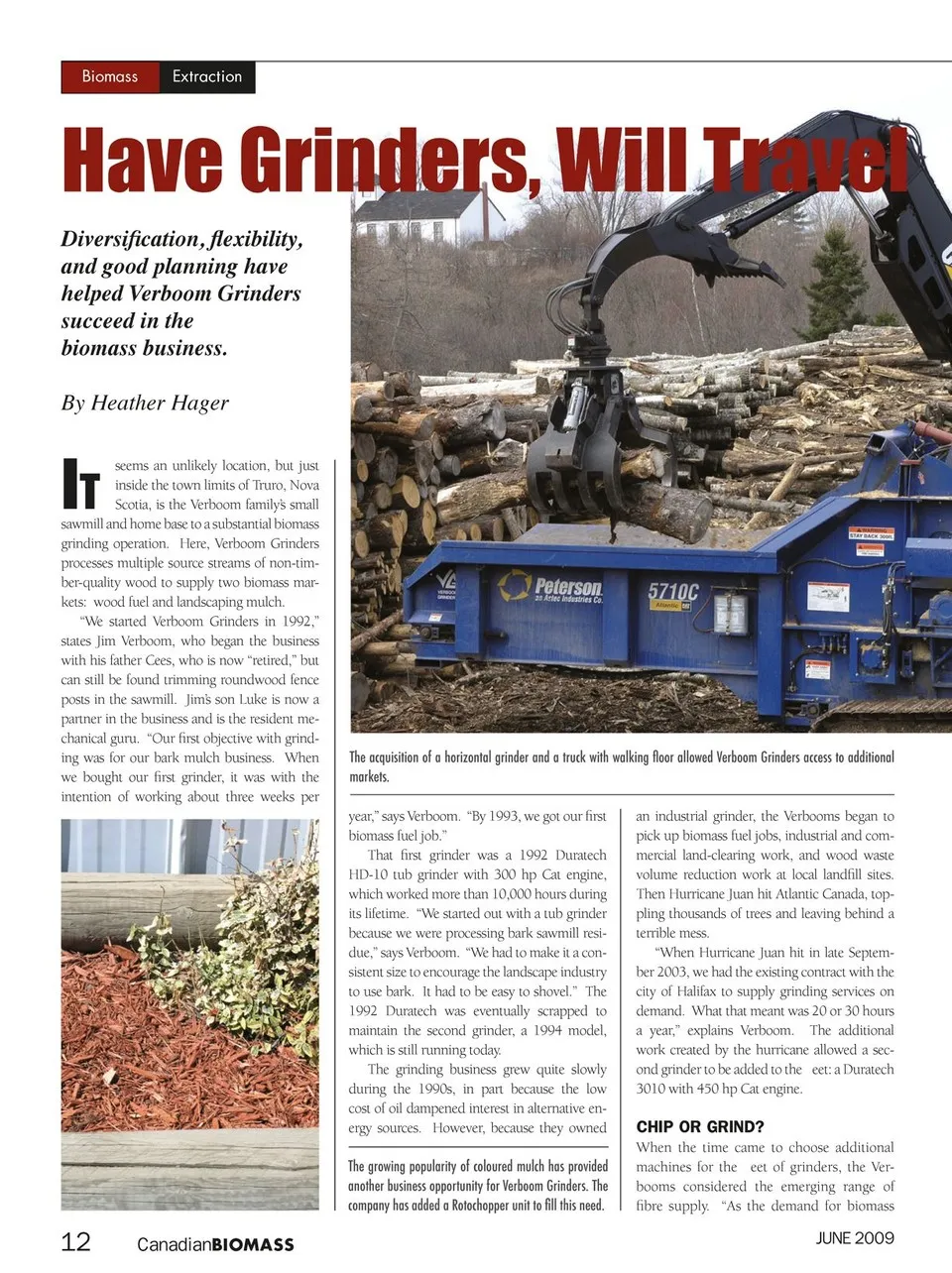
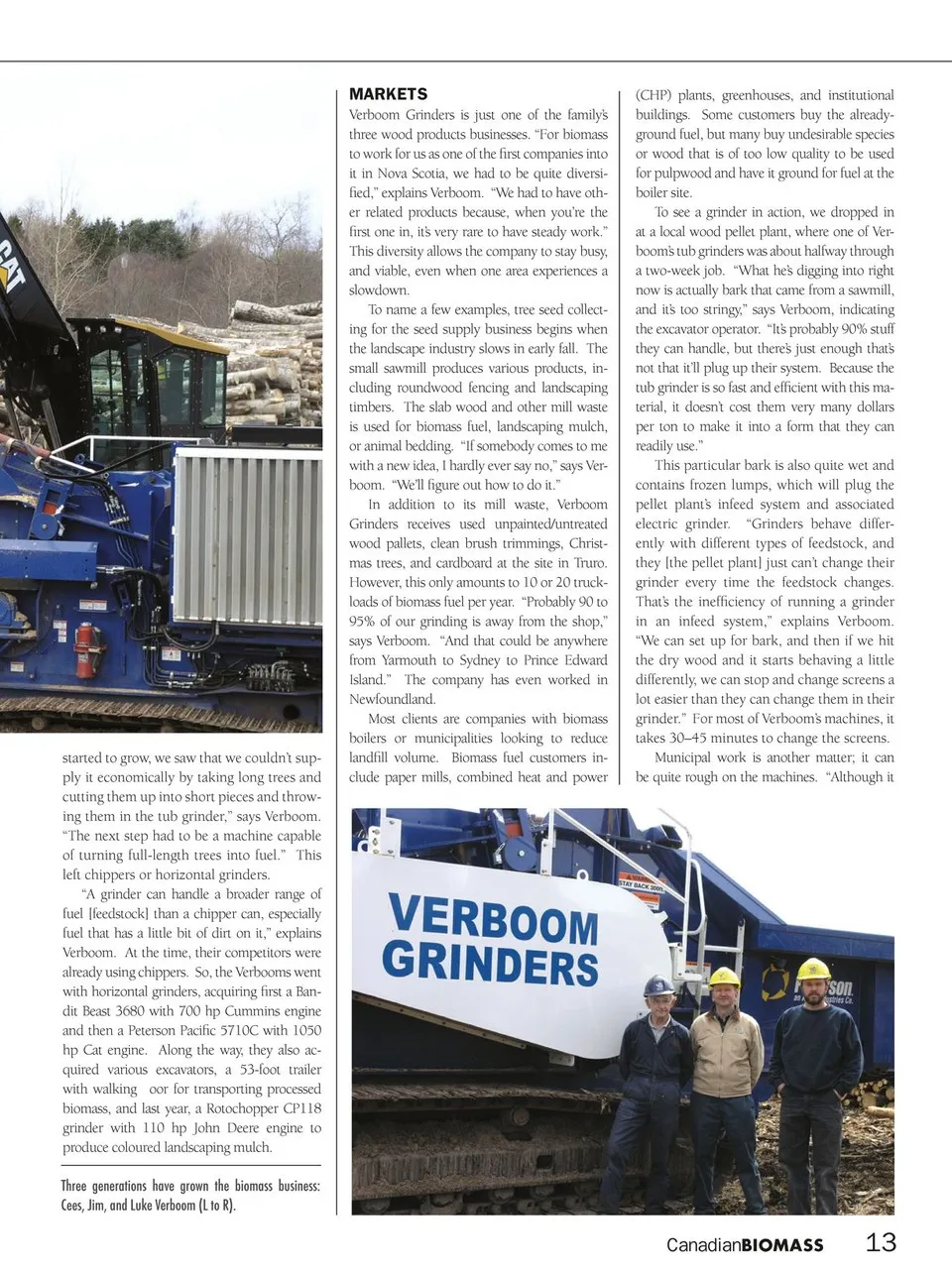
Biomass Extraction Have Grinders, Will Travel Diversification, flexibility, and good planning have helped Verboom Grinders succeed in the biomass business. By Heather Hager sawmill and home base to a substantial biomass grinding operation. Here, Verboom Grinders processes multiple source streams of non-tim- ber-quality wood to supply two biomass mar- kets: wood fuel and landscaping mulch. “We started Verboom Grinders in 1992,” It states Jim Verboom, who began the business with his father Cees, who is now “retired,” but can still be found trimming roundwood fence posts in the sawmill. Jim’s son Luke is now a partner in the business and is the resident me- chanical guru. “Our first objective with grind- ing was for our bark mulch business. When we bought our first grinder, it was with the intention of working about three weeks per seems an unlikely location, but just inside the town limits of Truro, Nova Scotia, is the Verboom family’s small The acquisition of a horizontal grinder and a truck with walking floor allowed Verboom Grinders access to additional markets. year,” says Verboom. “By 1993, we got our first biomass fuel job.” That first grinder was a 1992 Duratech HD-10 tub grinder with 300 hp Cat engine, which worked more than 10,000 hours during its lifetime. “We started out with a tub grinder because we were processing bark sawmill resi- due,” says Verboom. “We had to make it a con- sistent size to encourage the landscape industry to use bark. It had to be easy to shovel.” The 1992 Duratech was eventually scrapped to maintain the second grinder, a 1994 model, which is still running today. The grinding business grew quite slowly during the 1990s, in part because the low cost of oil dampened interest in alternative en- ergy sources. However, because they owned The growing popularity of coloured mulch has provided another business opportunity for Verboom Grinders. The company has added a Rotochopper unit to fill this need. 12 CanadianBIOMASS an industrial grinder, the Verbooms began to pick up biomass fuel jobs, industrial and com- mercial land-clearing work, and wood waste volume reduction work at local landfill sites. Then Hurricane Juan hit Atlantic Canada, top- pling thousands of trees and leaving behind a terrible mess. “When Hurricane Juan hit in late Septem- ber 2003, we had the existing contract with the city of Halifax to supply grinding services on demand. What that meant was 20 or 30 hours a year,” explains Verboom. The additional work created by the hurricane allowed a sec- ond grinder to be added to the fleet: a Duratech 3010 with 450 hp Cat engine. chip or grind? When the time came to choose additional machines for the fleet of grinders, the Ver- booms considered the emerging range of fibre supply. “As the demand for biomass JUNE 2009
Canadian Biomass June 2009: Page 12