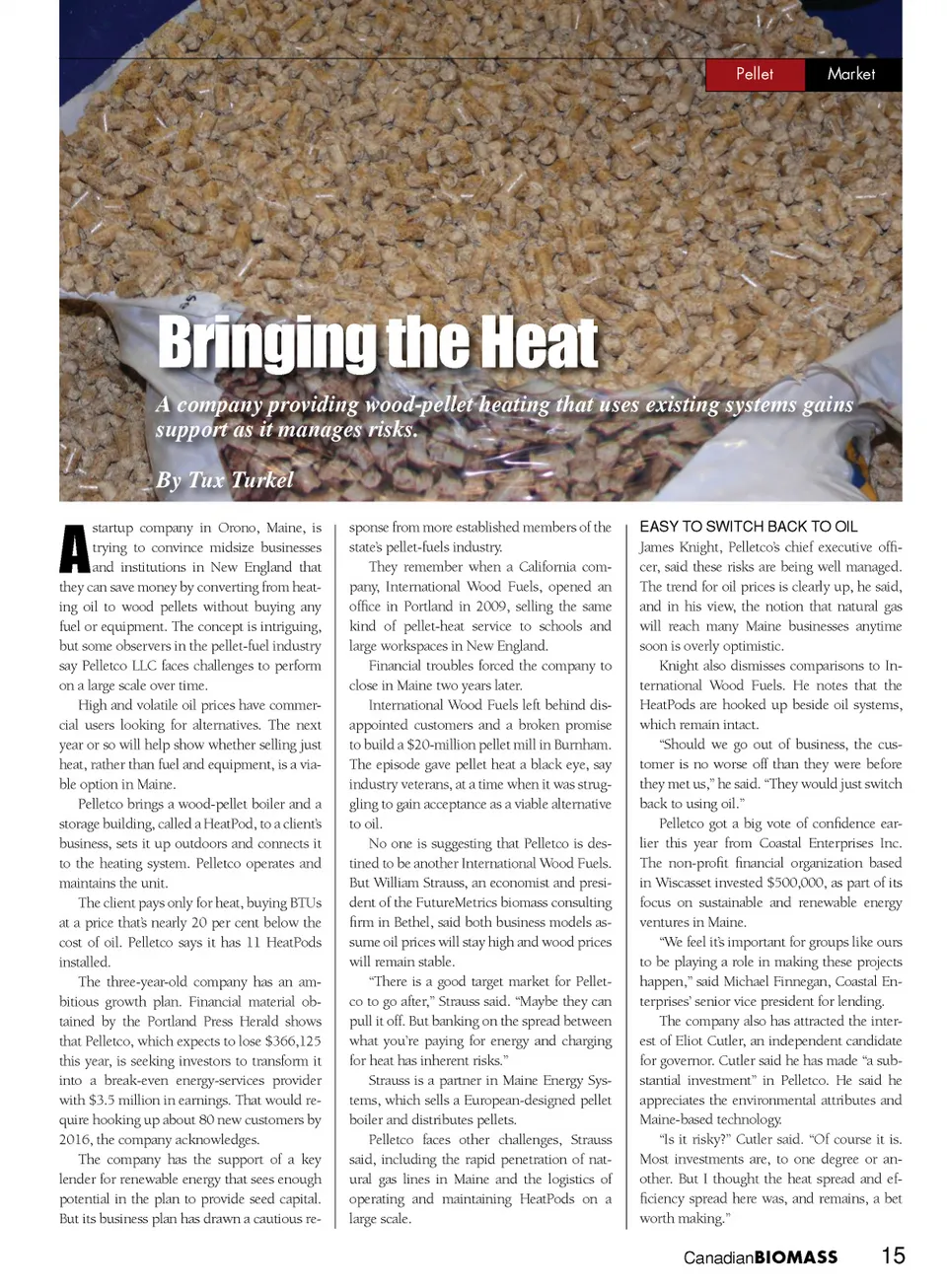
Pellet Market Bringing the Heat A company providing wood-pellet heating that uses existing systems gains support as it manages risks. By Tux Turkel A startup company in Orono, Maine, is trying to convince midsize businesses and institutions in New England that they can save money by converting from heat-ing oil to wood pellets without buying any fuel or equipment. The concept is intriguing, but some observers in the pellet-fuel industry say Pelletco LLC faces challenges to perform on a large scale over time. High and volatile oil prices have commer-cial users looking for alternatives. The next year or so will help show whether selling just heat, rather than fuel and equipment, is a via-ble option in Maine. Pelletco brings a wood-pellet boiler and a storage building, called a HeatPod, to a client’s business, sets it up outdoors and connects it to the heating system. Pelletco operates and maintains the unit. The client pays only for heat, buying BTUs at a price that’s nearly 20 per cent below the cost of oil. Pelletco says it has 11 HeatPods installed. The three-year-old company has an am-bitious growth plan. Financial material ob-tained by the Portland Press Herald shows that Pelletco, which expects to lose $366,125 this year, is seeking investors to transform it into a break-even energy-services provider with $3.5 million in earnings. That would re-quire hooking up about 80 new customers by 2016, the company acknowledges. The company has the support of a key lender for renewable energy that sees enough potential in the plan to provide seed capital. But its business plan has drawn a cautious re-sponse from more established members of the state’s pellet-fuels industry. They remember when a California com-pany, International Wood Fuels, opened an office in Portland in 2009, selling the same kind of pellet-heat service to schools and large workspaces in New England. Financial troubles forced the company to close in Maine two years later. International Wood Fuels left behind dis-appointed customers and a broken promise to build a $20-million pellet mill in Burnham. The episode gave pellet heat a black eye, say industry veterans, at a time when it was strug-gling to gain acceptance as a viable alternative to oil. No one is suggesting that Pelletco is des-tined to be another International Wood Fuels. But William Strauss, an economist and presi-dent of the FutureMetrics biomass consulting firm in Bethel, said both business models as-sume oil prices will stay high and wood prices will remain stable. “There is a good target market for Pellet-co to go after,” Strauss said. “Maybe they can pull it off. But banking on the spread between what you’re paying for energy and charging for heat has inherent risks.” Strauss is a partner in Maine Energy Sys-tems, which sells a European-designed pellet boiler and distributes pellets. Pelletco faces other challenges, Strauss said, including the rapid penetration of nat-ural gas lines in Maine and the logistics of operating and maintaining HeatPods on a large scale. eAsY to swItCh bACk to oIl James Knight, Pelletco’s chief executive offi-cer, said these risks are being well managed. The trend for oil prices is clearly up, he said, and in his view, the notion that natural gas will reach many Maine businesses anytime soon is overly optimistic. Knight also dismisses comparisons to In-ternational Wood Fuels. He notes that the HeatPods are hooked up beside oil systems, which remain intact. “Should we go out of business, the cus-tomer is no worse off than they were before they met us,” he said. “They would just switch back to using oil.” Pelletco got a big vote of confidence ear-lier this year from Coastal Enterprises Inc. The non-profit financial organization based in Wiscasset invested $500,000, as part of its focus on sustainable and renewable energy ventures in Maine. “We feel it’s important for groups like ours to be playing a role in making these projects happen,” said Michael Finnegan, Coastal En-terprises’ senior vice president for lending. The company also has attracted the inter-est of Eliot Cutler, an independent candidate for governor. Cutler said he has made “a sub-stantial investment” in Pelletco. He said he appreciates the environmental attributes and Maine-based technology. “Is it risky?” Cutler said. “Of course it is. Most investments are, to one degree or an-other. But I thought the heat spread and ef-ficiency spread here was, and remains, a bet worth making.” Canadian BIOMASS 15
Canadian Biomass September/October 2013: Page 15