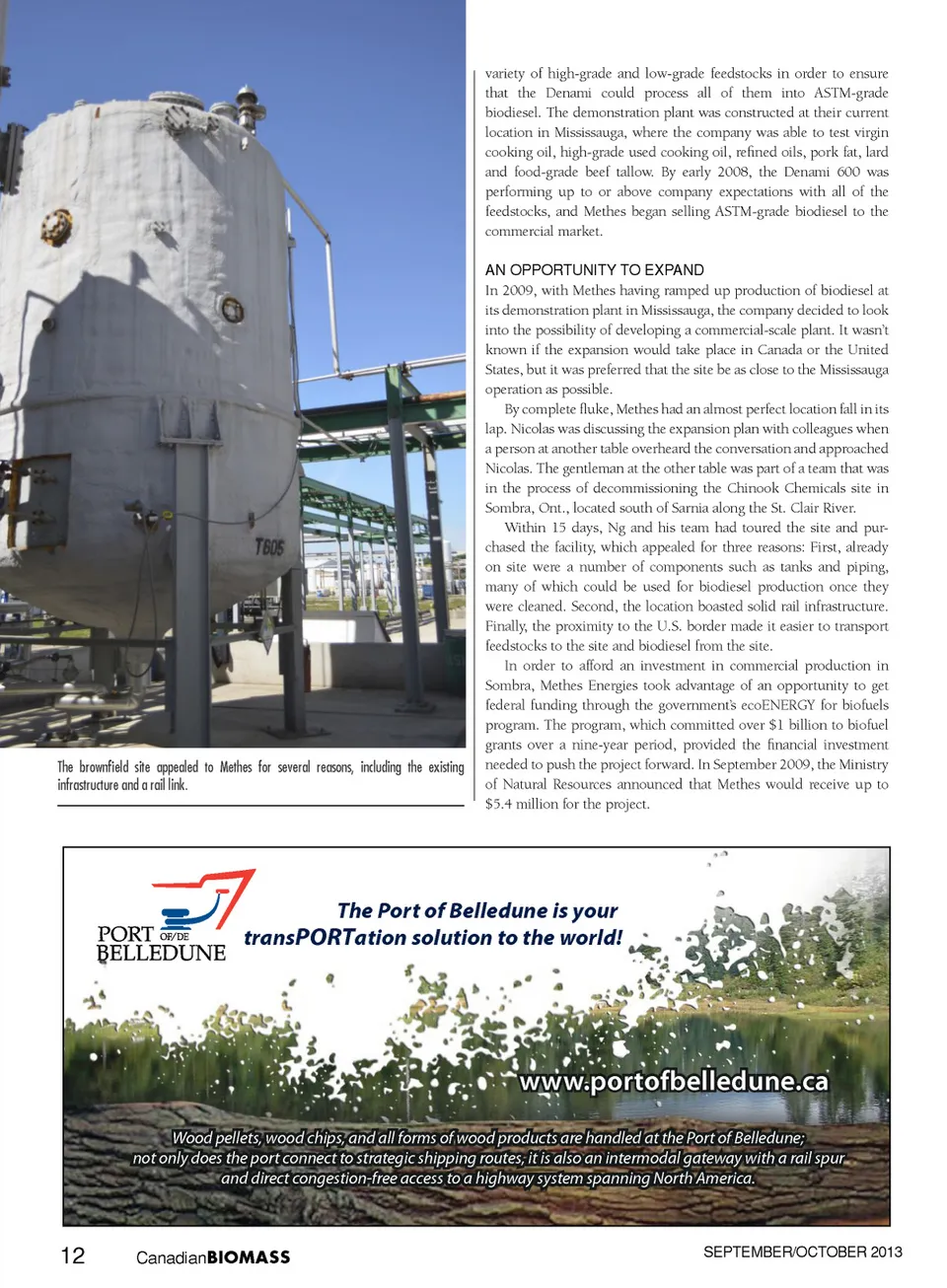
variety of high-grade and low-grade feedstocks in order to ensure that the Denami could process all of them into ASTM-grade biodiesel. The demonstration plant was constructed at their current location in Mississauga, where the company was able to test virgin cooking oil, high-grade used cooking oil, refined oils, pork fat, lard and food-grade beef tallow. By early 2008, the Denami 600 was performing up to or above company expectations with all of the feedstocks, and Methes began selling ASTM-grade biodiesel to the commercial market. AN opportuNItY to expAND In 2009, with Methes having ramped up production of biodiesel at its demonstration plant in Mississauga, the company decided to look into the possibility of developing a commercial-scale plant. It wasn’t known if the expansion would take place in Canada or the United States, but it was preferred that the site be as close to the Mississauga operation as possible. By complete fluke, Methes had an almost perfect location fall in its lap. Nicolas was discussing the expansion plan with colleagues when a person at another table overheard the conversation and approached Nicolas. The gentleman at the other table was part of a team that was in the process of decommissioning the Chinook Chemicals site in Sombra, Ont., located south of Sarnia along the St. Clair River. Within 15 days, Ng and his team had toured the site and pur-chased the facility, which appealed for three reasons: First, already on site were a number of components such as tanks and piping, many of which could be used for biodiesel production once they were cleaned. Second, the location boasted solid rail infrastructure. Finally, the proximity to the U.S. border made it easier to transport feedstocks to the site and biodiesel from the site. In order to afford an investment in commercial production in Sombra, Methes Energies took advantage of an opportunity to get federal funding through the government’s ecoENERGY for biofuels program. The program, which committed over $1 billion to biofuel grants over a nine-year period, provided the financial investment needed to push the project forward. In September 2009, the Ministry of Natural Resources announced that Methes would receive up to $5.4 million for the project. The brownfield site appealed to Methes for several reasons, including the existing infrastructure and a rail link. The Port of Belledune is your trans PORT ation solution to the world! www.portofbelledune.ca Wood pellets, wood chips, and all forms of wood products are handled at the Port of Belledune; not only does the port connect to strategic shipping routes, it is also an intermodal gateway with a rail spur and direct congestion-free access to a highway system spanning North America. 12 Canadian BIOMASS september/oCtober 2013
Canadian Biomass September/October 2013: Page 12