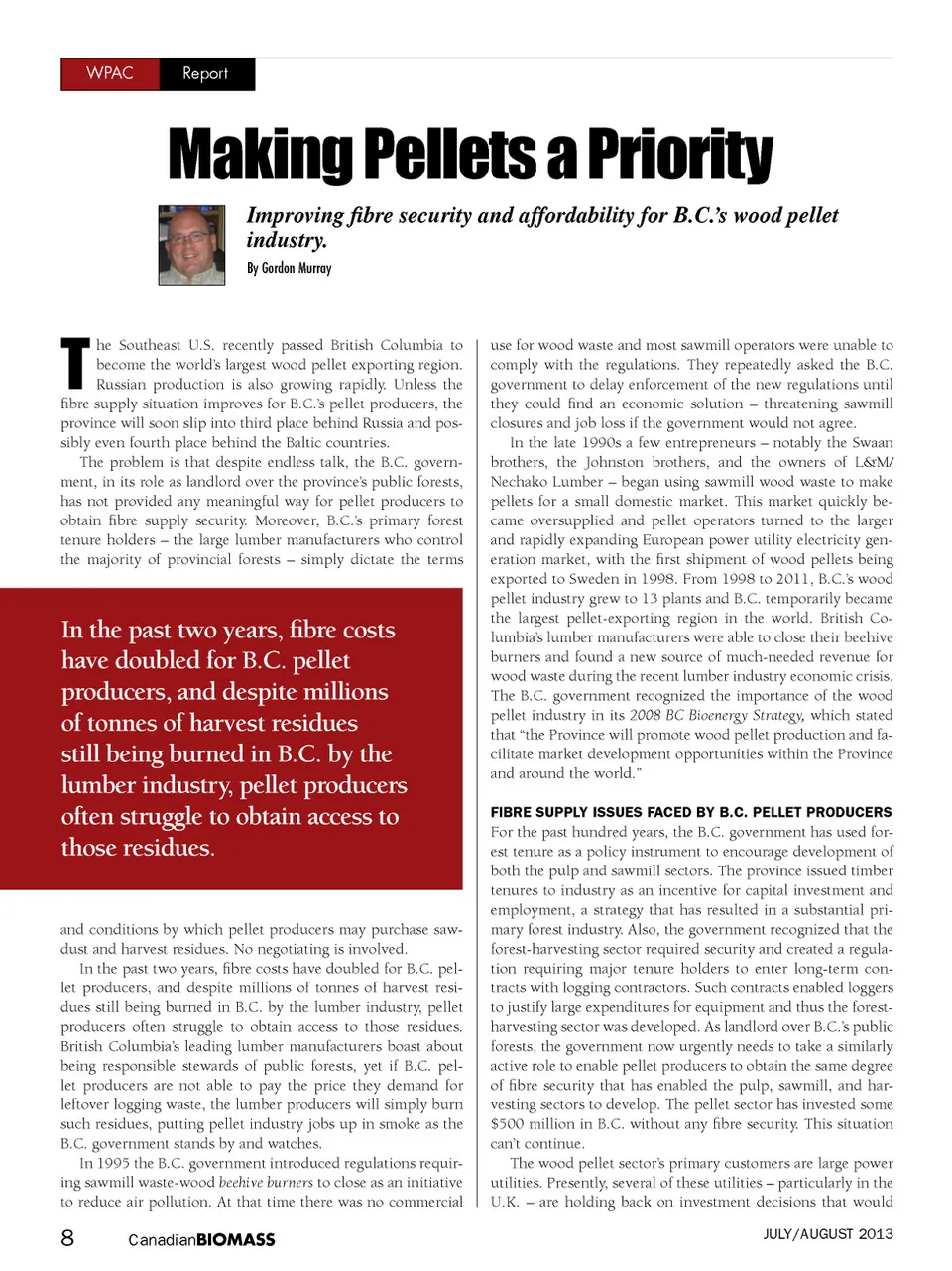
Pellet producers continuously struggle for wood despite sights like this all across B.C. greatly expand our markets, due to regulatory and fibre supply uncertainty. It is frustrating for B.C.’s pellet produc-ers to be unable to demonstrate to their customers that they have long-term fibre security. To date the B.C. government has tak-en a hands-off approach with the pellet sector. This simply isn’t good enough. The government’s policy direction has been to leave it to the wood pellet sector to develop “business to business rela-tionships” with primary tenure holders to obtain fibre. The government ratio-nalizes that is a “free market approach” when in fact it is anything but. It is not a free market when the government has created a situation where the large lum-ber producers who control the majority of B.C.’s public forests have the power to simply dictate terms and conditions to pellet manufacturers and where they can refuse to enter long-term fibre supply contracts with pellet producers for ma-terial that the lumber producers would otherwise burn. The government has given primary tenure holders the right to harvest pub-lic forest, but allows them to pick and choose whatever timber they wish to take. Then they can simply burn the rest if they choose, without any requirement to ensure that the bioenergy industry has the maximum opportunity to utilize the leftovers. There are no consequences to a primary tenure holder who simply chooses to burn post-harvest logging re-siduals along with the associated pellet industry jobs. What is particularly gall-ing is that this deliberate wasting of fibre is being decided by B.C.’s professional foresters, who are supposed to have an ethical obligation to the public to maximize the benefits received from public forests. The B.C. government introduced the fibre licence to cut as a half-hearted ten-ure solution for the bioenergy sector. This tenure is ineffective. It is merely a small-scale, short-term salvage ten-ure. The fibre licence to cut puts the onus on the licence applicant (i.e., pellet producer) to prove that a pri-mary tenure holder is unco-operative. If pursued, this would create a poten-tial adversarial relationship that would eliminate any chance of a productive working arrangement and would only worsen the fibre supply situation for pellet producers. The government and the primary forest industry (pulp and sawmill sec-tors) have jointly created a Bio-econo-my Transition Committee to plan the future of the forest bioeconomy. Un-believably, the pellet sector is excluded from this committee. As I have been unable to find any public record of pro-ceedings of this committee, it leads to the appearance of a secret group where the participants conspire to keep new entrants out and to make sure that the Canadian BIOMASS 9
Canadian Biomass August/September 2013: Page 9