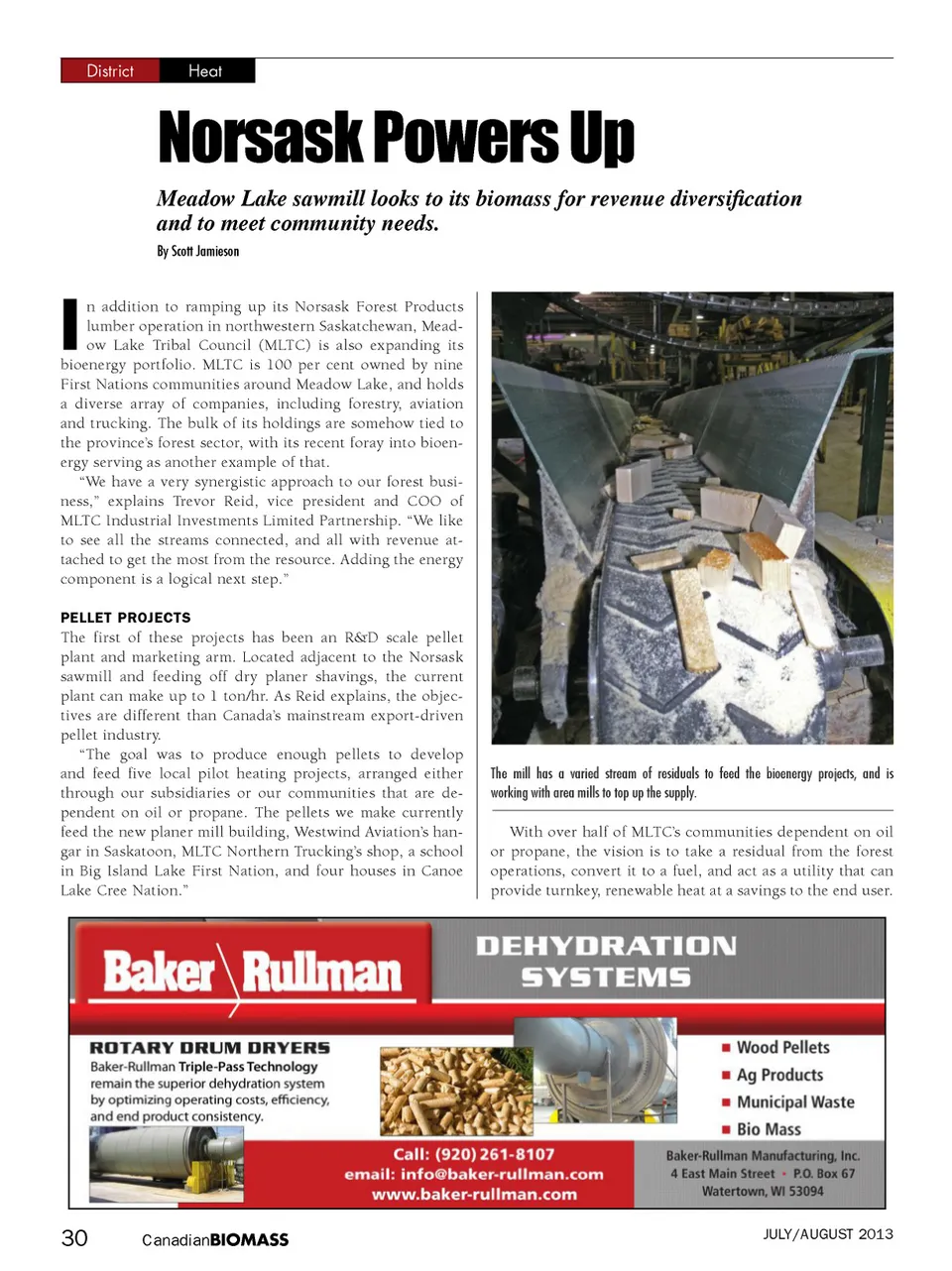
The upgraded planer mill is heated by a pellet burner, seen to the right with the pellet hopper. “We are challenged logistically from a pellet export perspective, but at the same time we see a real need among our communities for an alternative fuel. Rather than treating pellets like a commodity, we’ll offer total heating packages that we’ll supply with our pellets.” The company has been collecting data for the past 18 months, and feels comfortable now ramping up produc-tion to consume the full mill shavings output. That will amount to 40 to 50 tons per shift, for about 35 tons of pel-lets per shift. residual power Part of the reason for a slight delay in expanding the pellet project has been a welcome distraction in trying to get a massive 40 MW power generation project going (36 MW net). The $210 million project ($160 million for con-struction costs) has been in the works for almost three years, and when we spoke with Reid in late June, the fi-nal steps were being taken to secure debt financing and an engineering, procurement and construction (EPC) turnkey contractor had been selected. Reid was anticipating foundation work to start in the fall. One of the main drivers for the project sits just a few hundred meters from the Norsask sawmill, in the form of one of Canada’s few remaining tee-pee burners. “It’s an obvious opportunity to turn a liability into revenue, and com-pletes the whole business model. Also Saskatchewan has seen tremendous growth in recent years, and expects more. Sask Power is reaching out via the First Nations Power Authority for some significant extra generating ca-pacity, and we see a role in that.” With its own integrated forestry op-eration, MLTC avoids the fuel risk that many other proposed bioenergy proj-ects can get bogged down in. “The sawmill provides 50 to 60 per cent of the needs of the proposed plant. Our preference is to get the rest in the form of residuals from other plants, but regardless we have the fibre from har-vest residuals and other supplies.We’ve had an independent fuel study done, and we have a secure supply.” All of the power generated would be sold direct to the grid. For more on bioenergy, visit www.canadianbiomassmagazine.ca Canadian BIOMASS 31
Canadian Biomass August/September 2013: Page 31