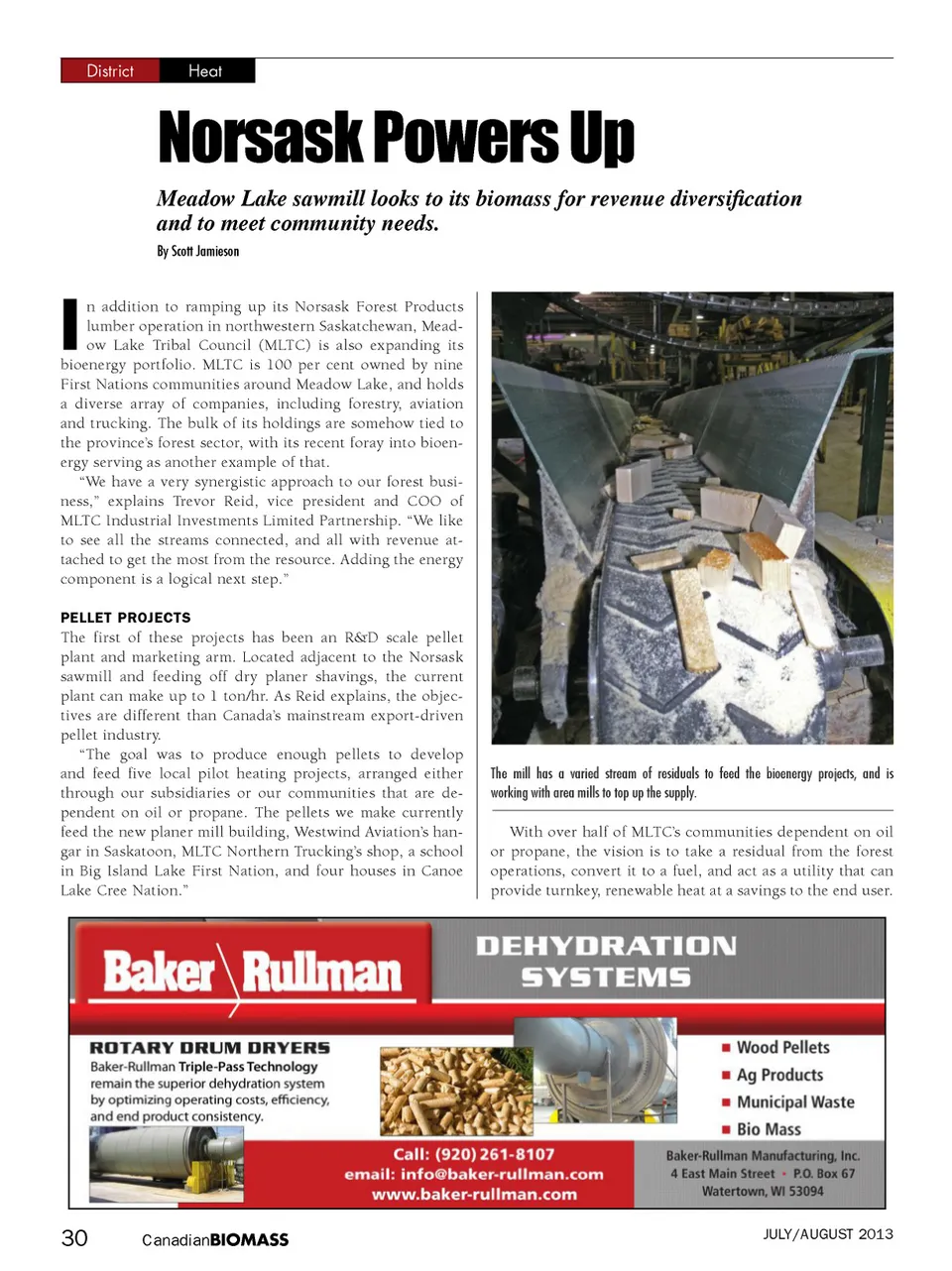
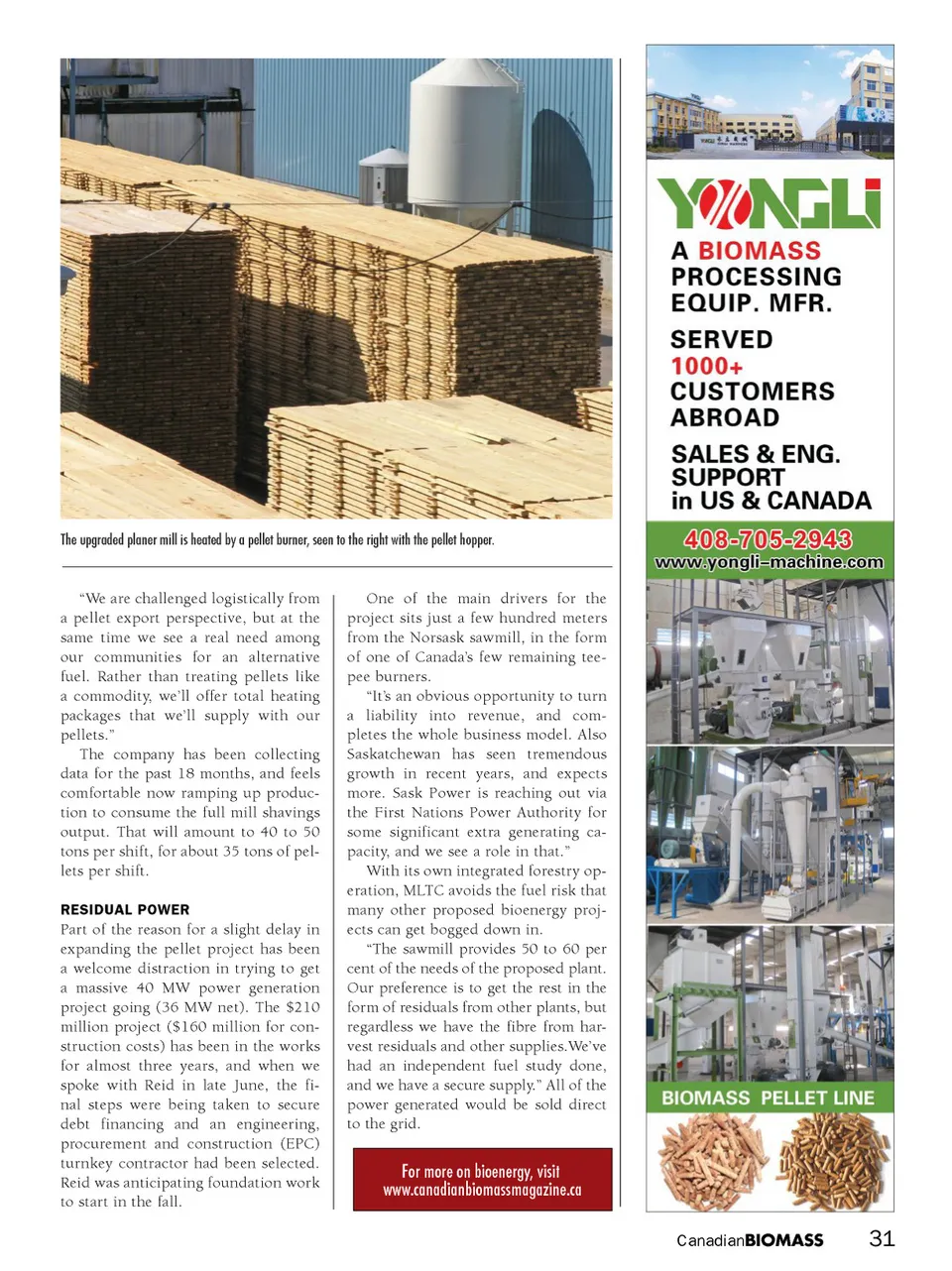
District Heat Norsask Powers Up Meadow Lake sawmill looks to its biomass for revenue diversification and to meet community needs. By Scott Jamieson I n addition to ramping up its Norsask Forest Products lumber operation in northwestern Saskatchewan, Mead-ow Lake Tribal Council (MLTC) is also expanding its bioenergy portfolio. MLTC is 100 per cent owned by nine First Nations communities around Meadow Lake, and holds a diverse array of companies, including forestry, aviation and trucking. The bulk of its holdings are somehow tied to the province’s forest sector, with its recent foray into bioen-ergy serving as another example of that. “We have a very synergistic approach to our forest busi-ness,” explains Trevor Reid, vice president and COO of MLTC Industrial Investments Limited Partnership. “We like to see all the streams connected, and all with revenue at-tached to get the most from the resource. Adding the energy component is a logical next step.” pellet projects The first of these projects has been an R&D scale pellet plant and marketing arm. Located adjacent to the Norsask sawmill and feeding off dry planer shavings, the current plant can make up to 1 ton/hr. As Reid explains, the objec-tives are different than Canada’s mainstream export-driven pellet industry. “The goal was to produce enough pellets to develop and feed five local pilot heating projects, arranged either through our subsidiaries or our communities that are de-pendent on oil or propane. The pellets we make currently feed the new planer mill building, Westwind Aviation’s han-gar in Saskatoon, MLTC Northern Trucking’s shop, a school in Big Island Lake First Nation, and four houses in Canoe Lake Cree Nation.” The mill has a varied stream of residuals to feed the bioenergy projects, and is working with area mills to top up the supply. With over half of MLTC’s communities dependent on oil or propane, the vision is to take a residual from the forest operations, convert it to a fuel, and act as a utility that can provide turnkey, renewable heat at a savings to the end user. 30 Canadian BIOMASS JULY/AUGUST 2013
Canadian Biomass August/September 2013: Page 30