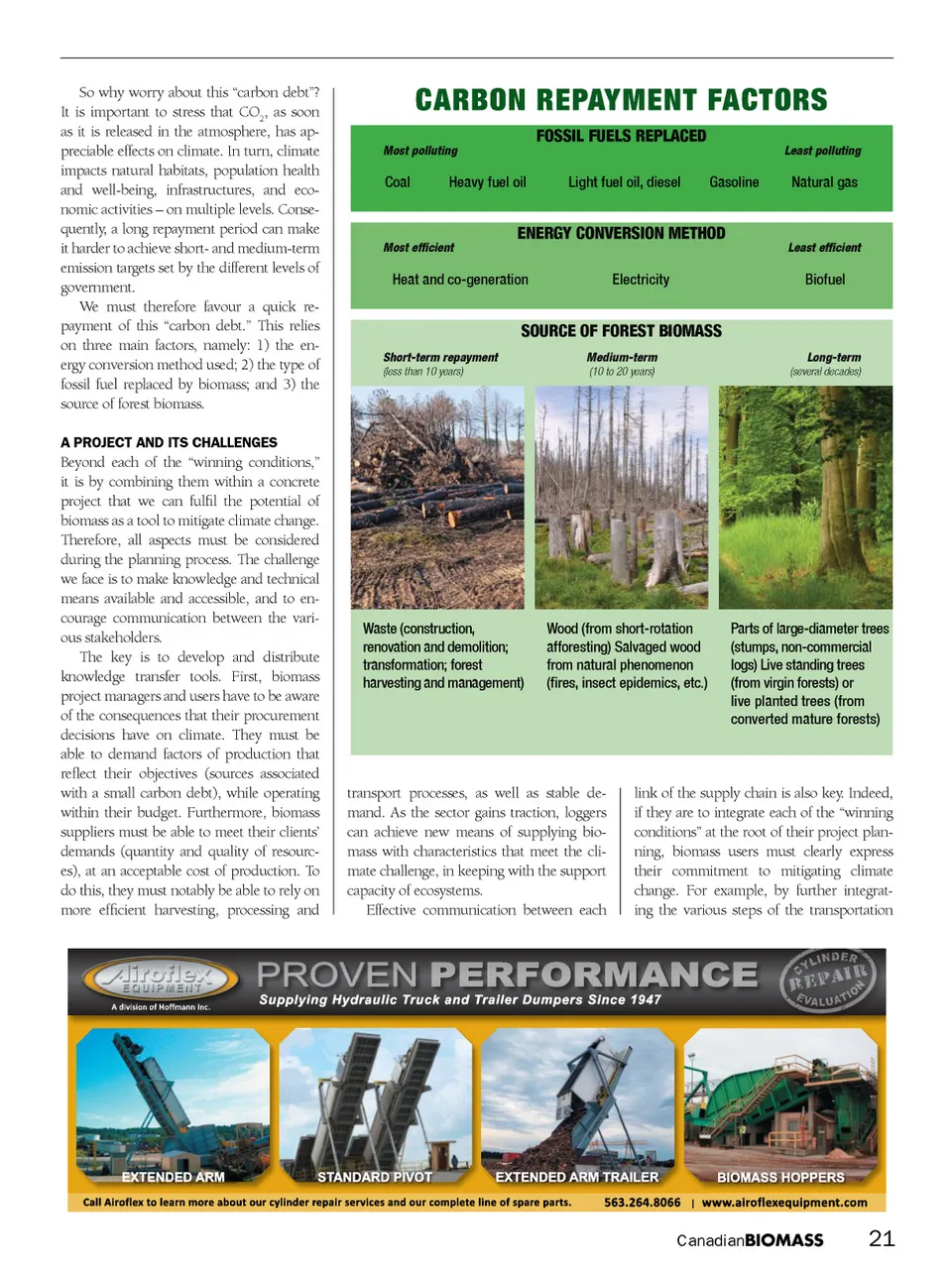
So why worry about this “carbon debt”? It is important to stress that CO 2 , as soon as it is released in the atmosphere, has ap-preciable effects on climate. In turn, climate impacts natural habitats, population health and well-being, infrastructures, and eco-nomic activities – on multiple levels. Conse-quently, a long repayment period can make it harder to achieve short-and medium-term emission targets set by the different levels of government. We must therefore favour a quick re-payment of this “carbon debt.” This relies on three main factors, namely: 1) the en-ergy conversion method used; 2) the type of fossil fuel replaced by biomass; and 3) the source of forest biomass. a project and its challenges Carbon repayment FaCtors Most polluting FOSSIL FUELS REPLACED Light fuel oil, diesel Gasoline Least polluting Coal Heavy fuel oil Natural gas Most efficient ENERGY CONVERSION METHOD Electricity Least efficient Heat and co-generation Biofuel SOURCE OF FOREST BIOMASS Short-term repayment (less than 10 years) Medium-term (10 to 20 years) Long-term (several decades) Beyond each of the “winning conditions,” it is by combining them within a concrete project that we can fulfil the potential of biomass as a tool to mitigate climate change. Therefore, all aspects must be considered during the planning process. The challenge we face is to make knowledge and technical means available and accessible, and to en-courage communication between the vari-ous stakeholders. The key is to develop and distribute knowledge transfer tools. First, biomass project managers and users have to be aware of the consequences that their procurement decisions have on climate. They must be able to demand factors of production that reflect their objectives (sources associated with a small carbon debt), while operating within their budget. Furthermore, biomass suppliers must be able to meet their clients’ demands (quantity and quality of resourc-es), at an acceptable cost of production. To do this, they must notably be able to rely on more efficient harvesting, processing and Waste (construction, renovation and demolition; transformation; forest harvesting and management) Wood (from short-rotation afforesting) Salvaged wood from natural phenomenon (fires, insect epidemics, etc.) Parts of large-diameter trees (stumps, non-commercial logs) Live standing trees (from virgin forests) or live planted trees (from converted mature forests) transport processes, as well as stable de-mand. As the sector gains traction, loggers can achieve new means of supplying bio-mass with characteristics that meet the cli-mate challenge, in keeping with the support capacity of ecosystems. Effective communication between each biomass_chart.indd 1 link of the supply chain is also key. Indeed, if they are to integrate each of the “winning conditions” at the root of their project plan-ning, biomass users must clearly express their commitment to mitigating climate change. For example, by further integrat-ing the various steps of the transportation 2013-07-23 9:52 AM Canadian BIOMASS 21
Canadian Biomass August/September 2013: Page 21