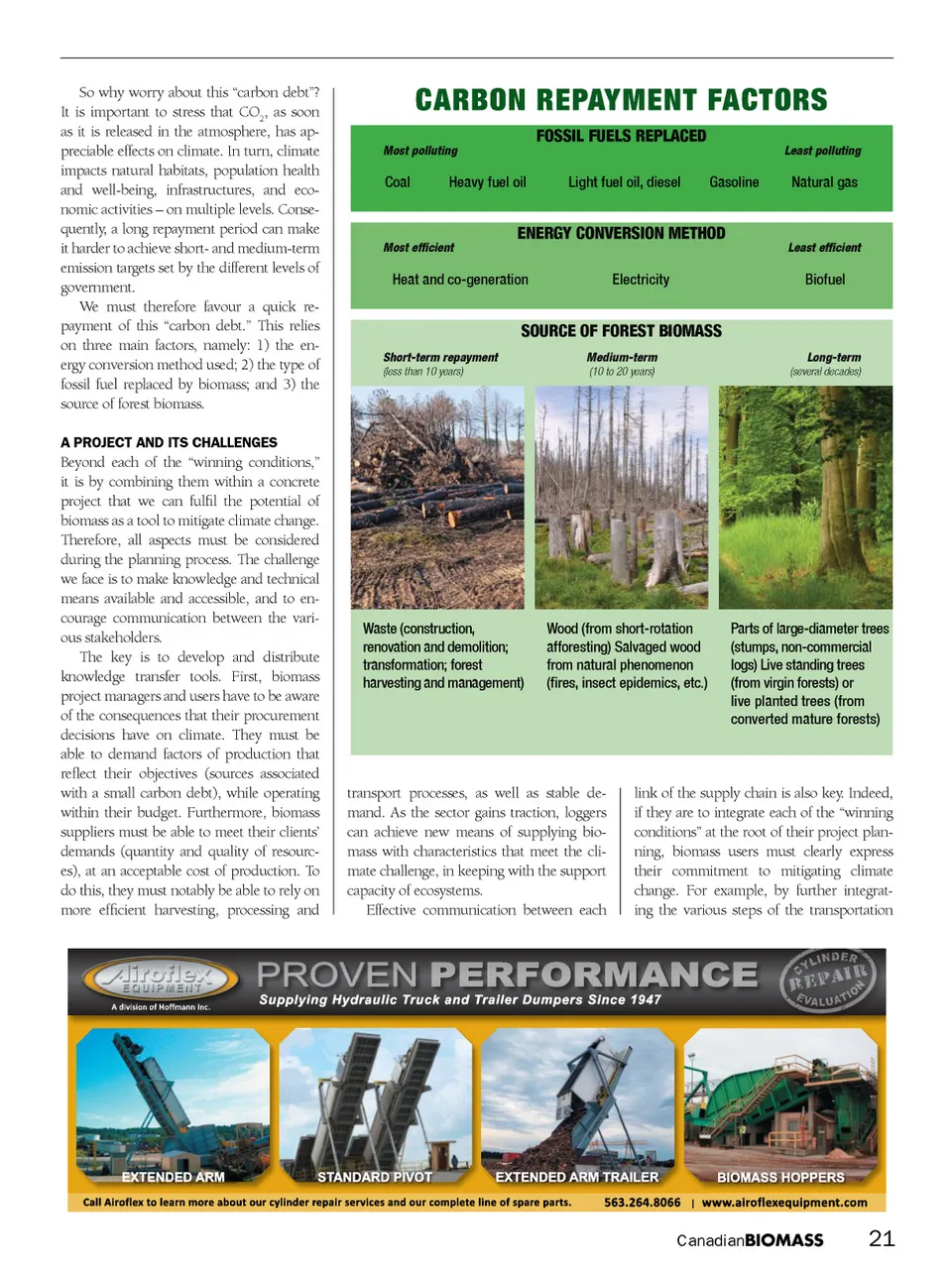
Carborn Debt Paying off Carbon Debt Exploring how biomass fuels can help the climate challenge in Quebec. By Amélie St-Laurent Samuel M uch has been said about the benefits of using forest biomass energy as an alternative to fossil fuels. There is no shortage of arguments in support of the new energy sectors forming around this resource: job creation and growth, economic diversifi-cation of communities, independence from oil, mitigation of climate change, and lower costs for users. However, several stakehold-ers are now raising questions about the impacts of biomass energy and about our actual capacity to achieve all of its benefits. Based on the notion that all energy sourc-es have an inevitable impact on the natural environment where they are deployed, pro-cesses must systematically be put in place to ensure projects are executed in the most harmonious and sustainable way possible. Research, especially that provided by field studies, helps document their impacts and define best practices likely to reduce or eliminate them. But if this research is to be useful, those involved closely with the proj-ects must embrace and implement these en-vironmental frameworks. In Quebec, the forest biomass heating sector is still in its infancy. A multitude of stakeholders – equipment manufactur-ers, consultants, raw materials suppliers, economic development organizations, re-searchers, environmentalists, etc. – are still working to solidify its foundations. This burgeoning sector has thus developed into a complex web involving several different players, a reality that can cause confusion for municipalities and organizations who hope to invest in forest biomass-based heat production projects. Furthermore, in the absence of an official advocate, environmen-tal issues run the risk of falling through the cracks. In this context, one question remains unanswered: how can we give proper em-phasis to these challenges? the winning conditions The actual impact of forest biomass energy as a means to mitigate climate change is still a hot topic in the public arena. And yet, the scientific community generally agrees on the “winning conditions” that must be in place in order to ensure that forest bioenergy is produced in a way that maximizes the re-duction of greenhouse gas (GHG) emissions. You may not be aware that forest biomass combustion produces more CO 2 emissions per energy unit than fossil fuels. For this rea-son, biomass energy production results in an initial surplus of GHG emissions, a “carbon debt,” when compared with conventional fuels. Fortunately, the biological processes involved in the carbon cycle contribute to repaying this temporary debt. The carbon cycle of fossil fuels, which extends over mil-lions of years, is much longer than the cycle of biomass. Since biomass relies on the nat-ural growth and decomposition of trees, its cycle extends over a few decades only. With time, carbon sequestration by trees compen-sates for additional emissions related to the use of biomass and generates permanent, cumulative environmental benefits. JULY/AUGUST 2013 20 Canadian BIOMASS
Canadian Biomass August/September 2013: Page 20