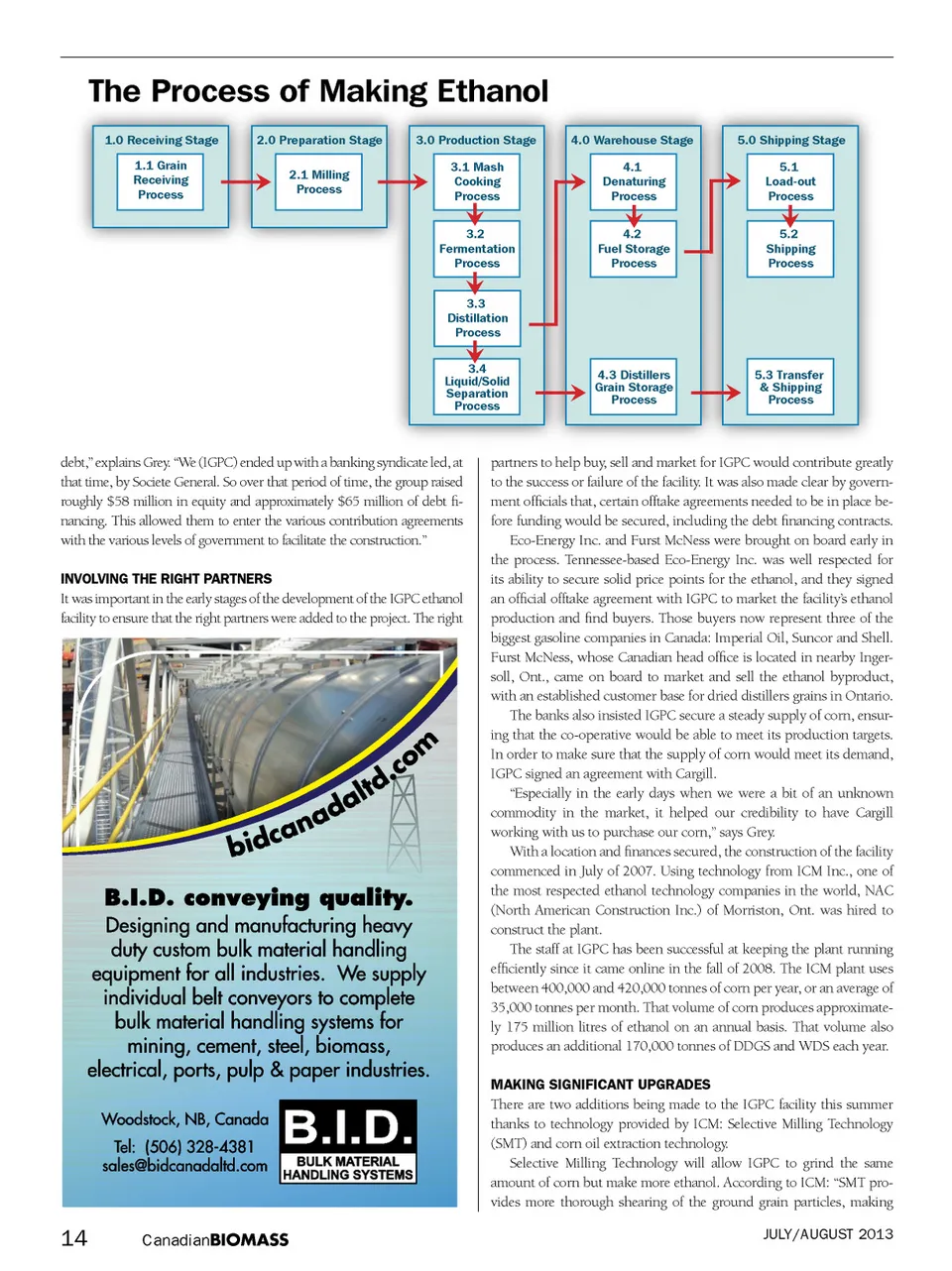
more starch available for conversion to sug-ars. Starch that is not made available to yeast can pass through fermentation untouched, exiting the plant as lost potential in distillers’ grain. These residual starches are not only lost ethanol, potential, they also add increased load on downstream equipment such as cen-trifuges and dryers.” The additional ethanol yield created by the addition of the SMT system is targeted at 2-3 per cent, which in the case of the IGPC plant’s current production, should result in an increase of 3.5-5.25 million litres in ethanol yield. “You must squeeze as much ethanol as you can out of every kernel of corn,” says Grey. “You have to keep driving for efficiencies because this really is a business of pennies; you have to run your plants in that way.” Adding corn oil extraction technol-ogy provides another salable product that can be produced as part of the ethanol extraction process. The ICM Advanced Oil Separation System is built to provide maximum recovery of bio-oil from emulsion concentrate after the centrifugal phase of separation. “Corn oil extraction allows us to take the oil out of the corn,” says Grey. “We have signed a Letter of Intent with a biodiesel manufacturer and they will be taking all of our oil to fill out some of their feedstock requirements to make biodiesel.” The Letter of Intent has been signed with Biox, a Ham-ilton, Ont.-based company, which currently produces approximately 67 million litres of biodiesel per year. Looking ahead, IGPC continues to seek ways to improve the efficiency of its plant. Management continues to consult with ICM about emerging technologies to help improve yield. As far as expansion is con-cerned, there is no plan at this point, how-ever, that could change if national demand for ethanol increases. “Canada is in a reasonably good bal-ance right now when it comes to the pro-duction of ethanol,” says Grey. “There is a certain amount of U.S. product coming in to Canada, but it heads into areas like Western Canada, which, obviously, does not have a lot of corn growing.” The demand for ethanol production could increase though if the mandate for ethanol as a gasoline additive ever increas-es. Currently, nearly 900 million litres of the approximately 2.1-2.2 billion litres of Work is being done on both the addition of the SMT system and the new corn oil system at the same time, with both expected to come online in the next few months. ethanol needed for Canadian consump-tion comes from south of the border. But should the mandate increase, the demand for Canadian will rise substantially. “Will we ever see the mandate increase? Certainly, from an industry perspective, we’d like to see that happen at some point in time,” explains Grey. “But to do that, areas like the GTA would have to blend at over the 10 per cent level just because of the logistics of this country. That poses some infrastructure difficulties, but as an industry, we’d be silly not to continue to push for greater inclusion rates. For more on biofuels, visit www.canadianbiomassmagazine.ca 5064 Features • Features an enclosed engine compartment with a self-cleaning air intake system • Available on CAT Track System or as a fifth wheel trailer • Large feed opening and 64 inch hammermill Call today or visit us online to learn more. in action View products ech on the DuraT channel! • Three different level options of CAT Tier III horsepower ranging from 475 hp (354 kw) to 630 hp (470 kw) • Oscillating stacking conveyor • Also manufactures a wide variety of quality tub grinders 888-402-4638 www.duratech.info Canadian BIOMASS 15
Canadian Biomass August/September 2013: Page 15