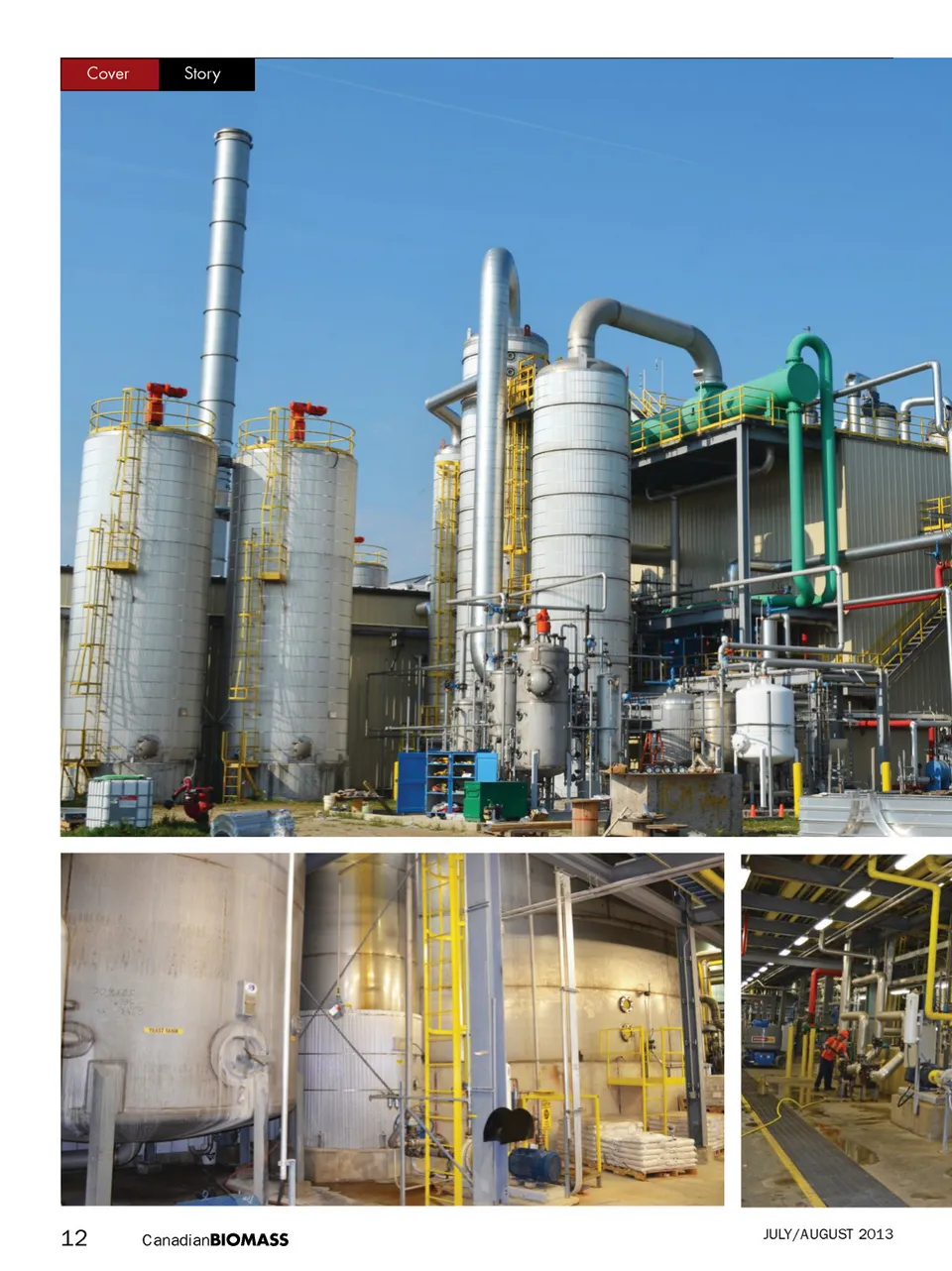
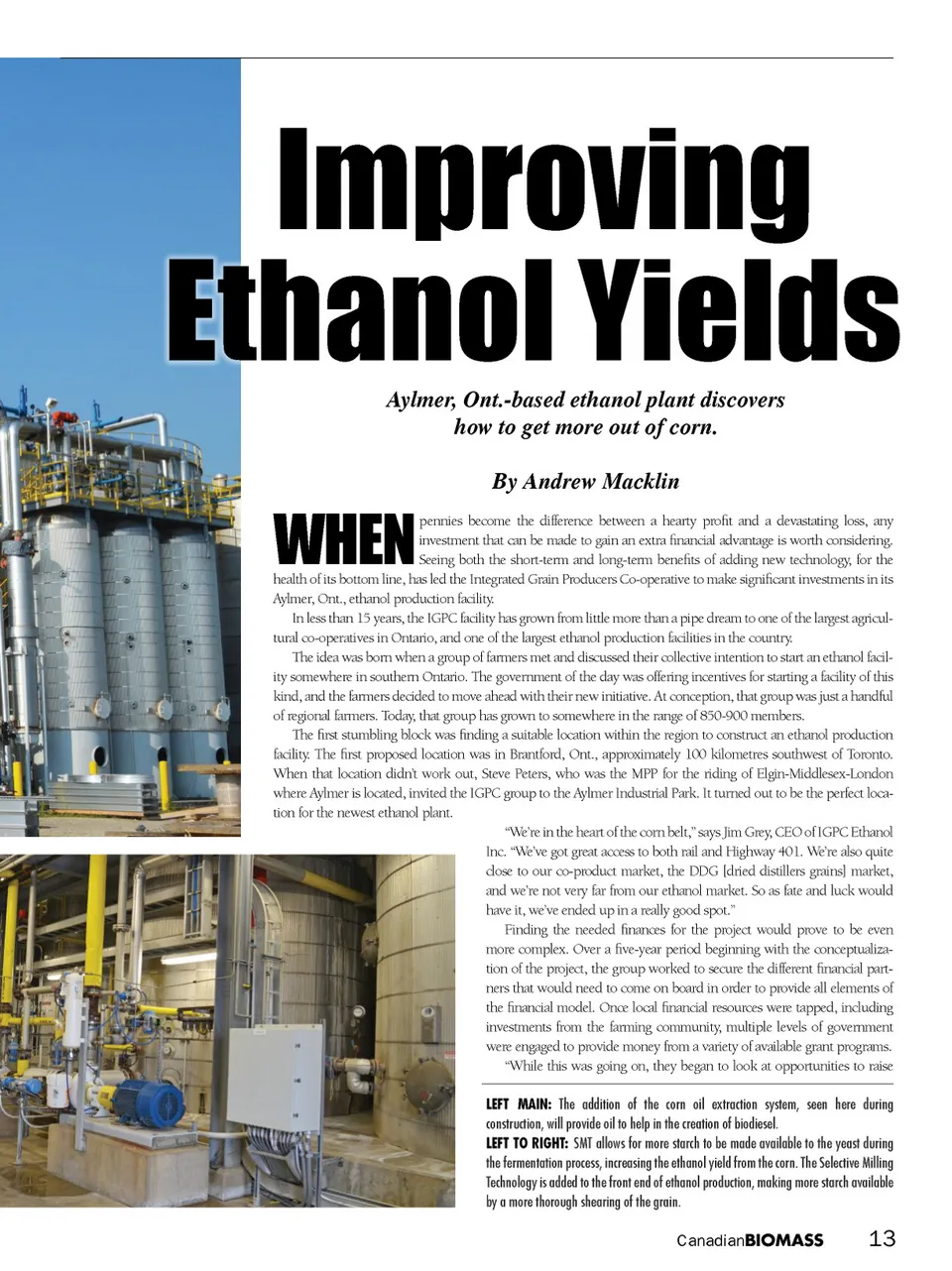
Improving Ethanol Yields Aylmer, Ont.-based ethanol plant discovers how to get more out of corn. By Andrew Macklin WHEN pennies become the difference between a hearty profit and a devastating loss, any investment that can be made to gain an extra financial advantage is worth considering. Seeing both the short-term and long-term benefits of adding new technology, for the health of its bottom line, has led the Integrated Grain Producers Co-operative to make significant investments in its Aylmer, Ont., ethanol production facility. In less than 15 years, the IGPC facility has grown from little more than a pipe dream to one of the largest agricul-tural co-operatives in Ontario, and one of the largest ethanol production facilities in the country. The idea was born when a group of farmers met and discussed their collective intention to start an ethanol facil-ity somewhere in southern Ontario. The government of the day was offering incentives for starting a facility of this kind, and the farmers decided to move ahead with their new initiative. At conception, that group was just a handful of regional farmers. Today, that group has grown to somewhere in the range of 850-900 members. The first stumbling block was finding a suitable location within the region to construct an ethanol production facility. The first proposed location was in Brantford, Ont., approximately 100 kilometres southwest of Toronto. When that location didn’t work out, Steve Peters, who was the MPP for the riding of Elgin-Middlesex-London where Aylmer is located, invited the IGPC group to the Aylmer Industrial Park. It turned out to be the perfect loca-tion for the newest ethanol plant. “We’re in the heart of the corn belt,” says Jim Grey, CEO of IGPC Ethanol Inc. “We’ve got great access to both rail and Highway 401. We’re also quite close to our co-product market, the DDG [dried distillers grains] market, and we’re not very far from our ethanol market. So as fate and luck would have it, we’ve ended up in a really good spot.” Finding the needed finances for the project would prove to be even more complex. Over a five-year period beginning with the conceptualiza-tion of the project, the group worked to secure the different financial part-ners that would need to come on board in order to provide all elements of the financial model. Once local financial resources were tapped, including investments from the farming community, multiple levels of government were engaged to provide money from a variety of available grant programs. “While this was going on, they began to look at opportunities to raise LEFT MAIN: The addition of the corn oil extraction system, seen here during construction, will provide oil to help in the creation of biodiesel. LEFT TO RIGHT: SMT allows for more starch to be made available to the yeast during the fermentation process, increasing the ethanol yield from the corn. The Selective Milling Technology is added to the front end of ethanol production, making more starch available by a more thorough shearing of the grain. Canadian BIOMASS 13
Canadian Biomass August/September 2013: Page 13