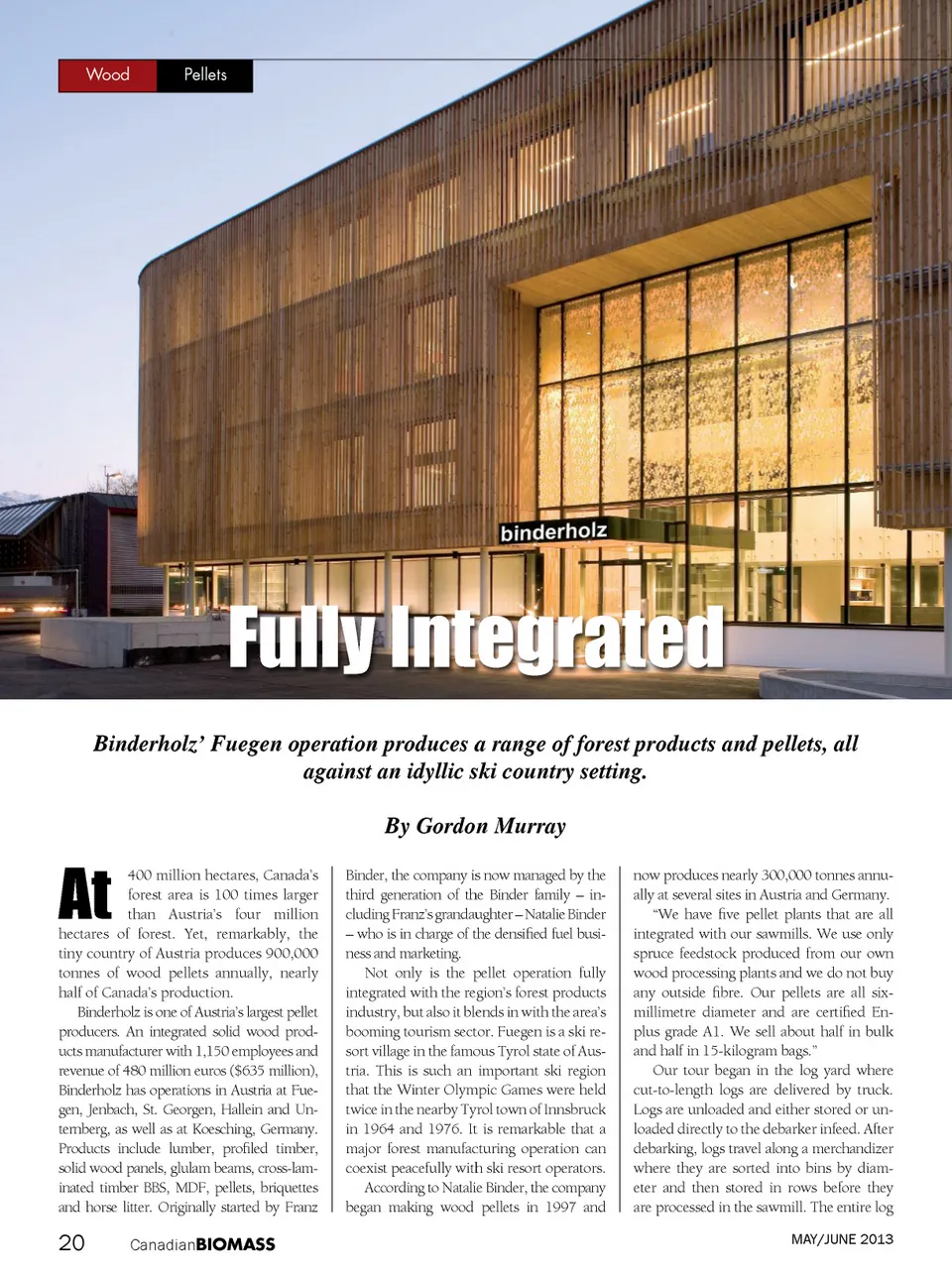
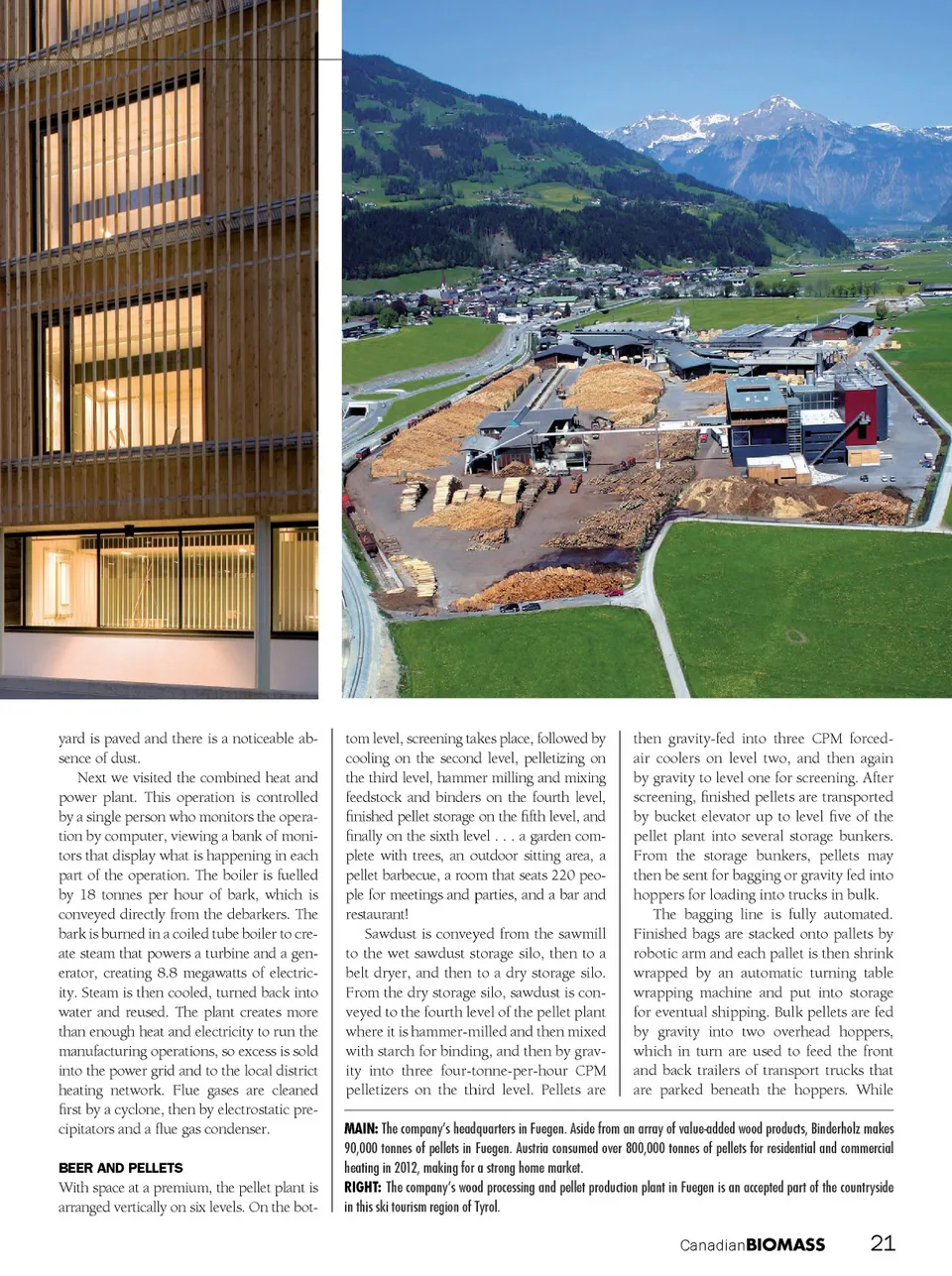
yard is paved and there is a noticeable ab-sence of dust. Next we visited the combined heat and power plant. This operation is controlled by a single person who monitors the opera-tion by computer, viewing a bank of moni-tors that display what is happening in each part of the operation. The boiler is fuelled by 18 tonnes per hour of bark, which is conveyed directly from the debarkers. The bark is burned in a coiled tube boiler to cre-ate steam that powers a turbine and a gen-erator, creating 8.8 megawatts of electric-ity. Steam is then cooled, turned back into water and reused. The plant creates more than enough heat and electricity to run the manufacturing operations, so excess is sold into the power grid and to the local district heating network. Flue gases are cleaned first by a cyclone, then by electrostatic pre-cipitators and a flue gas condenser. beer And Pellets tom level, screening takes place, followed by cooling on the second level, pelletizing on the third level, hammer milling and mixing feedstock and binders on the fourth level, finished pellet storage on the fifth level, and finally on the sixth level . . . a garden com-plete with trees, an outdoor sitting area, a pellet barbecue, a room that seats 220 peo-ple for meetings and parties, and a bar and restaurant! Sawdust is conveyed from the sawmill to the wet sawdust storage silo, then to a belt dryer, and then to a dry storage silo. From the dry storage silo, sawdust is con-veyed to the fourth level of the pellet plant where it is hammer-milled and then mixed with starch for binding, and then by grav-ity into three four-tonne-per-hour CPM pelletizers on the third level. Pellets are then gravity-fed into three CPM forced-air coolers on level two, and then again by gravity to level one for screening. After screening, finished pellets are transported by bucket elevator up to level five of the pellet plant into several storage bunkers. From the storage bunkers, pellets may then be sent for bagging or gravity fed into hoppers for loading into trucks in bulk. The bagging line is fully automated. Finished bags are stacked onto pallets by robotic arm and each pallet is then shrink wrapped by an automatic turning table wrapping machine and put into storage for eventual shipping. Bulk pellets are fed by gravity into two overhead hoppers, which in turn are used to feed the front and back trailers of transport trucks that are parked beneath the hoppers. While With space at a premium, the pellet plant is arranged vertically on six levels. On the bot-MAIN: The company’s headquarters in Fuegen. Aside from an array of value-added wood products, Binderholz makes 90,000 tonnes of pellets in Fuegen. Austria consumed over 800,000 tonnes of pellets for residential and commercial heating in 2012, making for a strong home market. RIGHT: The company’s wood processing and pellet production plant in Fuegen is an accepted part of the countryside in this ski tourism region of Tyrol. Canadian BIOMASS 21
Canadian Biomass May/June 2013: Page 21